

Reported by: Oahimire Omone Precious | Edited by: Gabriel Osa
Nigeria’s downstream petroleum sector is facing one of its most disruptive moments in recent years as oil marketers and fuel importers grapple with mounting financial losses triggered by an aggressive price reduction by Dangote Petroleum Refinery. The price war, which has rapidly reshaped the petrol market, is forcing competitors to sell below cost and absorb what industry estimates describe as crushing monthly losses running into tens of billions of naira.
The turmoil began after Dangote Refinery slashed its petrol gantry price from ₦828 per litre to ₦699 per litre, a sharp adjustment that immediately altered market dynamics. With Dangote’s refined products increasingly setting the benchmark for domestic pricing, import-dependent marketers had little choice but to follow suit in order to remain competitive. The result has been a sudden and severe squeeze on margins across the supply chain.
Industry calculations indicate that the impact is enormous. Nigeria’s daily petrol consumption is estimated at about 50 million litres, with importers supplying roughly 26.48 million litres of that volume. The ₦129 per litre difference between the old cost base and the new market price translates into daily losses of about ₦3.41 billion for importers. Over the course of a month, those losses are projected to reach approximately ₦102.48 billion, a figure that has sent shockwaves through the downstream sector.
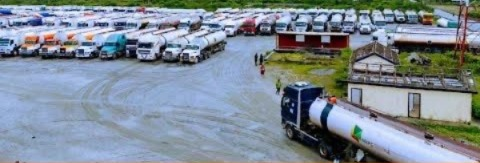
Private depots, particularly in Lagos, have already adjusted their prices downward by an average of 14 per cent in response to the refinery’s move. In practical terms, this has meant price reductions from around ₦828 per litre to roughly ₦710 per litre in some facilities. While the lower prices have been welcomed by consumers, marketers say sales volumes have weakened, profit margins have shrunk dramatically, and unsold stocks are beginning to pile up across depots and filling stations.
The situation is especially dire for importers with petrol cargoes still on the waterways or awaiting discharge at Nigerian ports. These companies purchased their products at higher international prices and foreign exchange rates before the sudden domestic price drop. With the market now anchored to a much lower price, many of them are struggling to sell their stocks without incurring massive losses. Industry insiders describe the outlook for such operators as uncertain, warning that prolonged exposure could push some firms to the brink of insolvency.
Retail marketers are also bearing a heavy burden. Many filling stations are currently holding large volumes of petrol bought at around ₦828 per litre, which they are now compelled to sell at significantly lower prices to stay competitive. Sector estimates suggest that retail marketers alone could be facing collective losses exceeding ₦80 billion. Several operators have described the abrupt ₦129 per litre reduction as a major shock, noting that the interconnected nature of depot supply, retail pricing, and cash flow makes it extremely difficult to absorb such losses without external support.
Beyond the immediate financial pain, the price war has raised broader questions about how Nigeria’s fuel market will adjust to the growing dominance of domestic refining. For decades, the downstream sector has been structured around imported petrol, with pricing largely influenced by international markets and foreign exchange fluctuations. Dangote Refinery’s entry was always expected to disrupt this model, but the speed and scale of the current adjustment have caught many players off guard.
Some industry voices are now calling for mitigation measures to ease the transition. There are growing appeals for Dangote Refinery to consider compensation mechanisms, such as discounts on future product purchases, to help marketers recover some of their losses. Others are urging regulators and policymakers to explore transitional pricing arrangements that would allow the market to adapt more gradually, rather than through abrupt shocks that threaten the survival of smaller operators.
Analysts warn that if the situation persists without intervention, it could lead to consolidation within the downstream sector, as weaker marketers are forced out and larger players absorb market share. While such consolidation might eventually create a more streamlined market, critics argue that it could also reduce competition and leave consumers vulnerable in the long run if alternative supply channels shrink.
At the same time, supporters of Dangote Refinery’s pricing strategy argue that the development represents a long-overdue correction in Nigeria’s fuel market. They note that cheaper locally refined petrol aligns with national goals of energy security, reduced import dependence, and lower costs for consumers. From this perspective, the current losses suffered by importers are seen as part of a painful but necessary adjustment to a new market reality driven by domestic refining capacity.
For now, uncertainty hangs over the sector as marketers, importers, regulators, and policymakers weigh their next steps. What is clear is that the price war has exposed deep structural vulnerabilities in Nigeria’s downstream petroleum industry, particularly its reliance on imported fuel and its limited buffers against sudden price shocks. As discussions continue behind closed doors, the outcome will likely shape the future of fuel supply, competition, and pricing in Africa’s largest economy.
📩 Stone Reporters News | 🌍 stonereportersnews.com
✉️ info@stonereportersnews.com | 📘 Facebook: Stone Reporters | 🐦 X (Twitter): @StoneReportNew | 📸 Instagram: @stonereportersnews
Add comment
Comments