

Reported By Mary Udezue | Edited by: Gabriel Osa
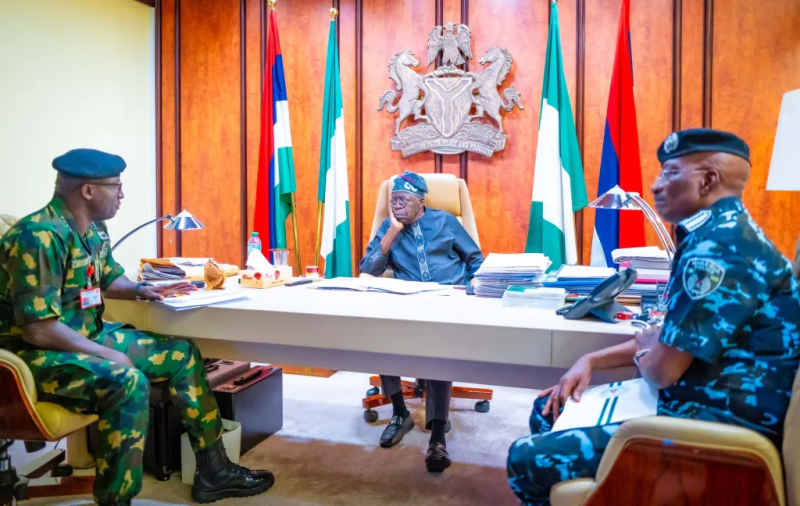
In a significant shift in Nigeria’s policing strategy, the Inspector‑General of Police (IGP), Kayode Egbetokun, has ordered the quiet demobilisation of officers assigned to President Bola Ahmed Tinubu’s Presidential Escort Unit, with immediate plans to redeploy them to state commands across the country. The move follows a presidential directive aimed at refocusing police manpower on frontline duties and core policing functions amid mounting security challenges nationwide.
According to an official police signal issued on December 16, 2025, from the Department of Finance and Administration at the Force Headquarters in Abuja, the directive affects personnel attached to the No. 24 Police Mobile Force (PMF) Presidential Escort Unit formerly stationed at the State House. The communication instructed senior police formations, including the Deputy Inspector‑General in charge of Operations, Assistant Inspectors‑General overseeing the PMF and zonal commands, and Commissioners of Police nationwide, to implement the redeployment without delay.
Under the relocation plan, officers have begun returning to their respective state commands, with assignments covering a wide geographic spread. Among the redeployed are dozens of inspectors and non‑commissioned officers sent to states such as Adamawa, Kebbi, Kaduna, Anambra, Bauchi, Benue, Borno, Bayelsa, Cross River, Ebonyi, Ekiti, Enugu, the Federal Capital Territory and Gombe. Additional deployments extend to Imo, Jigawa, Kogi, Kano, Katsina, Kwara, Nasarawa, Niger, Ondo, Osun, Plateau, Sokoto, Taraba and Yobe states, reflecting the scale of the internal police personnel movement.
Senior police officials say the redistribution of personnel aims to reinforce public safety efforts and bolster the capacity of state commands to respond to crime, insecurity, banditry, kidnapping and other pressing security threats. By returning officers to conventional policing roles, authorities hope to enhance visibility and responsiveness, particularly in hard‑to‑reach and high‑risk areas.
The demobilisation aligns with a broader reform agenda championed by President Tinubu, who in late November ordered the withdrawal of police personnel assigned to VIP protection duties nationwide. The president has repeatedly emphasised that police officers should prioritise safeguarding vulnerable communities and combating crime rather than providing personal security for elites. In response to the directive, the IGP confirmed that over 11,500 officers attached to VIP and special protection duties have been recalled and reassigned to frontline policing.
President Tinubu has framed the policy as vital to strengthening national security, noting that deploying police officers away from personalised guard roles will allow them to more effectively tackle rampant kidnappings, banditry and other violent crimes that have escalated across Nigeria. He has also directed ministers and senior government officials to seek presidential clearance through the IGP should they require any form of police protection, emphasising the need for tighter oversight and coordination.
The response from within the police ranks underscores the strategic nature of the reassignments. By integrating highly trained personnel into local commands, leadership expects to improve operational outcomes, enlarge patrol coverage and expand intelligence‑led policing. Police spokespeople further clarified that compliance with the withdrawal order is being monitored, and that officers found continuing to provide VIP escort services without authorisation may face disciplinary action.
Security analysts have broadly welcomed the redeployment as a necessary step toward addressing manpower shortages that have long hampered the Nigeria Police Force’s ability to protect the public effectively. For years, significant numbers of officers were tied up in VIP protection and special duties, a practice critics say detracted from core policing functions and contributed to gaps in community security coverage. The reassignment initiative, they argue, is poised to help rebalance the force’s priorities as it confronts a complex and fluid security environment.
Nonetheless, observers caution that redeployment alone cannot solve deep‑seated structural issues within the police and broader security architecture. Challenges such as inadequate funding, training deficiencies, and logistical shortages must be addressed comprehensively if the redeployed officers are to operate effectively in their new postings. Analysts emphasise the need for sustained investment in policing infrastructure and community engagement to foster trust and resilience against criminal networks.
The withdrawal and redeployment also raise questions about the future of VIP security in Nigeria. With police officers no longer routinely performing these functions, responsibility for protecting public officials and dignitaries is increasingly expected to shift toward other security agencies such as the Nigeria Security and Civil Defence Corps (NSCDC) and specialised units within the broader security apparatus, as envisaged in recent government directives.
For ordinary Nigerians, the reallocation of police resources represents a potentially transformative policy, particularly in communities that have suffered from longstanding security neglect. Residents in crime‑affected areas have expressed cautious optimism that an increased police presence will translate into quicker responses, more effective crime prevention and greater stability. Yet, many also stress that measurable improvements must materialise on the ground to justify the significant institutional shift.
As the redeployment continues, national security authorities are urging patience and cooperation from the public, while reiterating that the overarching goal is to create a more proactive, responsive and community‑oriented policing framework. Senior officials maintain that the demobilisation of the Presidential Escort Unit is a critical step in recalibrating the country’s security priorities and reinforcing the Nigeria Police Force’s core mandate to protect and serve.
📩 Stone Reporters News | 🌍 stonereportersnews.com
✉️ info@stonereportersnews.com | 📘 Facebook: Stone Reporters | 🐦 X (Twitter): @StoneReportNew | 📸 Instagram: @stonereportersnews
Add comment
Comments