

Reported by: Ijeoma G | Edited by: Gabriel Osa
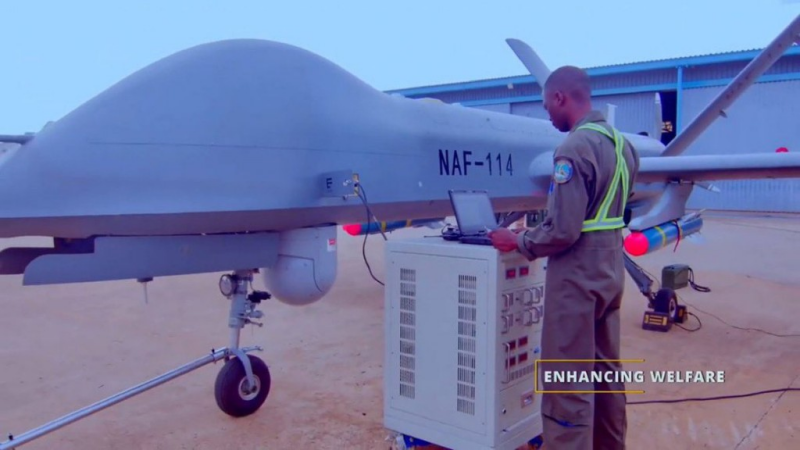
In a significant development for Nigeria’s ongoing security operations in the volatile North-Central region, a Nigerian military combat drone has crashed in the Kontagora Forest area of Niger State under circumstances that remain under investigation. The incident, which took place on Friday during an operational mission, has drawn attention to both the risks inherent in modern aerial surveillance and the broader challenges facing security forces combating armed groups and criminal networks across the region.
Eyewitness accounts and early reports indicate that the unmanned aerial vehicle (UAV), deployed by the Nigerian Air Force, went down in the dense forest terrain while conducting what military sources described as a routine combat surveillance mission. Photographs circulating online show the drone badly damaged but lying intact on the forest floor without signs of an explosion, suggesting that it may have crashed rather than been destroyed in combat. No explosions, fires, or secondary detonations were reported at the impact site. There were no reported casualties or injuries to personnel or civilians in the vicinity of the crash.
The Nigerian Air Force has publicly acknowledged the incident, confirming that the UAV lost communication with its base during operations. Air Commodore Ehimen Ejodame, Director of Public Relations and Information for the Air Force, said that all efforts to re-establish contact with the drone were unsuccessful, prompting established safety protocols to be activated. According to the military statement, once communication was lost, efforts shifted to contain and recover the platform in coordination with other security services. Preliminary assessments and recovery operations are underway, with technical teams beginning evaluations to determine the cause of the communications failure and crash.
While details surrounding the precise mission objectives at the time of the crash have not been disclosed, the deployment of UAVs in Niger State forms part of Nigeria’s expanding use of unmanned systems for counter-insurgency, surveillance, and reconnaissance across forested and remote areas frequently exploited by bandits, armed criminal gangs, and militant groups. The Kontagora Forest and surrounding regions have long been areas of military focus due to recurring attacks, kidnappings, and movements by organized armed elements who use difficult terrain to evade ground operations.
The Nigerian military’s reliance on drones and other aerial assets has grown in recent years as part of broader counter-banditry and anti-terrorism campaigns designed to enhance situational awareness, quickly identify threats, and coordinate responses with ground forces. Air reconnaissance capabilities have been particularly crucial in areas where roads are poor and accessibility is limited. However, incidents such as this underscore the technical and operational challenges of UAV deployments, including signal loss, equipment failure, and the difficulty of maintaining unmanned systems in harsh environments.
The crash also comes at a time of intensified aerial and ground operations in Niger State, reflecting both persistence and escalation of security threats. Over the past year, Nigerian forces have conducted multiple air interdiction operations against bandits and militants in the state’s forested corridors, leveraging both fixed-wing aircraft and drones to disrupt criminal networks and protect vulnerable communities. These joint efforts have resulted in reported strikes against armed elements and the destruction of logistics and hideouts linked to such groups, as the military seeks to reduce the frequency and lethality of raids on villages and travellers in the region.
Local reaction to the drone crash has been mixed. Some residents of communities near Kontagora expressed concern about the implications of intensified military activity in the area, especially given the potential for misidentification or accidents in zones where civilians and armed groups may intermingle. Others view the presence of military drones as a necessary deterrent against kidnappers and bandits who have orchestrated frequent attacks on rural communities, sometimes abducting families or looting property.
Despite mounting public interest, the Niger State government has not yet issued an official statement regarding the incident, and federal military officials have maintained a measured public posture, underlining that no loss of life occurred and that operations remain ongoing. The absence of immediate official commentary has fueled speculation on social media and among local observers, though analysts emphasise that such responses are typical in early phases of military incident reporting, particularly when technical investigations are underway.
The crash raises important questions about the future of aerial operations in challenging environments. While drones offer strategic advantages—such as remote surveillance, lower operational risk to personnel, and rapid data collection—they also face vulnerabilities related to weather conditions, electromagnetic interference, technical malfunctions, and potential countermeasures from hostile actors. The Nigerian military’s technical teams are expected to scrutinise the recovered UAV to ascertain whether the loss of communication stemmed from equipment failure, environmental factors, or other causes.
This event also underscores the broader security context in Nigeria, where forests and ungoverned spaces have become theatres of protracted conflict and banditry. These areas, spanning from the northwest into central belt states like Niger, present persistent challenges for national security forces, as bandits and criminal cells exploit deep-lying terrain to avoid detection and stage operations, including kidnappings and attacks on isolated communities. The continued use of drones and aerial reconnaissance is part of evolving strategies to counter these threats, even as security officials work to safeguard civilian populations and build confidence in their operations.
For now, the focus remains on the ongoing investigation into the crash, the recovery of the drone wreckage, and the lessons learned that could influence future UAV missions. As Nigeria navigates its complex internal security environment, the interaction between technology, tactical operations, and community safety will continue to shape the trajectory of military engagements in states like Niger and beyond.
📩 Stone Reporters News | 🌍 stonereportersnews.com
✉️ info@stonereportersnews.com | 📘 Facebook: Stone Reporters | 🐦 X (Twitter): @StoneReportNew | 📸 Instagram: @stonereportersnews
Add comment
Comments