

Reported by: Ijeoma G | Edited by: Gabriel Osa
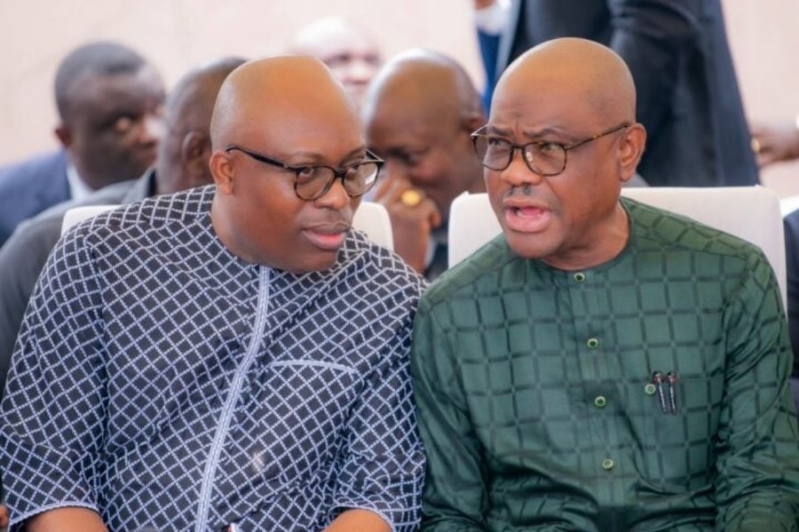
Port Harcourt, Nigeria — A fresh and highly publicised political confrontation has reignited between Nyesom Wike, Nigeria’s Minister of the Federal Capital Territory (FCT) and former governor of Rivers State, and Siminalayi Fubara, the incumbent governor of the oil‑rich state. The renewed clash, which Wike described in strikingly personal terms, reflects deepening divisions in the ruling Peoples Democratic Party (PDP) and raises fresh questions about political stability in one of Nigeria’s most influential regions.
The latest escalation centres on Wike’s accusation that Fubara showed him “disrespect” by allegedly referring to him as a “barking dog,” a remark that has been widely reported and circulated in Nigerian media and among political commentators. Wike made the allegation during a public appearance in Ogba/Egbema/Ndoni Local Government Area (ONELGA) on Friday, where he was on what was described as a “thank‑you visit” to supporters.
During the address, Wike — a veteran political heavyweight whose influence has long extended beyond Rivers State — castigated Fubara for failing to honour what he described as commitments in a peace pact that was brokered by President Bola Tinubu in an effort to end months of bitter internal disputes within the PDP in Rivers. Wike insisted that the governor had not fulfilled promises made at the peace meeting, portraying the breakdown of the accord as indicative of broader governance failures.
“It is very unfortunate that the same dog is barking,” Wike said, alluding to what he claimed were disparaging remarks made by Fubara and his camp. He framed the episode as symptomatic of a deeper rift in Rivers politics, and he reaffirmed his intent not to repeat perceived past mistakes in future electoral cycles, hinting at strategic political recalibration ahead of the 2027 general elections.
The situation has also been fuelled by internal fracturing within the PDP’s Rivers State structures. On the same day as Wike’s speech, Dr Nname Ewor, a factional chairman of the PDP who had previously aligned with Fubara’s camp, announced that he had dissolved his faction and merged it into the caretaker committee led by Aaron Chukwemeka — a committee backed overtly by Wike. Ewor justified the move by claiming Fubara had “failed to keep agreements” and was “not trusted,” further entrenching perceptions of division and disorder within the state party apparatus.
The collapse of Ewor’s faction into Wike’s fold is widely interpreted as a symbolic victory for the former governor and indicates the shifting loyalties that have marked Rivers politics since Fubara succeeded Wike in 2023. Wike’s supporters argued that bringing faction members under a unified leadership would stabilise the party, while critics view the development as consolidating Wike’s dominance over the state’s PDP infrastructure at the expense of the sitting governor’s authority.
Fubara, for his part, has tried to project calm amid the recriminations. In a separate address to the people of Rivers, he urged residents not to be overly troubled by political tension and spoke in terms resonant with appeals for unity and focus on governance. Observers note that while Fubara’s message was aimed at reassuring the public, it has done little to assuage concerns among party loyalists about ongoing factionalism.
The feud has its roots in earlier disputes dating back to when Fubara first assumed office, with power struggles between him and Wike playing out in the corridors of state institutions and within the State House of Assembly. That conflict once escalated to the point that an emergency rule was declared in Rivers, and was only temporarily subdued by peace efforts mediated from Abuja. Despite those efforts, tensions have continued to simmer, with both politicians and their allies periodically trading allegations — sometimes personal, sometimes strategic — that reflect unresolved grievances.
Political analysts say that the latest public denunciation by Wike and the concurrent reshuffling of PDP factions underscore the fragility of peace deals that lack broad, grassroots buy‑in and are overly dependent on individual personalities. Given Rivers State’s prominence — both economically and politically — instability among its leadership has implications that extend beyond the state’s borders, potentially shaping alliances and power balances within the broader PDP ahead of national elections.
Grassroots reactions have been varied. Some residents express concern that the public spat will distract from crucial governance priorities such as infrastructure development, employment, and security. Others appear more resigned, viewing the protracted conflict as emblematic of entrenched political rivalries that have defined Rivers politics for several electoral cycles.
Observers also warn that the ongoing feud may provide leverage to opposition parties, including the ruling All Progressives Congress (APC), offering an opening to exploit internal divisions and strengthen their foothold in the region. Indeed, the broader political realignments — including defections and coalition‑building efforts — have already begun to draw attention as part of a strategic landscape that all parties are watching keenly ahead of the 2027 general elections.
For now, the political skirmish between Wike and Fubara shows little sign of abating, with both camps seemingly entrenched in their positions and prepared to marshal supporters to advance competing narratives. Whether the feud will ultimately be resolved through negotiation, power recalibration, or further political contest remains a central question for the future of governance in Rivers State.
📩 Stone Reporters News | 🌍 stonereportersnews.com
✉️ info@stonereportersnews.com | 📘 Facebook: Stone Reporters | 🐦 X (Twitter): @StoneReportNew | 📸 Instagram: @stonereportersnews
Add comment
Comments