

Reported by Ariajegbe Sylvia Esezobor
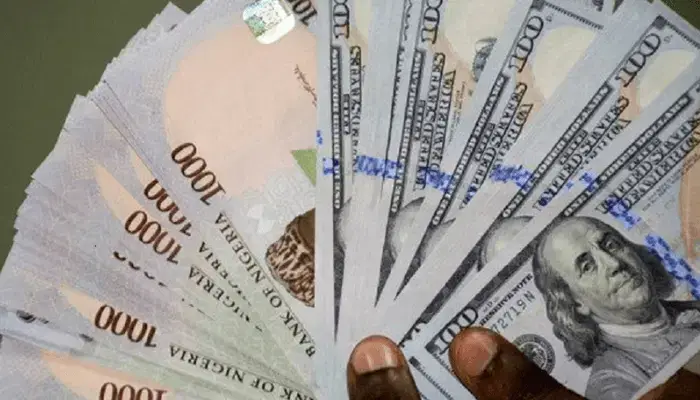
The naira appreciated to N1,362 per dollar in the parallel market on Thursday, October 2, 2026, gaining N8 from the N1,370/$ recorded on Wednesday, even as the local currency weakened at the official Nigerian Foreign Exchange Market, where the indicative rate rose to N1,332/$ from N1,329.50/$, a depreciation of N2.50. The divergent movements narrowed the margin between the parallel and official markets to N30 per dollar from N40.50 per dollar on Wednesday, according to data from the Central Bank of Nigeria.
The parallel market's gain marked a continuation of the naira's recent strengthening in the informal segment, where Bureau de Change operators quoted the dollar at N1,355 to buy and N1,370 to sell as of Friday afternoon. The weekly trajectory showed the dollar's buy and sell quotes each falling by N15 between Monday, September 28, and Friday, October 2, according to rate board data. The naira also appreciated against other major currencies in the parallel market, with the British pound falling to N1,825 to buy and N1,860 to sell from N1,835 and N1,880, the euro declining to N1,550 and N1,580 from N1,560 and N1,600, and the Canadian dollar easing to N951 and N965 from N972 and N982. The pound, euro and Canadian dollar each recorded declines on both the buy and sell sides over the course of the week.
At the official window, however, the picture was less favourable for the naira. The indicative exchange rate at the Nigerian Foreign Exchange Market rose to N1,332 per dollar from N1,329.50 per dollar on Wednesday, representing a depreciation of N2.50. The value of interbank turnover in the NFEM fell by 14.19 per cent to $154.02 million from $179.50 million the previous day, reflecting reduced trading activity in the official segment. The decline in turnover came as the market resumed trading after Nigeria's Independence Day holiday on October 1, and it suggests that liquidity conditions in the official window remain uneven, with the naira occasionally coming under mild downward pressure when interbank FX turnover declines and isolated corporate dollar demand emerges.
The narrowing of the gap between the official and parallel markets is a notable development in the context of Nigeria's foreign exchange reforms. In previous years, the disparity between the two windows was as wide as N100 or more, creating opportunities for arbitrage and fuelling speculative demand for dollars. The Central Bank of Nigeria has consistently identified the reduction of the exchange rate gap as a key objective of its monetary policy strategy, arguing that a stable and convergent exchange rate regime is essential for price stability and investor confidence. The margin has fluctuated in recent months, narrowing to below two per cent in August 2026 when the gap between the official rate and Bureau de Change rates fell below that threshold, before widening again in September to around N62 or 4.6 per cent. The latest figure of N30, or approximately 2.25 per cent of the official rate, represents a meaningful improvement over the September spread.
The naira's performance in the parallel market has been shaped by a combination of factors, including the Central Bank's tight monetary policy stance, improved external buffers, and sustained inflows from oil exports, diaspora remittances and foreign portfolio investment. Gross external reserves edged higher to $54.920 billion as of September 29, 2026, up from $54.906 billion the previous day, providing the apex bank with significant firepower to defend the currency against speculative attacks and meet legitimate commercial and invisible foreign exchange demand. The reserves have remained above $54 billion for several weeks, supported by steady oil and gas receipts and resilient remittance flows, which have helped stabilise the naira despite persistent structural pressures.
The Central Bank's Monetary Policy Committee delivered a bold 350-basis-point rate cut in September 2026, bringing the Monetary Policy Rate down from 26.5 per cent to 23 per cent, in a move aimed at realigning transmission effectiveness in domestic financial markets and easing inflation, which declined to 15.39 per cent in August. The rate cut has reduced the appeal of high-yielding fixed-income instruments to foreign portfolio investors, raising concerns that hot money flows could decelerate and put pressure on foreign exchange supply. However, the naira has remained relatively stable despite the cut, a development that analysts attribute to the strength of the reserves buffer and the Central Bank's continued intervention in the foreign exchange market.
The reduction in NFEM turnover on Thursday suggests that the official market is not yet operating at full capacity, and that the naira's stability in the parallel market may be more a function of reduced demand for dollars than of a fundamental improvement in supply. Analysts have noted that when liquidity dries up in the official market, the naira comes under mild downward pressure, and that small pockets of corporate demand can induce intraday softening. The continued demand for dollars for energy imports and raw materials remains a source of structural friction, and stability will largely depend on keeping crude oil production at or above the 2 million barrels per day mark, a target that Nigeria has struggled to achieve consistently in recent years.
For Nigerians, the naira's performance has direct implications for the cost of imported goods, fuel prices and the broader cost of living. A stronger naira in the parallel market reduces the cost of sourcing dollars for importers, traders and individuals, but the pass-through to consumer prices is often uneven and delayed. The government has consistently argued that its reforms, including the unification of the exchange rate and the removal of the petrol subsidy, are creating the conditions for a more stable currency and a more resilient economy. The latest figures offer a measure of encouragement, with the parallel market rate gaining and the gap with the official window narrowing, but they also highlight the continued fragility of the foreign exchange market and the challenges of sustaining stability in an economy that remains heavily dependent on oil revenues and import flows. The coming weeks will determine whether the naira's parallel market gains are sustained or whether the currency resumes its familiar pattern of volatility as liquidity conditions evolve.
📩 Stone Reporters News | 🌍 stonereportersnews.com
✉️ info@stonereportersnews.com | 📘 Facebook: Stone Reporters News | 🐦 X (Twitter): @StoneReportNew | 📸 Instagram: @stonereportersnews
Add comment
Comments