

Reported by: L. Imafidon | Edited by: Gabriel Osa
As the conflict between Iran and a coalition of United States and Israeli forces intensifies across the Middle East, recent developments indicate that Russia’s military relationship with Tehran has so far stopped short of major direct involvement, with the most significant form of assistance to Iran appearing to be intelligence sharing rather than overt military deployment or hardware provision.
According to Western officials familiar with intelligence assessments, Moscow has been providing Iran with targeting information that could help Tehran strike U.S. military assets in the region, including the locations of American warships, aircraft and other strategic forces operating in the Middle East. The information has reportedly been shared since the current conflict expanded earlier this month, marking one of the clearest indications of Russia’s indirect involvement in the war.
The targeting intelligence is understood to have come from Russia’s advanced surveillance capabilities, including space‑based and signals intelligence sources. Analysts suggest this data may assist Iran’s military in refining strike planning against U.S. forces, particularly given Tehran’s own limitations in situational awareness since the start of widespread U.S. and Israeli assaults on Iranian territory.
While the sharing of intelligence represents a significant form of cooperation, it is important to note that U.S. and Russian officials alike have downplayed the broader impact. U.S. President Donald Trump and Defence Secretary Pete Hegseth publicly stated that reports of Moscow’s assistance “are not making a difference” in Iran’s operational capabilities, indicating that U.S. forces are tracking and countering Iranian strikes regardless of any foreign intelligence input.
Russian government spokespeople have been cautious in responding to these allegations. Kremlin officials have reiterated that Russia has not received a formal request from Tehran for military support in the current conflict and have emphasised diplomatic condemnation of Western actions rather than military cooperation. Moscow has instead spoken publicly about Iran’s right to defend itself and condemned U.S. and Israeli airstrikes as “unprovoked aggression.”
From Tehran’s perspective, the partnership with Moscow remains strategically important. Iran’s foreign minister, Abbas Araghchi, has asserted that the relationship between the two countries is strong and enduring, acknowledging there are multiple dimensions to their cooperation even if he declined to describe specific forms of assistance. He emphasised that Iran and Russia maintain a “very good partnership” that predates the current crisis.
The limited nature of Russian support is widely seen by analysts as stemming from Moscow’s constrained military capacity. Russia is heavily engaged in its long‑running war in Ukraine, facing equipment losses and logistical strains that make it difficult to divert significant hardware or troops to another major conflict overseas. Consequently, providing actionable intelligence is viewed as a lower‑risk and more feasible form of assistance that does not directly entangle Russian forces in battle.
This dynamic also reflects broader geopolitical calculations. Russia seeks to balance its relations with multiple regional actors, including Israel and Gulf states, while preserving strategic ties with Iran. Direct military involvement against the United States or Israel would carry substantial risks of escalation and could jeopardise other Russian interests. By contrast, indirect support through intelligence sharing allows Moscow to signal alignment with Tehran without committing troops or heavy weaponry.
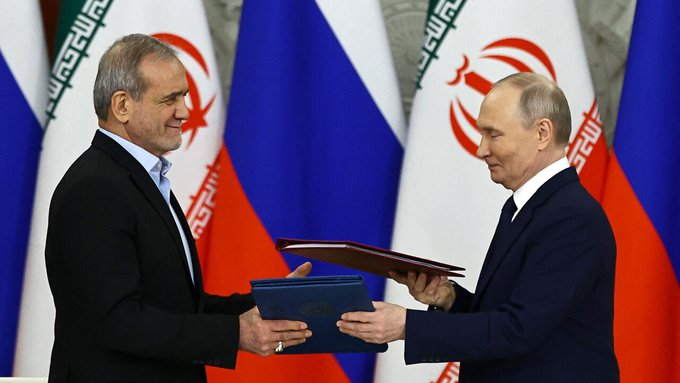
Moreover, the Russia‑Iran strategic partnership predates the current conflict and includes cooperation on defence, economic ties and technological exchange. In 2025, the two countries signed a comprehensive strategic partnership agreement aimed at enhancing coordination across multiple sectors, although it does not include mutual defence obligations that would legally bind Russia to fight on Iran’s behalf.
The intelligence cooperation now reported appears to be an extension of this evolving relationship. For years, Iran has provided Russia with drones and other military technology that the Kremlin has used in its own operations in Ukraine. The exchange of military data, therefore, is part of a broader pattern of reciprocal support between the two states.
Despite these developments, the overall scope of Russian involvement in the Middle East conflict remains limited. There is no public evidence yet that Russia has supplied Iran with large quantities of weapons, air defence systems, or deployed Russian forces to fight alongside Iranian troops. Moscow’s official statements emphasise diplomatic condemnation of Western actions and dialogue with Tehran rather than direct military cooperation.
For the United States, the revelation of Russian intelligence sharing has prompted cautious responses. While some officials have acknowledged the reports, they have simultaneously sought to minimise their operational significance, even as U.S. forces continue to confront a barrage of Iranian drone and missile attacks across the region.
Looking ahead, the evolving Russia‑Iran relationship is likely to remain a complex element of the broader geopolitical landscape. Intelligence cooperation may continue to play a role, particularly if the Middle East conflict persists. At the same time, Moscow’s primary strategic focus remains its confrontation with the West over Ukraine and broader efforts to position itself as a global power capable of navigating multiple regional crises without full‑scale military engagement.
The limited but tangible support in the form of intelligence to Iran underscores both the depth of Russian‑Iranian ties and the cautious approach Moscow is taking as the conflict enters a potentially protracted phase.
📩 Stone Reporters News | 🌍 stonereportersnews.com
✉️ info@stonereportersnews.com | 📘 Facebook: Stone Reporters | 🐦 X (Twitter): @StoneReportNew | 📸 Instagram: @stonereportersnews
Add comment
Comments