

Reported By Mary Udezue | Edited by: Gabriel Osa
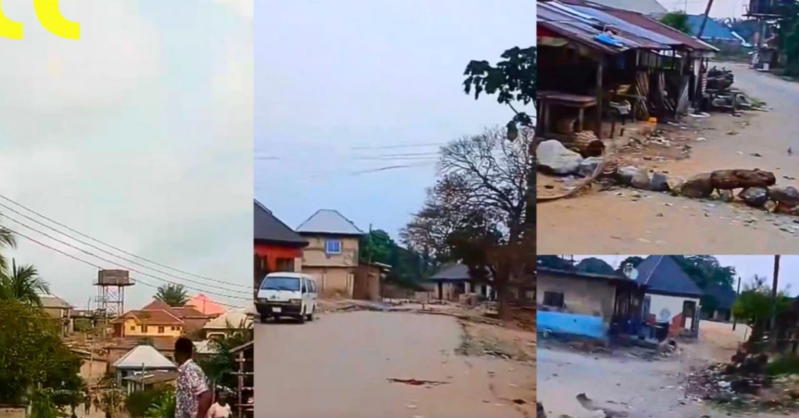
The once-thriving community of Amasiri in Afikpo North Local Government Area of Ebonyi State has been plunged into fear and near-abandonment following a deadly escalation of a long-running boundary dispute with neighbouring Okporojo in Oso Edda Local Government Area. A wave of violence in late January triggered an intensive security crackdown, sweeping administrative sanctions, and a 20-hour curfew that residents say has effectively brought social and economic life to a halt.
The crisis intensified after renewed clashes reportedly led to the killing of at least four people, with disturbing accounts indicating that some victims were beheaded and homes set ablaze. Security agencies confirmed fatalities linked to the dispute, describing the situation as a serious breach of public order requiring immediate intervention. The land conflict between the two communities has simmered for years, occasionally erupting into violence despite previous attempts at mediation and boundary clarification.
In response to the latest bloodshed, Governor Francis Nwifuru convened an emergency meeting of the Ebonyi State Security Council and announced sweeping measures aimed at restoring order. A strict 20-hour curfew was imposed on Amasiri, restricting movement to a narrow window each day. Schools, markets, banks and public offices were shut down indefinitely. Civil servants and teachers working in the area were directed to relocate temporarily, while residents were warned against gatherings or activities capable of escalating tensions.
Beyond movement restrictions, the state government took the unusual step of dissolving Amasiri’s local leadership structure. Traditional rulers were dethroned, political appointees from the community were removed from office, and the local development centre’s administrative operations were suspended. Officials described the measures as necessary to dismantle networks allegedly linked to the violence and to signal that communal unrest would not be tolerated.
Security forces comprising the Nigerian Army, Police, Department of State Services and Nigeria Security and Civil Defence Corps were deployed in large numbers. Military authorities confirmed that joint operations were launched to conduct cordon-and-search exercises aimed at identifying perpetrators and recovering weapons. During these operations, troops reportedly discovered shallow graves containing mutilated bodies within the broader conflict zone, reinforcing concerns about the brutality of the clashes.
The discovery of the graves heightened public anxiety and strengthened the state’s justification for the heavy security presence. Military officials stated that their mission was intelligence-driven and targeted at criminal elements rather than the wider civilian population. They maintained that stabilisation efforts were essential to prevent reprisal attacks and further loss of life.
However, residents and community advocates have expressed alarm over what they describe as blanket punitive actions. Several locals claim that security operatives have conducted mass arrests, detaining numerous young men and other residents during raids. Viral videos circulating online show individuals appealing directly to Governor Nwifuru, alleging that many innocent persons have been swept up in the operations. While authorities have not publicly disclosed the total number of detainees, they insist that investigations are ongoing and that only those connected to criminal activity will face prosecution.
The humanitarian impact has been significant. Businesses remain shuttered, transport has dwindled, and agricultural activities have stalled. Families dependent on daily commerce report severe financial strain. With schools closed and curfew hours extended, children and vulnerable residents face prolonged disruption to education and routine healthcare access. Aid groups and civil society organisations have begun urging the government to balance security enforcement with humanitarian considerations.
Community leaders from both sides of the dispute have renewed calls for a definitive boundary demarcation to prevent recurring violence. The land in question is considered economically and culturally significant, with generations tracing ancestral ties to the contested territory. Previous mediation attempts reportedly failed due to disagreements over survey interpretations and traditional claims. Observers note that without a transparent and mutually accepted boundary settlement, tensions are likely to resurface even after the current security measures are lifted.
Political analysts view the state government’s decisive actions as an effort to demonstrate zero tolerance for communal violence. The dethronement of traditional rulers and dismissal of local officials underscore a strategy of holding community leadership accountable for unrest. Yet critics argue that dissolving established authority structures may create governance vacuums that complicate reconciliation efforts.
Security experts emphasise that land disputes in Nigeria often intertwine with deeper issues of identity, resource control and historical grievances. When left unresolved, such conflicts can escalate rapidly, especially in rural communities where local vigilante groups and informal security arrangements operate alongside formal law enforcement. The Ebonyi crisis illustrates how quickly communal friction can transform into lethal confrontation when preventive mechanisms falter.
Governor Nwifuru has pledged that the curfew and sanctions will remain until normalcy is restored and perpetrators are brought to justice. He has called on residents to cooperate fully with security agencies and avoid spreading misinformation capable of inciting further violence. The administration maintains that the measures are temporary and targeted at preventing another cycle of reprisal attacks.
Meanwhile, rights advocates are urging authorities to ensure due process for detainees and to conduct an independent review of the circumstances surrounding the violence. They argue that accountability must be evidence-based and transparent to prevent alienation of innocent residents. The balancing act between enforcing security and safeguarding civil liberties remains a central concern.
As security patrols continue and investigations proceed, Amasiri stands at a crossroads. Once characterised by bustling markets and vibrant communal life, the town now reflects the heavy imprint of curfew enforcement and military oversight. Whether the current crackdown will pave the way for durable peace depends largely on the success of mediation efforts and the establishment of a clear, enforceable boundary agreement.
For now, residents wait anxiously for a return to stability, hoping that dialogue and lawful resolution will replace fear and uncertainty. The coming weeks are likely to determine whether the measures imposed in the wake of the killings can evolve into a sustainable framework for coexistence between Amasiri and its neighbours, or whether the underlying tensions will continue to simmer beneath enforced calm.
📩 Stone Reporters News | 🌍 stonereportersnews.com
✉️ info@stonereportersnews.com | 📘 Facebook: Stone Reporters | 🐦 X (Twitter): @StoneReportNew | 📸 Instagram: @stonereportersnews
Add comment
Comments