

Reported By Mary Udezue | Edited by: Gabriel Osa
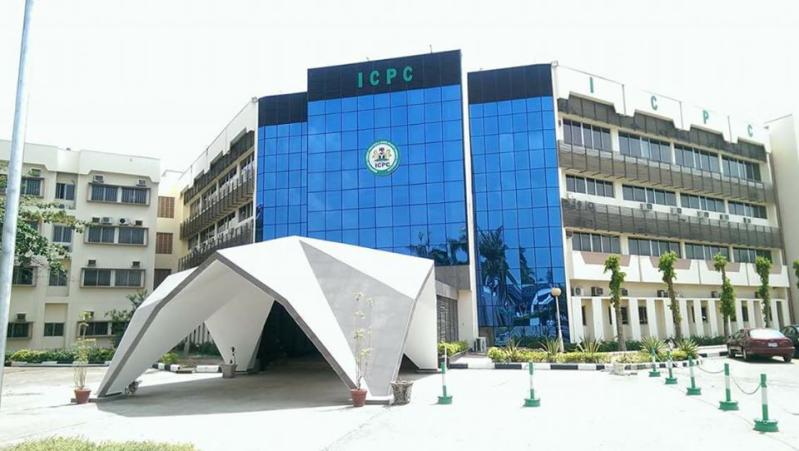
The Independent Corrupt Practices and Other Related Offences Commission has arraigned a staff member of the Ebonyi State Government before the Federal High Court sitting in Abakaliki over allegations of money laundering involving structured cash withdrawals and deposits totalling more than N61 million.
The defendant, Obasi Nicholas Sunday, was brought before Justice H. I. O. Oshomah of Federal High Court 1, Abakaliki, on a two-count charge filed under Charge No: FHC/A1/6C/25. Prosecutors allege that the accused, who works in the Office of the Accountant-General of Ebonyi State and is a signatory to the Ebonyi State Government Shopping Mall Account domiciled with the United Bank for Africa, carried out a series of financial transactions designed to evade mandatory reporting thresholds under Nigeria’s anti-money laundering laws.
According to the charge sheet, the defendant allegedly withdrew a cumulative sum of N61,000,000.00 from the government account in August 2020. The prosecution contends that the withdrawals were deliberately broken into six tranches of N10,000,000 each, with an additional N1,000,000 transaction, in a pattern commonly described in financial compliance practice as structuring or “smurfing.” Such structuring, authorities say, is typically used to avoid triggering automatic reporting obligations imposed on financial institutions for large cash transactions.
The Commission further alleges that within the same period, the defendant deposited N60,941,725.00 into the UBA account of one Ikechukwu Obiukwu, identified in court documents as a contractor to the Ebonyi State Government. These deposits were also reportedly made in structured instalments, including multiple N10,000,000 lodgements and a final deposit of N941,725.00. Prosecutors argue that the pattern of deposits demonstrates intent to circumvent statutory reporting duties required under anti-money laundering regulations.
The charges were filed under Section 19(1)(c) of the Money Laundering (Prevention and Prohibition) Act, 2022, and are punishable under Section 19(2)(b) of the same legislation. The Act criminalises structured transactions carried out with the intention of evading financial reporting obligations, reflecting Nigeria’s broader compliance commitments under international anti-money laundering frameworks.
At Thursday’s proceedings, the defendant entered a plea of not guilty to both counts. Following the arraignment, counsel to the ICPC, Mr. Agbili Ezenwa Kingsley, requested a trial date to enable the prosecution to present its case. Defence counsel, Mr. Michael Ngwu, moved a bail application on behalf of his client. The prosecution did not oppose the application.
Justice Oshomah subsequently granted bail to the defendant in the sum of N10 million. As part of the conditions, the court ordered that the defendant must provide one surety who is required to be the Accountant-General of the state. The surety is to sign a written undertaking guaranteeing the defendant’s appearance in court and must attach two recent passport photographs to the undertaking. The defendant is also required to execute a similar written undertaking to attend all court sittings, accompanied by two recent passport photographs.
The court adjourned the matter to March 24 and 25, 2026, for the commencement of trial. During the hearing, the prosecution is expected to present documentary evidence, including bank transaction records and internal authorisation documents, to substantiate its claims of structured withdrawals and deposits. Witness testimony from bank officials and government personnel may also form part of the evidentiary record.
Legal analysts note that cases involving structured financial transactions often hinge on demonstrating intent. Prosecutors must establish not only that transactions were broken into smaller amounts, but also that the pattern was deliberately designed to evade statutory reporting requirements. The defence, in turn, may argue alternative explanations for the transaction structure, including administrative or operational considerations.
The arraignment underscores the ICPC’s continued enforcement efforts within state-level financial administration. Although Nigeria operates multiple anti-corruption and financial crimes agencies, including the Economic and Financial Crimes Commission, the ICPC retains statutory authority to investigate and prosecute corruption-related offences, particularly within public institutions.
Ebonyi State, located in Nigeria’s South-East region, has in recent years pursued infrastructure and commercial development initiatives, including state-backed projects involving public-private arrangements. Financial oversight of such projects has drawn increased scrutiny amid national efforts to strengthen fiscal transparency and accountability.
The Money Laundering (Prevention and Prohibition) Act, 2022, represents Nigeria’s updated legislative framework aimed at aligning domestic enforcement with global standards set by international financial monitoring bodies. The law expands compliance obligations for financial institutions and enhances investigative powers for regulatory and prosecutorial agencies.
As the case proceeds to trial, attention will focus on whether the prosecution can demonstrate a direct link between the structured transactions and an intention to defeat statutory oversight mechanisms. The outcome could have implications for financial governance practices within subnational administrations and reinforce expectations regarding transaction reporting thresholds.
For now, the defendant remains on bail pending further proceedings. The Federal High Court is expected to commence substantive hearing in late March, marking the next phase in a case that places public financial management under judicial examination.
📩 Stone Reporters News | 🌍 stonereportersnews.com
✉️ info@stonereportersnews.com | 📘 Facebook: Stone Reporters | 🐦 X (Twitter): @StoneReportNew | 📸 Instagram: @stonereportersnews
Add comment
Comments