

Reported By Mary Udezue | Edited by: Gabriel Osa
Residents of the Ilupeju Community, Osogbo have staged a protest against plans to block the only access road linking their settlement to the main urban centre, warning that the project could effectively isolate the community and disrupt daily economic and social activities.
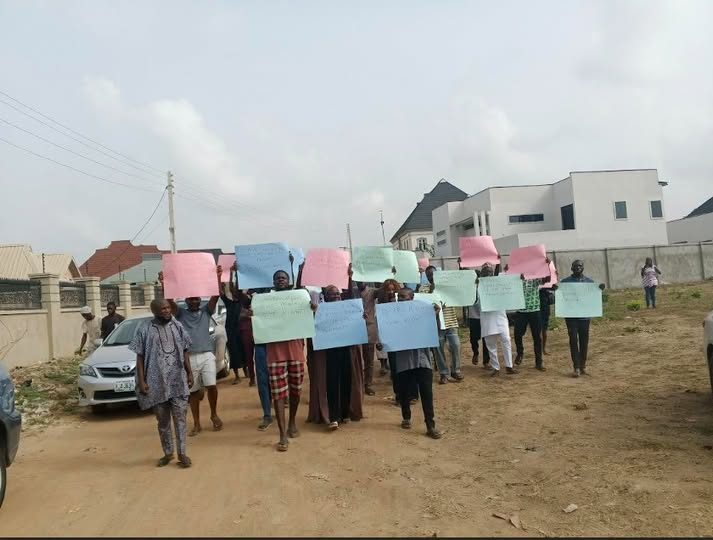
The demonstrators, mostly youths, traders and elderly residents, gathered along the disputed corridor to express concern over what they described as an impending infrastructural decision that could transform the community into a geographic enclave cut off from essential services. According to protesters, the road under consideration currently serves as the primary route for movement of people, goods, schoolchildren and emergency responders connecting Ilupeju to other parts of Osogbo.
Community representatives urged Ademola Adeleke to intervene urgently, arguing that any attempt to permanently obstruct the road without providing an alternative route would impose severe social and economic hardship on residents. They said the community depends heavily on the road for transportation of agricultural products, access to healthcare facilities, and commercial interaction with neighbouring markets.
Protesters carried placards expressing opposition to the planned closure, warning that isolation would increase poverty levels, limit educational access for children, and complicate medical emergencies requiring rapid evacuation. Some residents described the road as the community’s lifeline, stating that several households rely on motorcycle and vehicle transport along the route for daily survival.
Local leaders claim they were not adequately consulted before the decision reportedly associated with the proposed blockage. They argued that urban development projects should incorporate community engagement mechanisms to avoid unintended social consequences. The absence of an alternative access corridor was repeatedly highlighted as the central source of anxiety among residents.
The state government has not issued a detailed public statement confirming whether the road closure plan has been finalised. However, sources within local administration circles suggest that the proposal may be linked to broader urban planning or security management considerations. Officials are expected to evaluate whether traffic diversion, security zoning, or infrastructural redesign motivated the proposal.
Transportation experts warn that cutting off a sole community access road without providing substitute infrastructure can have cascading effects on local economies. When movement is restricted, small traders may lose access to supply chains, property values can decline, and social services delivery may deteriorate. In rural and semi-urban Nigerian communities, road connectivity remains a critical determinant of development outcomes.
Residents also expressed fear that emergency response operations could be compromised if the road is blocked. They pointed out that ambulance services, fire emergency vehicles and security patrols depend on unobstructed access to reach the settlement promptly during crises. Community elders recalled previous incidents where delayed transportation worsened medical emergencies due to poor road connectivity.
Youth groups within Ilupeju warned that isolation of the community could generate social tension and increase economic vulnerability. Some protesters urged the state government to conduct environmental and social impact assessments before implementing any infrastructural modification affecting public movement.
Political observers note that infrastructure decisions in densely populated urban neighbourhoods often attract strong public reactions, particularly where residents perceive that development projects may sacrifice community welfare for administrative convenience. In recent years, similar disputes across Nigerian cities have highlighted the importance of participatory urban governance.
The Osun State administration under Governor Adeleke has prioritized road rehabilitation and urban renewal initiatives since assuming office. Supporters of the government argue that infrastructure optimisation is necessary to reduce congestion, improve security surveillance and modernise city planning systems. Critics, however, insist that development should not come at the expense of community accessibility.
Security analysts suggest that authorities may be considering the road closure as part of a broader strategy to manage traffic flow or enhance surveillance around sensitive areas. Yet community members maintain that security objectives can be achieved without permanently denying them physical connection to the wider city network.
As of the time of reporting, residents have called for direct dialogue with state authorities, demanding clarification of the project’s scope and requesting the provision of an alternative road before any blockage is implemented. They warned that peaceful protests would continue if their concerns are not addressed.
The situation in Ilupeju reflects the broader challenge facing rapidly expanding Nigerian urban communities where infrastructure development, population growth and community welfare often intersect. Balancing administrative planning with grassroots livelihood protection remains a central policy dilemma for many state governments.
For now, Ilupeju residents remain apprehensive, awaiting official government clarification. Community leaders insist that preserving their only access road is essential to maintaining social stability, economic survival and the dignity of local inhabitants.
📩 Stone Reporters News | 🌍 stonereportersnews.com
✉️ info@stonereportersnews.com | 📘 Facebook: Stone Reporters | 🐦 X (Twitter): @StoneReportNew | 📸 Instagram: @stonereportersnews
Add comment
Comments