

Reported by: Agande Richard Aondofa | Edited by: Pierre Antoine
Major road corridors linking parts of northwest Nigeria have been rendered impassable after suspected bandits reportedly planted explosives along strategic highway stretches in Zamfara State, stranding dozens of travellers and commercial vehicles.
The affected routes include the road from Gusau to Tsafe and the corridor stretching from Wanzamai to Funtua. Local sources said the disruption followed reports that improvised explosive devices were planted in the middle of the highways between Kucheri town and Wanzamai, extending toward Bilbis axis.
Stone Reporters note that the affected areas fall within security flashpoints in Zamfara State, where armed bandit groups have frequently targeted highways to restrict movement, carry out kidnappings, and undermine security operations.
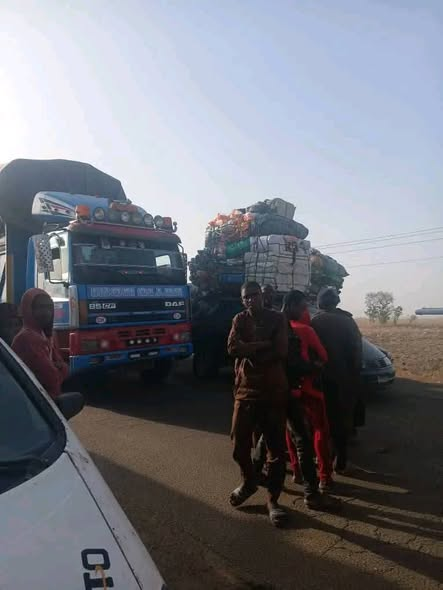
Eyewitness accounts indicate that vehicles were forced to halt abruptly after word spread that explosive devices had been discovered along the roadway. Several motorists reportedly abandoned forward movement, fearing detonation. Images circulating from the scene show long queues of stranded vehicles and passengers waiting at a safe distance.
The Gusau–Tsafe axis is a critical transport link connecting rural communities to the state capital, Gusau. The road also serves as an economic artery for agricultural produce and livestock trade. Disruption of this corridor carries significant implications for mobility, commerce, and emergency response access.
Security analysts say the use of explosives marks a tactical escalation by bandit groups who previously relied primarily on ambushes, abductions, and sporadic armed raids. Planting devices on highways not only creates physical barriers but also amplifies psychological fear among travellers, discouraging movement across already vulnerable zones.
Stone Reporters note that Zamfara has experienced repeated waves of insecurity over the past decade, with forested belts providing operational cover for armed groups. Road sabotage has increasingly become a tool for asserting territorial dominance and limiting the reach of state security patrols.
Local authorities have yet to issue a comprehensive public statement confirming the precise number or type of devices discovered. However, residents in nearby communities reported heightened security presence as bomb disposal units were believed to be mobilised to the affected locations.
The Wanzamai–Funtua stretch is also strategically important, linking communities across state lines and serving as a transit route for traders moving goods toward markets in Katsina and beyond. Prolonged closure of this route could affect regional trade flow and fuel supply logistics.
Passengers stranded on the highways described tense conditions as families, commercial drivers, and long-distance transport operators remained stationary, awaiting clearance from security personnel. Some travellers reportedly turned back toward safer towns, while others opted to wait for official confirmation that the route had been secured.
Security experts warn that the use of improvised explosive devices in rural road sabotage presents heightened risk not only to civilians but also to first responders. Explosive remnants can remain unstable if not properly neutralised, raising concerns about accidental detonation.
Stone Reporters note that such incidents further strain already limited security resources in the northwest. Counter-bandit operations in Zamfara often require coordinated deployment between the military, police, and local vigilante groups. Rapid neutralisation of explosive threats requires specialised equipment and trained personnel.
In recent months, bandit networks have intensified efforts to disrupt mobility in parts of Zamfara, Katsina, and Sokoto states. Highway targeting has been linked to attempts to extract ransom from travellers or to retaliate against communities perceived to cooperate with security agencies.
Residents of Kucheri and surrounding settlements expressed concern that prolonged road closures could isolate communities and hinder access to medical services, markets, and schools. Humanitarian actors caution that transportation blockages in conflict-prone zones can quickly evolve into broader socioeconomic hardship.
Authorities are expected to conduct route clearance operations before reopening the roads to public traffic. Until then, motorists are advised to avoid the affected corridors and monitor official security advisories.
Stone Reporters note that restoring safe passage on the Gusau–Tsafe and Wanzamai–Funtua routes will be critical in preventing secondary disruptions to commerce and civilian movement in the region.
As of the time of reporting, security operations were ongoing, and stranded travellers remained in place awaiting formal clearance to proceed.
📩 Stone Reporters News | 🌍 stonereportersnews.com
✉️ info@stonereportersnews.com | 📘 Facebook: Stone Reporters | 🐦 X (Twitter): @StoneReportNew | 📸 Instagram: @stonereportersnews
Add comment
Comments