

Reported by: L. Imafidon | Edited by: Pierre Antoine
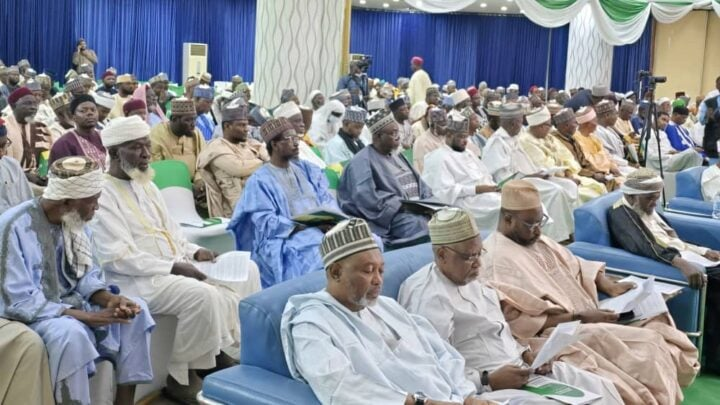
The Supreme Council for Shariah in Nigeria has formally rejected calls from some United States lawmakers urging the repeal of Sharia law in parts of Nigeria, describing the proposal as a misunderstanding of the country’s constitutional and religious framework.
In a statement issued by its leadership, the council maintained that Sharia operates within Nigeria’s constitutional structure and does not displace the authority of federal statutory law. It argued that external calls for repeal misrepresent the historical and legal context under which Islamic law functions in the country.
Stone Reporters note that Sharia law in Nigeria applies alongside statutory and customary legal systems in a plural legal arrangement that predates the country’s independence. While Islamic courts existed in northern regions during the pre-colonial and colonial eras, the modern expansion of Sharia into criminal jurisprudence occurred in 1999 when 12 northern states adopted it as part of their legal codes following Nigeria’s return to democratic rule.
Those states include Zamfara, Kano, Katsina, Sokoto, Kebbi, Jigawa, Yobe, Borno, Bauchi, Gombe, Kaduna, and Niger. In these jurisdictions, Sharia courts primarily handle matters involving Muslims, particularly in areas such as family law, inheritance, marriage, and certain criminal offences defined under Islamic jurisprudence. Non-Muslims are generally subject to statutory courts unless they voluntarily choose Sharia adjudication in civil matters.
The controversy intensified after some members of the United States Congress raised concerns about alleged persecution of Christians in Nigeria and linked those claims to the existence of Sharia-based legal systems in northern states. Advocacy groups in the US have urged stronger diplomatic pressure, including potential policy actions, arguing that religious freedom protections are being undermined.
The Nigerian federal government has consistently rejected claims that Sharia law amounts to institutionalised persecution. Officials have maintained that Nigeria remains a secular state under its constitution and that the adoption of Sharia by individual states is permitted within the framework of federalism, provided it does not contravene constitutional safeguards.
Stone Reporters note that Section 38 of Nigeria’s 1999 Constitution guarantees freedom of thought, conscience, and religion, including the right to manifest and propagate religious beliefs. At the same time, the constitution allows states to establish Sharia courts of appeal to handle Islamic personal law matters.
Legal scholars argue that the debate reflects broader tensions between international human rights advocacy and domestic interpretations of religious autonomy. Critics of Sharia’s criminal provisions cite high-profile cases from the early 2000s involving corporal punishments that drew global attention. Supporters contend that due process safeguards and appellate reviews within Nigeria’s judicial system have prevented the enforcement of extreme penalties in most controversial cases.
The Sharia Council’s statement emphasised that Nigeria’s judiciary, including the Supreme Court of Nigeria, retains ultimate authority over constitutional interpretation and that Sharia court decisions remain subject to appellate review within the national judicial hierarchy. The council argued that this structure ensures that fundamental rights are protected under federal law.
Stone Reporters note that the issue of religious freedom in Nigeria is complex and multifaceted, often shaped by regional security challenges, communal conflicts, and competition over land and political representation. Analysts caution against reducing sectarian violence or insecurity solely to the existence of Sharia courts, pointing instead to socioeconomic drivers, armed insurgency, and criminal banditry affecting both Muslim and Christian communities.
In recent years, international human rights organisations have documented violence affecting multiple religious groups across different parts of Nigeria, particularly in the Middle Belt region. The federal government has responded by attributing much of the violence to terrorism, banditry, and resource-based conflicts rather than state-sponsored religious discrimination.
The intervention by US lawmakers comes amid broader diplomatic engagement between Washington and Abuja on security cooperation, counterterrorism, and religious freedom monitoring. Nigeria has previously been placed on and removed from watchlists related to religious freedom concerns, reflecting fluctuating assessments within US policy frameworks.
Stone Reporters note that calls for repeal of Sharia law face significant constitutional and political hurdles. Any attempt to abolish Sharia in states where it has been adopted would require legislative action at the state level and would likely provoke strong resistance from local constituencies that view the system as integral to their religious identity.
As the debate continues, the Sharia Council has urged dialogue based on mutual respect and constitutional understanding, while Nigerian authorities reiterate that religious pluralism remains embedded within the country’s legal architecture.
The development underscores ongoing tensions between domestic legal sovereignty and external human rights advocacy, as Nigeria navigates complex questions surrounding faith, governance, and federal constitutional balance.
📩 Stone Reporters News | 🌍 stonereportersnews.com
✉️ info@stonereportersnews.com | 📘 Facebook: Stone Reporters | 🐦 X (Twitter): @StoneReportNew | 📸 Instagram: @stonereportersnews
Add comment
Comments