

Reported by: Ijeoma G | Edited by: Jevaun Rhashan
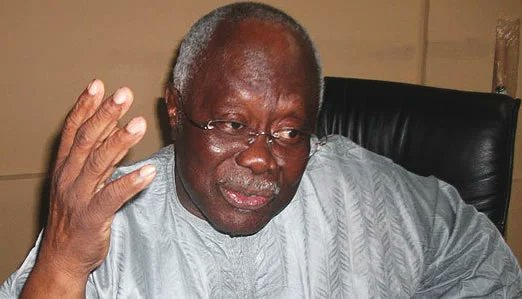
In a sharp escalation of political rhetoric ahead of the 2027 general elections, Chief Olabode “Bode” George, a senior chieftain of Nigeria’s main opposition party, the Peoples Democratic Party (PDP), issued a stark forecast that economic hardship and widespread dissatisfaction among Nigerians could produce an unforeseen political shock in the next national polls. The message from George underscores growing tensions between the opposition and the ruling All Progressives Congress (APC) as election season draws nearer, with hunger, governance, and electoral integrity at the centre of public discourse.
Speaking at the inauguration of new PDP leaders in Lagos on Friday, George framed his comments around the severe cost of living pressures confronting ordinary Nigerians — particularly the rising cost of food, fuel, and basic services — and warned that continued hardship under the APC’s watch could translate into political consequences that would surprise many in the ruling establishment. He explicitly told the APC and the Independent National Electoral Commission (INEC) that the electorate had been pushed to the brink, and if electoral processes are manipulated in 2027, “Nigerians will shock them.”
George described the ruling party as a “coalition of strange bedfellows” whose internal dysfunction and policy decisions have eroded public trust and inflicted hardship on millions of citizens. The statement reflects broader tensions over recent economic reforms — including fuel subsidy removal, foreign exchange liberalisation, and fiscal restructuring measures — which government officials argue are necessary for long-term stability but which opponents say have exacerbated short-term suffering.
At the same event, George underlined what he termed a “rebirth” of the PDP following its national convention in Ibadan in November 2025, insisting that the party has reoriented itself and regained confidence after years in opposition. He implied that this repositioning has strengthened the PDP’s appeal across Nigeria, and that it is poised to capitalise on the electorate’s frustration with the APC’s governance record, aiming to reclaim power at the centre in the 2027 elections.
Part of George’s broader message included a defence of internal party democracy within the PDP. He contrasted this with what he described as less transparent leadership selection processes in the APC, alleging imposition of key officials and undue influence on election outcomes. He warned that any attempt to leverage state institutions — including the electoral commission — against opposition parties would be met with resistance and would further inflame public resentment.
The former military governor and seasoned political figure blended his election forecast with historical references, evoking Nigeria’s past political crises to warn against undermining democratic norms. He claimed that abuses of electoral processes could provoke backlash not only electorally but socially, should democratic mechanisms be perceived as illegitimate — a subtle allusion to the potential for instability when citizens feel disenfranchised.
George’s remarks are not happening in isolation. They come amid broader jockeying among Nigeria’s political elite as parties position themselves for the high-stakes 2027 cycle. The opposition landscape has been fluid, marked by defections, realignments, and efforts to build coalition platforms that can challenge the APC’s dominance. For example, deep divisions within the PDP earlier prompted former Vice President Atiku Abubakar to leave the party and lead a coalition under the African Democratic Congress (ADC), a move seen by some analysts as an attempt to transform Nigeria’s political equation through a broader opposition front.
Moreover, high-profile figures such as former Labour Party presidential candidate Peter Obi have also shifted to alternative platforms like the ADC, signalling that opposition forces are reconfiguring in response to public appetite for change. These developments illustrate the uncertainty and fragmentation that characterise Nigerian politics ahead of 2027, even as economic hardship features prominently in popular sentiment.
The economic context in which George’s warning is issued cannot be separated from broader structural challenges facing Nigeria. The country has battled persistent inflation, a weakened currency, and constrained public revenues even as it copes with infrastructure deficits, insecurity, and high unemployment. These conditions have fuelled public dissatisfaction and created fertile ground for political contestation over the direction of policy and governance. Although government officials say reforms are necessary to stabilise the economy and restore investor confidence, critics argue that their pace and sequencing have inflicted undue hardship, particularly on low- and middle-income Nigerians who struggle to meet basic needs.
On the question of electoral integrity, George’s invocation of potential “shock” at the ballot box carries an implicit critique of the APC’s stewardship of Nigeria’s democratic institutions. Concerns about election fairness and transparency have long shadowed Nigerian politics, with critics alleging that incumbent powers often leverage state resources, security agencies, and institutional influence to tilt outcomes in their favour. George’s appeal to popular will and resistance to manipulation taps into these anxieties, appealing to citizens’ sense of agency and democratic rights.
Government response to George’s comments, as of now, has largely been muted in public media, though ruling party figures have in other contexts dismissed opposition critiques as opportunistic or overly dramatic. APC officials typically attribute economic difficulties to inherited structural deficits and global economic pressures, while defending policy choices as necessary for long-term prosperity. They have also characterised opposition rhetoric as part of routine political contestation in a vibrant democracy rather than an accurate reflection of public sentiment.
Political analysts observing the unfolding dynamics note that while economic grievances may indeed influence voter behaviour, elections in Nigeria are shaped by complex variables including ethnic and regional alignments, party structures, security conditions, and institutional credibility. The interplay between these forces will determine whether George’s predicted “shock” materialises as a significant shift in electoral outcomes or remains a rhetorical device in the broader contest between Nigeria’s major parties.
Regardless of whether the APC secures another term in 2027, Bode George’s pronouncements underscore the centrality of economic conditions and popular perceptions in the political narrative. They also reflect an intensifying battle for legitimacy and influence as Nigeria prepares for what promises to be one of its most consequential elections in recent memory.
📩 Stone Reporters News | 🌍 stonereportersnews.com
✉️ info@stonereportersnews.com | 📘 Facebook: Stone Reporters | 🐦 X (Twitter): @StoneReportNew | 📸 Instagram: @stonereportersnews
Add comment
Comments