

Reported by: Ijeoma G | Edited by: Gabriel Osa
CALABAR, Cross River State — A deadly road accident along the Calabar–Itu Federal Highway has claimed the life of a truck driver and left others injured, prompting renewed calls from road users and residents for urgent rehabilitation of the deteriorating corridor that links Cross River and Akwa Ibom states.
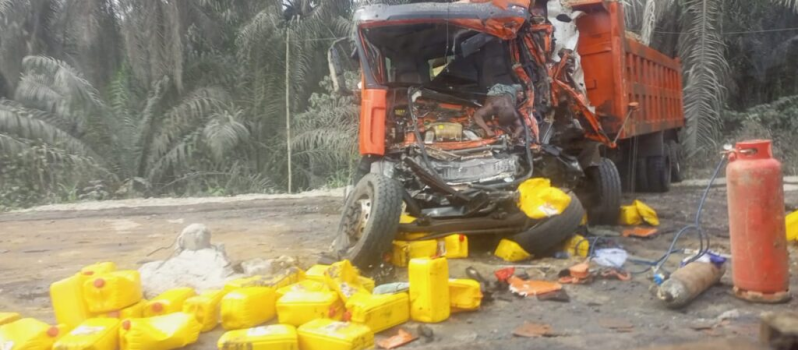
The collision occurred in the early hours of Monday, March 2, 2026, when two articulated trucks collided head-on on a stretch of highway widely criticised for its poor surface condition. Eyewitnesses said the route — afflicted by deep potholes, failed pavement sections and extensive gullies — made control difficult for heavy vehicles even at modest speeds. Many locals and motorists have repeatedly highlighted the stretch as one of the most hazardous sections of federal road in the South-South region, saying it has deteriorated significantly over years of delayed or ineffective maintenance.
According to residents present at the scene, one truck was laden with stones while the other was transporting jerricans of palm oil when the collision occurred. Neither vehicle appeared to be speeding, but the truck carrying stones reportedly swerved because of the uneven surface and sunk portions of the road, veering into the path of the oncoming palm oil truck. The impact was severe, crushing the front of the latter vehicle and resulting in the immediate death of its driver at the scene. Several others travelling in or near the vehicles sustained injuries and were treated at nearby health facilities, though authorities have not yet released comprehensive casualty figures or identities of those affected.
Motorists and bystanders who witnessed the crash described chaotic scenes as rescue efforts were mounted. “The driver driving the stone truck lost control because of how broken the road is. He didn’t look like he was rushing,” one eyewitness told reporters, calling on government agencies to accelerate rehabilitation works along the highway to stem further loss of life. Others said they had regularly encountered dangerous potholes and uneven terrain on the route, particularly during the wet season when depressions fill with water and become hidden hazards.
The Federal Road Safety Corps (FRSC) Cross River Sector Command confirmed the crash and said officers were deployed promptly to the scene to clear wreckage, evacuate the deceased’s remains and restore traffic flow. FRSC officials expressed sympathy for the driver’s family and emphasised the need for road users to exercise caution on poorly maintained corridors. However, the agency did not offer a preliminary official cause of the crash beyond urging vigilance and compliance with safety regulations.
The Calabar–Itu Highway, a key federal transport artery facilitating commerce and movement between Cross River and Akwa Ibom states, has been under prolonged and piecemeal rehabilitation for several years. Despite periodic announcements from the Federal Ministry of Works and contractors about ongoing repairs, many stretches remain compromised, with sections appearing worse after temporary patchwork than before. A 2024 infrastructure review highlighted that this and several other highways in the Niger Delta region had been rendered “dangerous and impracticable” by cumulative potholes and structural failures that made travel challenging and risk-laden for heavy goods vehicles and passenger traffic alike.
Local transport unions and community leaders have consistently decried the slow pace of substantive reconstruction, arguing that repeated surface failures create an environment ripe for accidents, vehicle damage and economic losses. Commerce groups in cross-border trade have warned that continued neglect could discourage freight movement along the corridor, affecting regional supply chains that depend on the highway for distribution of agricultural produce, manufactured goods and daily essentials.
In response to chronic infrastructure challenges, some stakeholders point to alternative long-term projects such as the Lagos–Calabar Coastal Highway, which federal authorities have indicated is slated for phased opening and commissioning. While the broader coastal corridor aims to provide a durable route linking multiple southern states and reduce traffic pressure on inland roads, the immediate safety of existing federal highways like Calabar–Itu remains a pressing concern for daily commuters, commercial drivers and communities that rely on them.
For now, families of the deceased and injured are left grappling with the human cost of the crash, while motorists continue to navigate one of Nigeria’s most troubled federal road links. Advocacy groups and road safety analysts urge comprehensive reconstruction rather than temporary patching, and call for transparent project timelines, stricter supervision of repair works, and expanded enforcement of traffic and safety protocols on major highways countrywide.
📩 Stone Reporters News | 🌍 stonereportersnews.com
✉️ info@stonereportersnews.com | 📘 Facebook: Stone Reporters | 🐦 X (Twitter): @StoneReportNew | 📸 Instagram: @stonereportersnews
Add comment
Comments