

Reported By Mary Udezue | Edited by: Gabriel Osa
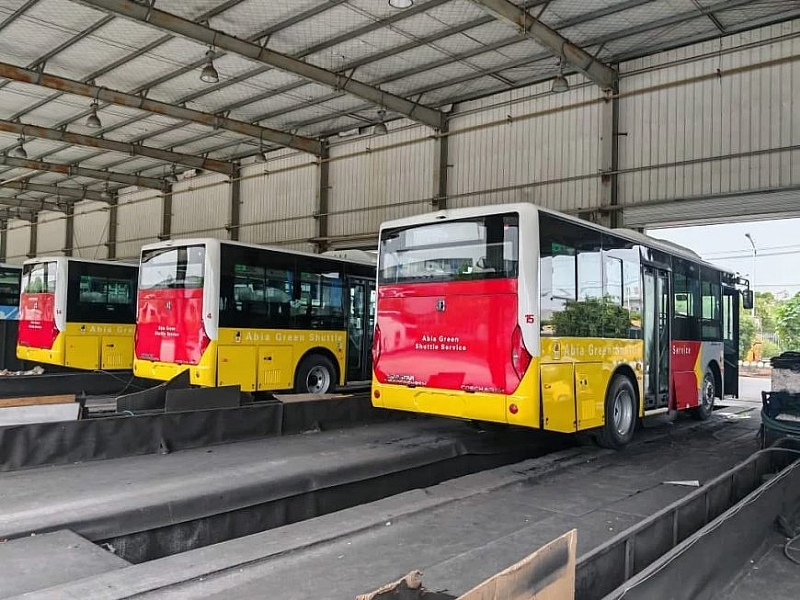
Authorities in Abia State are intensifying public education efforts after a commuter caused a notable scene at a government-backed Green Electric Bus boarding point by attempting to board without the mandated identification card required under the state’s new transit policy. The incident exposed confusion among some residents about the nature of the programme and its underlying payment and registration system as officials work to transition from early rollout to full implementation.
The Abia Green Electric Bus initiative was launched in late 2025 as part of Governor Alex Otti’s plan to modernise public transport and promote sustainable mobility. As the state rolls out hundreds of electric buses on intra-city and inter-city routes, authorities have introduced a cashless payment system known as the Abia Connect Card. The card, which residents must collect after verifying their identity through the ABSSIN social identification framework, is intended to streamline fare collection, reduce cash handling, and support efficient management of the transport network.
According to officials and eyewitnesses at the boarding point, the confrontation unfolded when a male commuter rushed toward a bus without presenting his ABSSIN–linked Abia Connect Card. State staff assisting with commuter registration and card issuance requested that he show valid identification. The man challenged the requirement, insisting that the buses were “free” based on earlier government announcements and threatening to report the operators if he was denied boarding.
Transport officials clarified that although the Green Electric Bus service began with a familiarisation phase in which some trips were offered free of charge, the introduction of the cashless Abia Connect Card and ABSSIN verification is now a necessary condition for boarding and payment. They explained that the card system links the commuter to the state’s digital payment platform and ensures accurate fare deductions and service tracking.
Under the Abia Connect framework, residents without an ABSSIN number — a state-level social identity credential — must complete registration through the Abia Pay portal or authorised enrolment centres in order to receive the free Green Shuttle card. Commuters then load funds onto the card to pay for rides, which are automatically debited on boarding. Fare rates announced by the government indicate subsidised but structured fees for different routes, a departure from the initial free-ride period.
Observers say the confusion that fuelled the confrontation may have arisen from mixed messaging during the initial launch period. Early rollout materials emphasised free access to familiarise residents with the system — an approach that helped promote the service but also generated expectations that traditional fare-free travel would continue indefinitely. As the programme shifts to a sustainable payment model, officials are seeking to clarify that “free” refers only to the initial introductory phase and not to a permanent fare exemption.
The ABSSIN policy itself goes beyond transport, forming part of a broader Abia State social identification system that authorities intend to use for targeted service delivery and programme eligibility checks. The ABSSIN number is now required not only for the Green Electric Bus scheme but also for other government-supported services where resident verification is necessary. Government sources have indicated that the ABSSIN system is part of a comprehensive effort to modernise public service access across health, welfare and transportation sectors.
Officials at the scene reported that the commuter was counselled on the need to comply with the identification requirement and was advised either to present his ABSSIN card or to pursue alternative transport options. Although the situation created a brief disruption, it was resolved without escalation, and other buyers continued to board buses as normal. Those present described the interaction as a learning moment that underlined the need for more robust communication about policy changes and enforcement.
In response to the incident, state authorities have pledged to increase public sensitisation campaigns to ensure that all residents understand how to obtain and use the Abia Connect Card and ABSSIN registration. Officials said mobile registration centres will be deployed to markets, motor parks and community centres to accelerate enrolment. They also stressed that there should be no cost barriers to acquiring the necessary documentation, with the first Abia Connect Card issued free of charge.
Local transport experts note that transitions to cashless systems often meet resistance when commuters are accustomed to informal arrangements or cash fares. They say clear, ongoing information campaigns are essential to prevent misunderstandings that could slow adoption or inadvertently create conflict at boarding points. Observers also underscore the importance of aligning digital payment requirements with citizens’ access to digital tools and financial services, especially among populations with limited banking infrastructure.
Civic groups in Abia have welcomed the state’s efforts to modernise transport but echo calls for enhanced communication and community outreach. They argue that while electronic fare systems can improve efficiency and transparency, they must be introduced in ways that minimise exclusion and frustration among commuters who are still adapting to new procedures.
State officials say the long-term goal of the Green Electric Bus programme is to deliver reliable, affordable and environmentally friendly public transport that meets the needs of Abia’s growing urban and inter-urban population. They emphasise that the success of the system depends on cooperation between government agencies and residents, backed by clear guidance on policy requirements and benefits.
The episode at the boarding point has thus become a catalyst for renewed efforts to strengthen public understanding of the Green Electric Bus policies, including the role of the ABSSIN card in ensuring efficient, equitable access to the state’s modernised transport network.
📩 Stone Reporters News | 🌍 stonereportersnews.com
✉️ info@stonereportersnews.com | 📘 Facebook: Stone Reporters | 🐦 X (Twitter): @StoneReportNew | 📸 Instagram: @stonereportersnews
Add comment
Comments