

Reported by: Oahimire Omone Precious | Edited by: Gabriel Osa
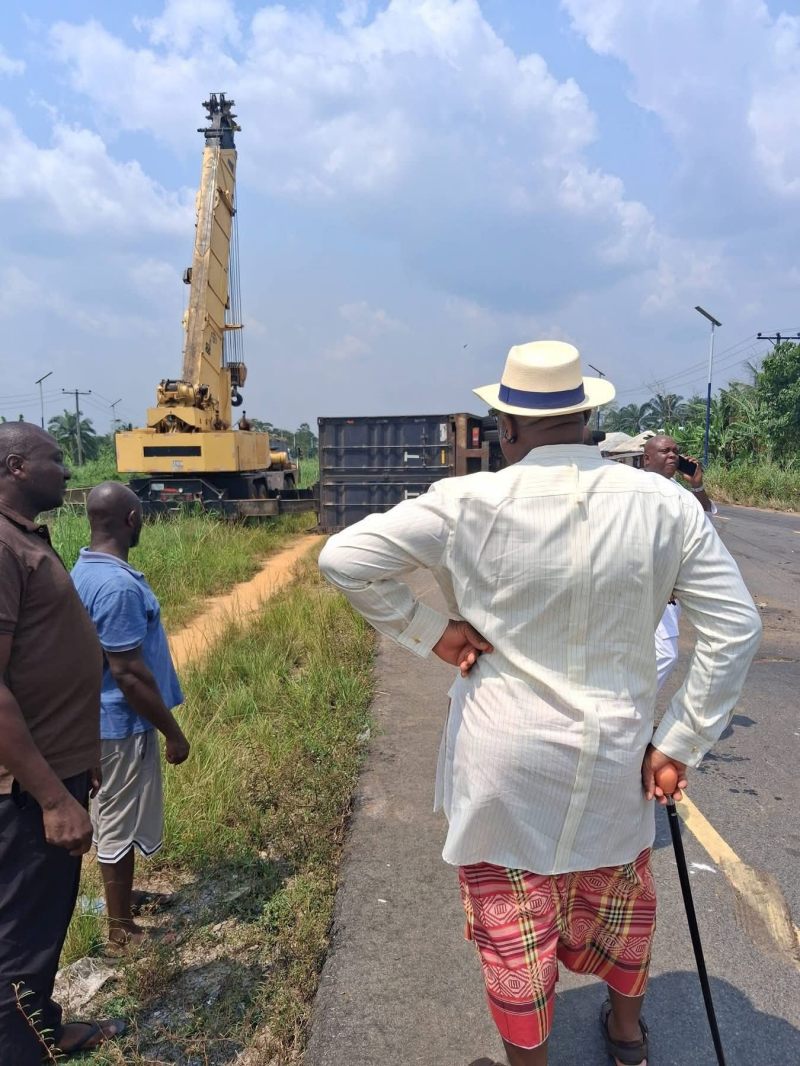
The Chairman of Emohua Local Government Area, Chidi Lloyd, on Saturday personally supervised the evacuation of a failed heavy-duty truck along the Rundele axis of the East‑West Road (Nigeria) in Emohua.
The truck had broken down while in motion several days earlier, creating a partial barricade on a critical section of the federal highway. The obstruction forced motorists to improvise dangerous traffic arrangements, including the use of one-way movement on portions of the road. The situation generated serious safety concerns for commuters, residents, and students around the vicinity of the Ignatius Ajuru University of Education, particularly those accessing the Ndele campus area.
Reports indicated that despite the passage of several days after the truck failure, relevant emergency or road maintenance agencies had not responded to remove the obstruction. The lack of immediate intervention heightened frustration among road users and community members who depend heavily on the highway for transportation and commercial movement.
Disturbed by the development, Lloyd reportedly adjusted his personal schedule on Saturday to address the situation. Local government officials mobilised technical personnel and equipment needed to safely move the abandoned heavy-duty vehicle away from the traffic corridor.
The evacuation operation was carried out in collaboration with local road safety and mechanical response teams engaged by the council administration. Workers carefully assessed the position of the failed truck before initiating towing and clearing procedures to avoid additional damage to the roadway or surrounding infrastructure.
Witnesses along the Rundele axis observed that traffic had been experiencing periodic congestion since the breakdown occurred. Commercial drivers, private motorists, and motorcycle operators were among the most affected groups, as the obstruction reduced the functional width of the highway and increased travel time for commuters.
Residents in communities surrounding the highway expressed relief following the evacuation exercise. Many locals said the abandoned truck had become a source of anxiety, particularly during nighttime travel when visibility was low. Some community members feared that the obstruction could lead to accidents involving speeding vehicles or pedestrians attempting to navigate around the blockade.
The East-West Road remains one of the most strategically important transportation corridors in southern Nigeria, linking several oil-producing states and serving as a major route for inter-state commerce. Over the years, the highway has faced challenges including road deterioration, heavy traffic load, and delayed maintenance interventions from responsible federal agencies.
Transportation analysts have repeatedly warned that unattended vehicle breakdowns along major highways can create secondary safety risks beyond traffic congestion. Such risks include rear-end collisions, night-time accidents, and opportunistic criminal activity exploiting poorly lit or obstructed road sections.
Local government authorities in Emohua said the decision to personally supervise the evacuation reflected the administration’s commitment to protecting residents and ensuring the free flow of transportation within the area. Officials described the intervention as a rapid response to a public safety emergency rather than a routine administrative exercise.
Community leaders within Emohua Local Government Area commended the chairman’s action, arguing that the prompt evacuation helped prevent possible road accidents and reduced hardship for commuters who rely on the highway for daily movement.
Some residents, however, used the incident to renew calls for stronger institutional maintenance of federal roads. They argued that local government authorities often bear the burden of emergency responses even though highway maintenance is primarily the responsibility of federal agencies.
Transportation stakeholders have suggested that establishing permanent roadside emergency response units along major highways could help address similar incidents faster. Such units would ideally be equipped with towing vehicles, warning sign systems, and trained personnel capable of handling heavy vehicle breakdowns without prolonged traffic disruption.
Road safety experts also emphasized the importance of regular mechanical inspection of commercial trucks operating on long-distance routes. Poor maintenance of heavy-duty vehicles is widely regarded as one of the contributing factors to sudden highway breakdowns across Nigeria.
Motorists who spoke after the evacuation expressed appreciation that the road had been cleared. Commercial drivers said the obstruction had forced them to spend additional fuel navigating alternative routes or waiting for safe passage around the blocked section.
Students and staff travelling to the Ndele campus of the university also welcomed the intervention, saying the cleared road improved safety for academic activities and reduced commuting stress.
The evacuation operation concluded with the removal of the failed truck from the highway corridor and restoration of near-normal traffic movement along the Rundele axis. Local officials said monitoring would continue temporarily to ensure that no residual obstruction or mechanical debris remained on the road.
While the immediate crisis was resolved, community members and transport operators urged authorities to implement preventive measures to avoid similar incidents in the future. Suggestions included installing emergency breakdown zones along strategic highway sections and strengthening collaboration between road agencies and local governments.
Stone Reporters note that the intervention by the Emohua Local Government chairman reflects the growing expectation that local authorities should play active roles in emergency public safety management, especially where federal infrastructure intersects with community life. The incident also underscores the persistent challenge of maintaining safe transportation corridors in Nigeria, where infrastructure pressure and administrative fragmentation often complicate rapid response to roadside emergencies.
📩 Stone Reporters News | 🌍 stonereportersnews.com
✉️ info@stonereportersnews.com | 📘 Facebook: Stone Reporters | 🐦 X (Twitter): @StoneReportNew | 📸 Instagram: @stonereportersnews
Add comment
Comments