

Reported by: Ijeoma G | Edited by: Carmen Diego
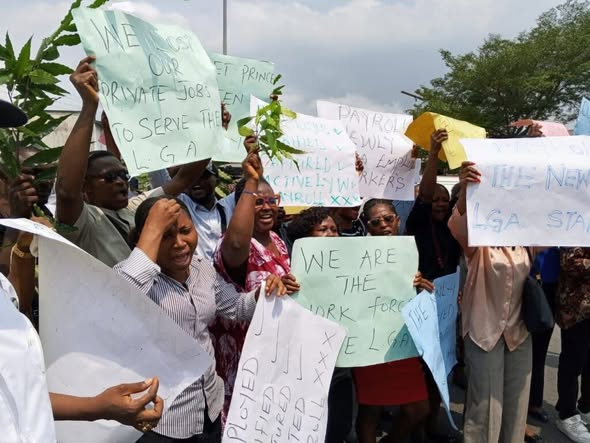
Local government workers in Nigeria’s Cross River State staged a protest in Calabar after months of unpaid salaries, highlighting deepening labour tensions and economic hardship among civil servants who say they have been working without pay for most of the past year. The demonstration, which took place outside the office of Governor Bassey Otu, brought together dozens of employees under the Cross River State Unified Local Government Service Commission who say they have been owed wages for up to nine months.
The workers gathered at the governor’s office carrying placards and chanting slogans demanding immediate payment of their salaries. Many said they had continued reporting for duty despite not receiving wages since late 2025, describing the situation as unsustainable for workers and their families. According to those who participated in the protest, the prolonged delay has created severe financial strain, with some employees struggling to afford food, transportation and school fees for their children.
In a formal letter submitted during the protest, the workers explained that many of them were recruited through the Local Government Service Commission and had fulfilled their professional responsibilities since their appointments. They said they had been reporting to their duty posts regularly but had not been placed on the government payroll system, leaving them without salaries for months.
“We have been faithfully serving the state,” one section of the letter stated, explaining that the workers had continued performing their duties despite the absence of wages. The protesters said the delay had become a “source of severe hardship” that was pushing many families toward financial crisis.
The protest follows earlier warnings by civil servants who had threatened to picket the office of the state’s Accountant-General over the unresolved salary issue. Several employees told reporters that repeated complaints to government offices had produced little progress. They said the decision to protest publicly was taken after months of silence from authorities responsible for payroll administration.
Workers also alleged that the payment process appeared inconsistent, claiming that some employees in certain ministries had received their salaries while others had not. One civil servant, Dorcas Obi, said the situation created suspicion that the payment system was selective. She explained that while some colleagues in her ministry had been paid, others remained unpaid despite working under the same conditions.
Another worker, Moses Effiong, said employees had repeatedly approached the Accountant-General’s office for clarification but received no satisfactory explanation. According to him, the absence of clear communication had deepened frustration among workers who felt abandoned by the government they serve.
The state government, however, has provided a different explanation for the salary delays. Cross River State Accountant-General Glory Effiong acknowledged that some workers had not received payments but said the issue was linked to administrative verification processes rather than deliberate withholding of wages. She explained that salaries are only processed after ministries submit verified nominal rolls containing accurate staff information.
Effiong said the government introduced stricter verification measures to address absenteeism and ensure that only legitimate employees receive payment. According to her, the process requires permanent secretaries to submit updated staff lists before salary processing can occur. She argued that delays in submitting these documents by some ministries contributed to the salary backlog.
The accountant-general also insisted that the majority of workers had already been paid. She stated that out of roughly 15,000 workers involved in the verification exercise, about 14,000 had received their salaries. The remaining employees, she said, would be paid once the required documentation was submitted and verified by the payroll office.
Despite the government’s explanation, many workers remain dissatisfied. Some protesters argue that the administrative verification process should not result in months of unpaid wages, especially for employees who continue to perform their duties. Labour advocates say such delays undermine workers’ morale and violate basic labour standards that guarantee compensation for services rendered.
The protest in Calabar also reflects broader concerns about salary delays within parts of Nigeria’s public sector. In Cross River State itself, other groups—including forest guards and university staff—have previously complained about prolonged wage delays, suggesting systemic challenges in payroll management and funding within the state government.
Economic pressures have intensified the impact of the salary dispute. Nigeria has faced rising living costs in recent years, making regular income critical for civil servants who rely almost entirely on monthly wages. Workers say that without consistent salary payments, they are forced to rely on loans, informal borrowing or family support to survive.
The situation has also raised concerns among labour unions and civil society groups. Some labour activists warn that prolonged salary arrears can lead to larger labour disputes, including strikes and disruptions in local government services. They argue that timely payment of wages is essential not only for workers’ welfare but also for maintaining efficient public administration.
During the protest, workers appealed directly to Governor Bassey Otu to intervene personally in resolving the issue. They urged the state government to expedite the payroll verification process and ensure that all affected employees are paid immediately. Protesters said their goal was not confrontation but recognition of their right to fair compensation for their work.
For now, the workers say they remain hopeful that their demonstration will prompt swift action. Many insist that they are willing to continue serving the state but cannot endure indefinite delays in payment.
The unfolding dispute highlights a recurring challenge within parts of Nigeria’s public sector, where bureaucratic verification procedures, payroll irregularities and budget constraints sometimes combine to delay workers’ wages. Whether the Cross River State government resolves the crisis quickly could determine whether tensions ease or escalate into broader labour unrest in the months ahead.
📩 Stone Reporters News | 🌍 stonereportersnews.com
✉️ info@stonereportersnews.com | 📘 Facebook: Stone Reporters | 🐦 X (Twitter): @StoneReportNew | 📸 Instagram: @stonereportersnews
Add comment
Comments