

Reported by: Oahimire Omone Precious | Edited by: Oravbiere Osayomore Promise.
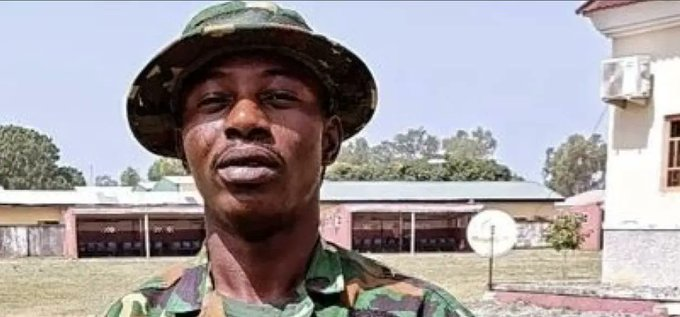
A dismissed Nigerian soldier, Lance Corporal Rotimi Olamilekan, has intensified a growing public controversy over military welfare after challenging the Nigerian Army to release its official payroll records to verify his claims about low salaries and inadequate provision of essential equipment.
Olamilekan, widely known as “Soja Boi,” has become the centre of a nationwide debate following a viral interview and subsequent online disclosures in which he alleged that soldiers in active service face difficult financial conditions and are often required to purchase their own uniforms and protective gear. His latest statement, urging the Army to “release your payroll if I’m lying,” has further escalated tensions between him and military authorities.
The dispute began after Olamilekan appeared on a widely circulated podcast, where he spoke candidly about his experience as a serving soldier, including his remuneration and working conditions. According to him, his earnings before a salary adjustment in 2025 were significantly low, and even after the increase, his monthly income remained modest relative to the demands of military service. He claimed his last salary before dismissal ranged between about ₦109,000 and ₦111,000, while earlier earnings were far lower, creating financial strain for personnel deployed in high-risk environments.
He further alleged that soldiers often bear the cost of essential items required for duty, including uniforms, boots, helmets, and other protective equipment. In his account, the cost of such items could equal or exceed a soldier’s monthly salary, forcing many to make difficult financial decisions. He also suggested that some protective gear was not consistently available, particularly in operational areas, except during high-level visits or inspections.
In a bid to substantiate his claims, Olamilekan released what he described as payment alerts and payslips reflecting his earnings during his time in service. He maintained that his intention was not to discredit the Nigerian Army but to present factual evidence of systemic issues affecting rank-and-file soldiers. He also encouraged Nigerians to verify his claims by speaking directly with friends or relatives currently serving in the military.
His challenge to the Army to publicly disclose its payroll structure has become a focal point of the controversy, raising broader questions about transparency and accountability within the armed forces. However, the authenticity of the documents he presented has not been independently verified, and some reports indicate that the transaction details do not clearly identify the Nigerian Army as the source of the payments.
The Nigerian Army has strongly rejected Olamilekan’s allegations, describing them as false, misleading, and potentially harmful to morale and public confidence. In multiple official statements, the Army insisted that it operates a structured and transparent salary system governed by established regulations, including the Manual of Financial Administration for the Armed Forces of Nigeria.
According to military authorities, soldiers receive salaries based on rank and years of service, along with various allowances, including uniform, ration, and operational allowances. These payments, the Army said, are made directly to personnel and are designed to ensure their welfare both in barracks and in active deployment.
The Army also categorically denied claims that soldiers are required to purchase their own uniforms or protective gear. It stated that all necessary equipment, including helmets, bulletproof vests, and uniforms, is provided through official logistics channels before deployment. While acknowledging that some personnel may choose to acquire additional items for personal comfort, the Army emphasized that such decisions are voluntary and do not reflect institutional shortcomings.
Addressing the circumstances surrounding Olamilekan’s dismissal, the Army maintained that his removal from service was due to repeated acts of indiscipline rather than his public statements. Officials cited violations of the Armed Forces’ social media policy, unauthorized media appearances, and misuse of military identity as key reasons for his discharge, stressing that due process was followed in line with military law.
The controversy has triggered mixed reactions across Nigeria, with some members of the public expressing support for the former soldier’s claims and calling for greater transparency and improved welfare for troops. Others have urged caution, noting that the claims originate from a dismissed serviceman and may not fully represent the experiences of all personnel.
The issue has also drawn attention to longstanding concerns about the welfare of Nigerian soldiers, particularly those deployed in conflict zones such as the northeast, where troops are engaged in counterinsurgency operations against armed groups. Analysts say the demands of such operations place significant pressure on personnel, making issues of pay, equipment, and overall welfare critical to both morale and effectiveness.
Olamilekan first gained widespread attention earlier in 2026 after posting a video urging political leaders to send their children to join the military, arguing that such exposure would help them understand the realities faced by soldiers. He was subsequently arrested and later dismissed from service, a sequence of events that has contributed to public interest in his claims and allegations.
Despite the Army’s firm rebuttal, the former soldier has continued to defend his position, insisting that his statements reflect the lived experiences of many within the ranks. His demand for the publication of payroll records has not been addressed directly by military authorities, leaving a key aspect of the dispute unresolved.
As the situation continues to unfold, it underscores a broader tension between institutional authority and calls for transparency in matters affecting public institutions. While the Nigerian Army maintains that its systems are adequate and its personnel properly cared for, the persistence of the debate suggests that concerns about welfare and accountability remain deeply rooted in public discourse.
For now, both sides remain entrenched in their positions, with the Army defending its record and Olamilekan standing by his claims. Whether the controversy will prompt further investigation or reforms remains uncertain, but it has already reignited national attention on the conditions under which Nigerian soldiers serve and the importance of trust between the military and the public it protects.
📩 Stone Reporters News | 🌍 stonereportersnews.com
✉️ info@stonereportersnews.com | 📘 Facebook: Stone Reporters News | 🐦 X (Twitter): @StoneReportNew | 📸 Instagram: @stonereportersnews
Add comment
Comments