

Reported by: Oahimire Omone Precious | Edited by: Oravbiere Osayomore Promise.
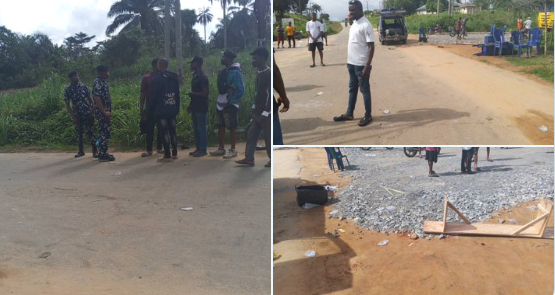
A protest by youths in Mkpat Enin Local Government Area of Akwa Ibom State over the condition of the Ikot Akpaden–Ibekwe road has drawn wider attention following reports of disruption by security operatives and claims that the demonstration was infiltrated by individuals with ulterior motives.
Mkpat Enin, one of the largest local government areas in the state and a key part of the Ikot Abasi/Mkpat Enin/Eastern Obolo federal constituency, is a strategically important region with strong economic ties to agriculture, oil and gas, and local trade networks. The Ikot Akpaden axis, in particular, hosts part of the Akwa Ibom State University and serves as a major link road connecting several communities within the LGA and beyond. The deteriorating condition of roads in the area has long been a source of concern among residents.
According to multiple local accounts, the protest began as a peaceful gathering of youths and community members seeking urgent government intervention on the road, which they say has become increasingly difficult to use. Residents reportedly complained about rising transportation costs, delays in moving goods, and the broader economic impact of poor infrastructure on rural livelihoods. Farmers and traders in the area have been among the hardest hit, as the road plays a critical role in moving produce to markets within and outside the state.
Eyewitnesses indicate that the protest initially maintained a calm and organised structure, with demonstrators carrying placards and voicing their demands without reported incidents of violence. Participants say the demonstration was intended to draw the attention of both the state government and relevant agencies to the urgency of fixing the road, which they argue has been neglected for too long despite its economic importance.
However, as the gathering progressed, some participants alleged that unfamiliar individuals joined the protest and began to steer its direction away from its original focus. Community sources claim that these individuals introduced actions and rhetoric that heightened tensions and created confusion among protesters, raising fears that the demonstration could spiral out of control.
While the exact identity and motives of those alleged to have hijacked the protest remain unclear, local observers note that such incidents are not uncommon in loosely organised public demonstrations. Without a centralised leadership structure, protests can become vulnerable to infiltration by individuals seeking to exploit the situation for unrelated purposes, thereby undermining the credibility of the original cause.
Concerns over the potential escalation appear to have prompted intervention by security authorities. Reports indicate that the Divisional Police Officer in the area, accompanied by other security personnel, moved to disperse the protest, citing the absence of prior notification or official authorisation.
Security officials reportedly insisted that public gatherings of that nature require advance notice to law enforcement agencies, a position consistent with standard policing procedures in many parts of the country. According to accounts from the scene, officers urged protesters to vacate the area and restore normal activities, warning that failure to comply could lead to further action.
The police intervention has since generated mixed reactions within the community. Some residents argue that the authorities acted within their mandate to maintain public order and prevent possible unrest, particularly in light of the allegations that the protest had been compromised by external elements.
Others, however, have criticised the move, suggesting that it curtailed a legitimate expression of public grievance. They argue that the protest, at least in its initial stages, was peaceful and focused on a pressing developmental issue affecting thousands of residents. For these critics, the intervention reflects broader concerns about the handling of civic protests and the balance between security enforcement and constitutional freedoms.
Legal analysts point out that the regulation of public protests in Nigeria has long been a subject of debate. While authorities often require prior notification for security reasons, court rulings have emphasised citizens’ rights to peaceful assembly and expression. The practical application of these principles continues to vary, leading to differing interpretations in situations like the one in Mkpat Enin.
Despite the dispersal of the protest, the underlying grievances remain unresolved. Residents continue to express frustration over the state of the Ikot Akpaden–Ibekwe road, which they say has deteriorated significantly over time. Many have called for urgent intervention, including rehabilitation work and a clear timeline for completion.
At the local level, some efforts have reportedly been made to address infrastructure challenges through grading and minor repairs, but residents argue that these measures are insufficient for a road of such importance. The demand for a more comprehensive and lasting solution remains a central issue for the community.
The protest also reflects a broader pattern of youth engagement in governance and development issues in Akwa Ibom State. Young people are increasingly using peaceful demonstrations and other forms of civic participation to demand accountability and improved service delivery. This trend underscores a growing awareness of civic rights and a willingness to engage with authorities on matters affecting daily life.
Community leaders have called for calm and urged both protesters and authorities to prioritise dialogue as a means of resolving the dispute. They emphasise that while the grievances are legitimate, maintaining peace and order is essential to achieving meaningful outcomes.
Observers say the situation highlights the importance of proactive communication between government officials and local communities. Transparent updates on project status, funding, and timelines could help build trust and reduce the likelihood of protests escalating into confrontations.
For many residents, the events in Mkpat Enin serve as a reminder of the critical role infrastructure plays in economic and social development. Roads, in particular, are seen as lifelines for rural communities, influencing everything from trade and agriculture to access to education and healthcare.
As tensions gradually subside following the police intervention, attention is expected to shift toward how authorities respond to the concerns raised by the protesters. The effectiveness of this response may determine whether the situation stabilises or leads to further agitation.
The developments in Mkpat Enin also carry broader implications for how public protests are managed in the state and across Nigeria. Striking a balance between maintaining public order and respecting citizens’ rights remains a key challenge for authorities, especially in contexts where socio-economic grievances are deeply felt.
For now, residents continue to await concrete action on the Ikot Akpaden–Ibekwe road, as well as assurances that their voices have been heard. Whether these expectations will be met in the coming weeks remains to be seen, but the events have undoubtedly placed renewed focus on infrastructure and governance in the region.
📩 Stone Reporters News | 🌍 stonereportersnews.com
✉️ info@stonereportersnews.com | 📘 Facebook: Stone Reporters News | 🐦 X (Twitter): @StoneReportNew | 📸 Instagram: @stonereportersnews
Add comment
Comments