

Reported by: Ijeoma G | Edited by: Oravbiere Osayomore Promise.
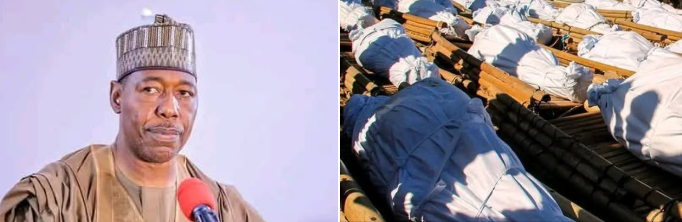
Governor of Borno State, Babagana Umara Zulum, has publicly expressed support for a recent military airstrike on Jilli market, stating that the location had long been abandoned and allegedly used as a hideout by Boko Haram insurgents who operated in the area and planned attacks from it, according to remarks attributed to him in Maiduguri.
The governor’s position comes amid renewed debate over military operations in parts of the North-East, where Nigerian forces have intensified counterinsurgency efforts against Boko Haram and its splinter faction, the Islamic State West Africa Province, following years of violence that displaced millions and disrupted economic activity across Borno State. Zulum emphasized that communities in conflict-affected areas have repeatedly called for decisive action against locations suspected of being used by armed groups, arguing that abandoned markets and settlements have often been repurposed by insurgents for logistical coordination and staging attacks against civilians and security personnel.
He said the Jilli market site had been closed for years due to insecurity and was no longer functioning as a commercial hub, insisting that its abandonment created an opportunity for armed groups to occupy the area. According to him, the military operation was therefore consistent with broader security strategies aimed at denying insurgents safe havens and disrupting their operational networks across the region. He added that local communities had long raised concerns about the transformation of deserted infrastructure into bases for criminal activity.
The airstrike has drawn attention across security and political circles, reflecting ongoing tensions between military tactics and humanitarian considerations in the fight against insurgency in Nigeria’s North-East. While the military has not released a detailed operational briefing on the incident, such strikes have in the past been part of coordinated campaigns targeting suspected insurgent enclaves, often relying on intelligence gathering and surveillance to minimize risks to civilians. However, these operations frequently generate debate over collateral impact, displacement, and the broader effectiveness of air power in counterinsurgency warfare.
Security analysts and local observers say the latest statement by Governor Zulum reflects a long-standing position within Borno State’s political leadership that decisive military force remains necessary to reclaim territories and infrastructure previously controlled or influenced by Boko Haram. Over the past decade, the state has been the epicentre of an insurgency that has killed tens of thousands of people and forced widespread displacement across communities in the North-East. Many towns and villages were abandoned at the height of the conflict, leaving behind public infrastructure that has in some cases been repurposed by armed groups. The governor has consistently urged security agencies to combine kinetic operations with stabilization efforts, including rebuilding schools, markets, and healthcare facilities, to prevent insurgents from returning to cleared areas. His latest comments on the Jilli market airstrike add to ongoing discussions about how best to balance military necessity with post-conflict recovery needs in affected communities.
Political reactions to the development have been measured, with stakeholders in the North-East emphasizing the importance of maintaining security gains achieved through years of military operations against insurgent groups. Some community leaders argue that abandoned economic centers such as markets and transport hubs should not be allowed to remain under the control or influence of armed groups, as this poses ongoing risks to civilians returning to previously contested areas. They maintain that airstrikes and other offensive operations, when guided by credible intelligence, remain a necessary component of Nigeria’s broader counterterrorism strategy, even as debates continue about precision, civilian protection, and long-term stabilization. National security experts note that the conflict in the North-East has evolved from large-scale territorial control by insurgents to more fragmented and adaptive tactics, requiring continuous adjustments in military strategy and coordination among security agencies. In this context, statements from political leaders such as Governor Zulum are often viewed as influential in shaping public understanding of ongoing operations and the challenges faced by the armed forces. The Nigerian Air Force and other security agencies have in previous years maintained that their operations are conducted in line with international humanitarian law and based on intelligence-driven targeting aimed at minimizing harm to civilians. However, civil society organizations have frequently called for greater transparency and independent assessments following major strikes, particularly in densely populated or recently abandoned areas where the presence of civilians may be uncertain. The Jilli market incident, as described in the governor’s remarks, therefore becomes part of a broader national conversation about the balance between military necessity and humanitarian responsibility in conflict zones. As Nigeria continues its counterinsurgency campaign, the interplay between political support, military strategy, and community perception remains a defining feature of the security landscape in the North-East. Observers say sustained progress will depend not only on kinetic operations but also on rebuilding trust, restoring livelihoods, and ensuring that liberated areas do not relapse into cycles of violence. The governor’s endorsement of the airstrike underscores the complex and often controversial nature of security decision-making in regions still recovering from prolonged insurgency.
Analysts further stress that coordination between federal and state authorities remains critical, particularly as military operations increasingly intersect with civilian resettlement programmes in liberated communities. In several parts of Borno State, reconstruction efforts have been delayed by persistent insecurity, with some areas repeatedly experiencing infiltration attempts by insurgent remnants. Governor Zulum’s remarks are also seen in the context of his broader advocacy for both aggressive military action and accelerated humanitarian intervention, a dual-track approach he has repeatedly presented in national security discussions. While the airstrike on Jilli market is still being assessed by independent observers, it has already contributed to renewed debate about how security operations are communicated to the public and how local intelligence shapes targeting decisions. The balance between operational secrecy and public accountability continues to be a central challenge for Nigerian security institutions operating in high-risk environments. As the situation develops, attention remains focused on preventing further civilian harm while ensuring that insurgent groups do not regain footholds in previously cleared territories. Officials emphasize sustained vigilance and community cooperation as essential to consolidating gains achieved in the counterinsurgency campaign across the region going forward in Borno State.
📩 Stone Reporters News | 🌍 stonereportersnews.com
✉️ info@stonereportersnews.com | 📘 Facebook: Stone Reporters News | 🐦 X (Twitter): @StoneReportNew | 📸 Instagram: @stonereportersnews
Add comment
Comments