

Reported by: Ijeoma G | Edited by: Carmen Diego
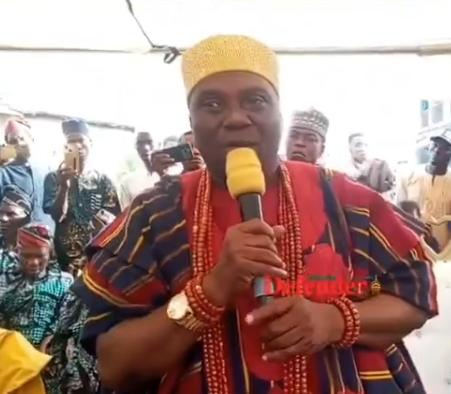
A sharp political controversy has erupted in Osun State after the Aragbiji of Iragbiji, Oba Abdulrasheed Ayotunde Olabomi, was captured in a circulating video declaring that any indigene of Iragbiji, at home or in the diaspora, who does not support President Bola Tinubu is a “bastard,” a remark that has stirred debate over the role of traditional rulers in partisan politics and reopened old sensitivities around loyalty, identity and power in the president’s ancestral town. The comments were reported on Monday by Osun Defender and circulated more widely through social media accounts that reposted the same video.
According to the published account of the video, the monarch made the statement while addressing subjects in Iragbiji, the headquarters of Boripe Local Government Area of Osun State. The report quoted him as saying that no one among the royal families should speak against Tinubu, even if they are engaged in politics, before extending the rebuke to the wider town. He was quoted as saying: “Any indigene of Iragbiji both at home and in diaspora who is not with President Bola Tinubu is a bastard,” and then repeating the point for emphasis. The repetition matters because it reduces the possibility that the wording was accidental or merely garbled in transmission; the available report presents it as a deliberate public statement.
The immediate significance of the remark lies in the unusually blunt language used by a first-class traditional ruler in a politically charged environment. Nigerian monarchs often speak on public affairs and sometimes openly endorse candidates or office-holders, but direct abuse of dissenting indigenes is far less common, especially in words tied to legitimacy of birth and belonging. In practical terms, the statement appears to have collapsed the distinction between community identity and political preference, suggesting that support for the president should be treated not simply as a partisan choice but as a measure of loyalty to Iragbiji itself.
That broader symbolism is not accidental. Iragbiji has long featured in public conversation about Tinubu’s roots. While Tinubu is politically identified with Lagos and built his dominant machine there, reporting and commentary over the years have repeatedly linked his ancestry to Iragbiji in Osun. In a 2023 interview carried by ThisDay, Asiwaju of Iragbiji Lanre Ogunwale said Tinubu is “a Lagosian who has his roots in Iragbiji,” reflecting a line of local elite opinion that sees the president as one of the town’s own. The federal government’s establishment of the Federal University of Agriculture and Development Studies in Iragbiji, assented to by Tinubu in 2025, further reinforced the president’s symbolic and political importance in the town.
The present controversy also lands in the middle of a tense Osun political season. Governor Ademola Adeleke of the Peoples Democratic Party remains locked in a long-running rivalry with the All Progressives Congress establishment in the state, where Tinubu ally and Marine and Blue Economy Minister Gboyega Oyetola remains a central force. Oyetola himself is from Iragbiji, which gives the town uncommon symbolic weight in Osun politics. That intersection of local elite networks, state-level rivalry and presidential ancestry helps explain why comments from the palace can quickly take on partisan significance well beyond the immediate audience that heard them.
The available reporting suggests the comment may have emerged from a local exchange over expectations that Iragbiji would “receive our rights,” with the monarch apparently reacting to a skeptical remark that invoked Tinubu’s earlier promises. In that telling, the outburst was not an abstract political sermon but a response to dissent from within the community itself. That detail is important because it points to possible frustration beneath the surface: if Iragbiji is widely treated as part of Tinubu’s ancestral base, then unmet expectations of federal or political benefit could produce sharp internal disagreement, and palace rhetoric may be an attempt to discipline that dissent.
So far, however, no public clarification or retraction was visible in the reports reviewed on Monday, and no formal response was immediately evident from the Osun State Government, the presidency or the major state party structures in the material available at the time of writing. What has spread instead is the raw clip and the quoted wording, which has given the episode the character of a viral political flashpoint rather than a managed public dispute. In the absence of a clarifying statement from the palace, the words themselves have become the story.
The episode also revives an old Nigerian question about what traditional rulers are expected to be in a constitutional democracy. Though monarchs retain enormous moral and social influence, they hold no partisan electoral mandate and are widely expected to serve as custodians for all segments of their communities, including those divided by party, religion or ideology. When a royal father moves from persuasion into denunciation, especially with language that questions the standing of his own people, the effect can be polarising. Supporters may read it as emotional loyalty to a prominent son of the soil. Critics may see it as a misuse of traditional authority to stigmatise legitimate democratic disagreement.
The timing makes the remark still more combustible. Tinubu remains a deeply contested national figure as economic hardship, insecurity and political realignment continue to shape public debate ahead of the next electoral cycle. In that climate, even local endorsements carry wider national resonance. A monarch in a town linked to the president calling non-supporters “bastards” can easily be read far beyond Osun as a metaphor for the sharper intolerance that critics say is creeping into Nigerian political culture. Supporters of the president, on the other hand, may argue that the monarch was speaking in the heat of local emotion about communal solidarity and not issuing a literal political decree.
What is beyond dispute is that the remark has placed the Aragbiji and Iragbiji at the centre of a broader argument about the boundaries of royal speech in partisan times. It has also exposed how quickly community pride can harden into exclusion when politics becomes fused with ancestry. Whether the palace chooses to clarify the statement, defend it or ignore the backlash will shape how long the controversy lasts. But for now, the words attributed to the Aragbiji have already done enough to ignite a storm, precisely because they turned support for a president into a test of belonging.
📩 Stone Reporters News | 🌍 stonereportersnews.com
✉️ info@stonereportersnews.com | 📘 Facebook: Stone Reporters News | 🐦 X (Twitter): @StoneReportNew | 📸 Instagram: @stonereportersnews
Add comment
Comments