

Reported by: Oahimire Omone Precious | Edited by: Oravbiere Osayomore Promise.
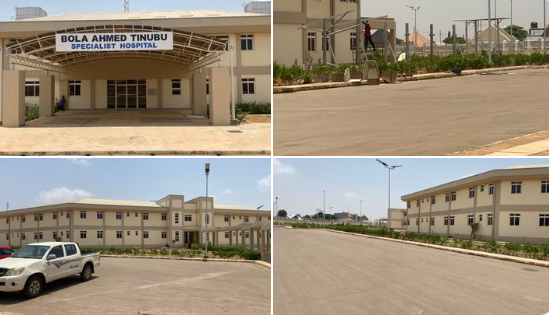
Growing public concern has trailed the continued closure of the Bola Tinubu Specialist Hospital in Millennium City, Chikun Local Government Area of Kaduna State, more than ten months after it was officially commissioned amid high expectations of improved healthcare delivery.
The 300-bed facility, now known as the Bola Tinubu Specialist Hospital, was inaugurated in June 2025 as a flagship project intended to expand access to specialised medical services in the state. At the time, government officials described the hospital as a major milestone in efforts to strengthen healthcare infrastructure and reduce the burden on overstretched public hospitals.
However, nearly a year later, the hospital remains non-operational, with its gates reportedly locked and no medical services being provided to the public. The situation has sparked frustration among residents of Millennium City and surrounding communities, many of whom had anticipated improved access to healthcare without the need to travel long distances.
Residents say the continued closure has had real consequences, particularly for those requiring specialised care. In the absence of a functional facility, patients are still being referred to other hospitals within and outside Kaduna, often at significant cost and inconvenience. For many families, this has meant delayed treatment or reliance on already overcrowded health centres.
The development has also raised broader questions about governance and project implementation in the state. Critics argue that commissioning a major public facility without ensuring its readiness for immediate use reflects deeper systemic issues, including gaps in planning, coordination, and accountability.
Attention has particularly focused on the role of the Kaduna State Government under Governor Uba Sani, as well as the oversight responsibilities of the Kaduna State Ministry of Health. Stakeholders have called for urgent clarification on why the hospital has not been opened to the public and what steps are being taken to address the delay.
Compounding the concerns are reports from members of the host community indicating that ambulances initially presented during the commissioning ceremony are no longer at the facility. While there has been no official confirmation regarding their status, the claims have intensified scrutiny over the management of public assets and the transparency of post-commissioning processes.
Health sector observers note that the situation is not unique to Kaduna but reflects a recurring pattern across parts of Nigeria, where infrastructure projects are inaugurated before the necessary operational frameworks are in place. These frameworks typically include staffing, equipment installation, funding for recurrent expenses, and administrative structures required to run complex facilities such as specialist hospitals.
In the case of the Bola Tinubu Specialist Hospital, questions remain about whether adequate provisions were made for recruiting and deploying medical personnel, securing essential equipment, and ensuring a steady power supply—factors that are critical to the functioning of any modern healthcare institution.
Public health experts warn that leaving such a facility idle represents a significant loss of opportunity, particularly in a country where access to quality healthcare remains uneven. A fully operational 300-bed hospital has the potential to serve thousands of patients annually, reduce referral pressures on tertiary institutions, and improve health outcomes across a wide catchment area.
The delay also carries economic implications. Beyond the initial capital investment, idle infrastructure can deteriorate over time if not properly maintained, leading to additional costs when eventual efforts are made to bring it into use. Moreover, the expected economic benefits, including job creation and local business activity linked to hospital operations, remain unrealised.
Civil society groups and community leaders have increasingly joined calls for action, urging the government to move beyond ceremonial milestones and prioritise service delivery. They argue that public confidence in government projects depends not only on their completion but also on their functionality and impact on citizens’ lives.
In response to the growing criticism, there have been appeals for a comprehensive audit of the project, including a review of all assets associated with the hospital. Such an audit, stakeholders say, would help clarify the status of equipment and vehicles, including the reportedly missing ambulances, and ensure accountability for public resources.
There have also been calls for the immediate development and implementation of a clear operational plan. This would involve setting timelines for opening the facility, outlining staffing requirements, and establishing management structures to ensure efficient service delivery once the hospital becomes functional.
As pressure mounts, the situation is increasingly being viewed as a test of the Kaduna State Government’s commitment to healthcare reform and public accountability. Observers note that addressing the issue promptly could help restore public trust and demonstrate responsiveness to citizens’ concerns.
For residents of Millennium City and neighbouring communities, the expectation is straightforward: that a hospital built with public funds should serve the public without unnecessary delay. Until that happens, the facility stands as a visible reminder of the gap between infrastructure development and actual service delivery.
The coming weeks are likely to be critical in determining whether the Bola Tinubu Specialist Hospital transitions from a completed project to a functioning healthcare centre. For now, it remains a symbol of both potential and unmet expectations in Nigeria’s ongoing struggle to strengthen its healthcare system.
📩 Stone Reporters News | 🌍 stonereportersnews.com
✉️ info@stonereportersnews.com | 📘 Facebook: Stone Reporters News | 🐦 X (Twitter): @StoneReportNew | 📸 Instagram: @stonereportersnews
Add comment
Comments