

Reported by: Ijeoma G | Edited by: Oravbiere Osayomore Promise.
Nigeria’s Senate has intensified its scrutiny of the Nigerian National Petroleum Company Limited (NNPCL), issuing a firm directive for the state-owned oil firm to appear before its Committee on Public Accounts by April 29, 2026, to explain a staggering N210 trillion flagged in audit reports spanning from 2017 to 2023.
The directive marks a significant escalation in an ongoing legislative probe into the financial records of the national oil company, with lawmakers expressing dissatisfaction over previous explanations provided by the company’s management. The N210 trillion figure, drawn from audited financial statements across the seven-year period, is understood to comprise a wide range of liabilities, expenditures, and unresolved audit queries requiring detailed clarification.
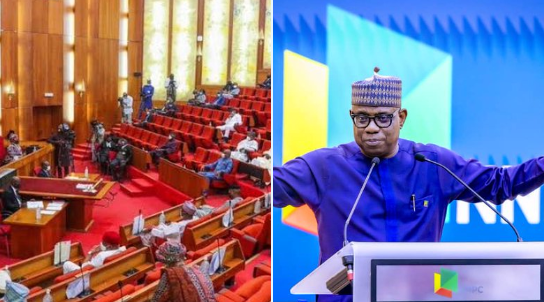
At the center of the investigation is the Senate Committee on Public Accounts, chaired by Senator Aliyu Wadada, which has been examining the audited accounts of NNPCL in line with its constitutional oversight mandate. The committee’s decision to issue a fresh deadline followed what it described as unsatisfactory responses from the company to multiple audit queries previously raised during earlier sessions.
Lawmakers have insisted that the explanations provided so far lack sufficient detail and transparency to justify the enormous figures recorded in the company’s books. Particular concern has been raised over the structure and classification of the financial entries, especially the aggregation of large sums under broad categories without clear itemisation.
Central to the scrutiny are two major components of the N210 trillion figure. Lawmakers indicated that approximately N103 trillion was recorded as accrued liabilities and expenses, while another N107 trillion was linked to joint venture cash calls and related obligations. The committee has questioned both the accuracy and the breakdown of these figures, noting that such large amounts require clear documentation and traceability.
Members of the committee emphasized that liabilities should be properly itemised into identifiable components such as operational costs, legal obligations, and audit-related expenses, rather than presented as consolidated figures. Concerns were also raised about references to debts allegedly linked to defunct financial institutions, with lawmakers demanding full disclosure of the entities involved and the basis for such claims.
As part of the directive, the Senate has summoned both current and former top officials of the company to appear before the committee. Those expected to testify include the current Group Chief Executive Officer, Bayo Ojulari, as well as his predecessor, Mele Kyari, alongside other senior management staff and external auditors associated with the financial statements under review.
The move reflects growing frustration within the National Assembly over what some lawmakers perceive as delays or reluctance by key public institutions to fully comply with legislative oversight. During deliberations, members stressed the importance of accountability and warned that failure to honour the invitation could lead to the invocation of constitutional powers to compel attendance.
The probe itself forms part of a broader review process that began earlier, when discrepancies and ambiguities in NNPCL’s audited financial records first came under legislative scrutiny. Previous sessions of the committee revealed what lawmakers described as troubling inconsistencies, prompting a series of engagements with company officials aimed at obtaining clarity.
At one stage, committee members expressed concern that the scale of the figures being questioned appeared disproportionately large when compared with the company’s reported revenues over a similar timeframe. This observation has fueled demands for a comprehensive and detailed breakdown of all entries to determine whether the figures represent legitimate accounting obligations, accumulated liabilities, or potential irregularities.
The Senate’s insistence on a firm deadline underscores the economic and political weight of the matter. As Nigeria’s national oil company, NNPCL occupies a central position in the country’s revenue generation, foreign exchange earnings, and overall fiscal stability. Any uncertainty surrounding its financial records carries implications not only for governance but also for investor confidence and public trust.
Industry analysts note that joint venture cash calls, which account for a substantial portion of the questioned суммы, are a routine aspect of Nigeria’s oil and gas operations. These obligations involve funding contributions between the government and private sector partners for exploration and production activities. However, the magnitude of the amounts cited in the audit reports has raised questions about how these expenditures were calculated, recorded, and reconciled over time.
The unfolding probe also brings renewed attention to longstanding concerns about transparency in Nigeria’s oil sector, which has historically faced scrutiny over revenue management, subsidy frameworks, and remittance practices. Although reforms in recent years, including the transformation of the Nigerian National Petroleum Corporation into a limited liability company, were intended to enhance governance and efficiency, the current controversy suggests that challenges persist.
For the Senate, the April 29 deadline represents a decisive moment in its oversight efforts. Lawmakers have made it clear that they expect comprehensive, verifiable, and itemised explanations from the company’s leadership, warning that anything short of this standard will not be accepted.
NNPCL has yet to issue a detailed public response to the latest directive, though previous submissions to the committee attempted to justify parts of the figures as legitimate financial obligations. Whether those explanations will satisfy lawmakers remains uncertain, given the strong position adopted by the committee in recent proceedings.
As the deadline approaches, attention is expected to focus on the anticipated appearance of top executives before the Senate panel, where they will be required to defend the company’s financial records in detail. The outcome of the hearing could carry significant implications, including possible policy reforms, administrative measures, or further investigations into the management of the country’s most strategic economic institution.
The case is also seen as a broader test of institutional accountability in Nigeria, where public demand for transparency in the management of national resources continues to grow. Observers note that the Senate’s handling of the probe will be closely watched as an indicator of the effectiveness of legislative oversight in addressing complex financial issues at the highest levels of government.
📩 Stone Reporters News | 🌍 stonereportersnews.com
✉️ info@stonereportersnews.com | 📘 Facebook: Stone Reporters News | 🐦 X (Twitter): @StoneReportNew | 📸 Instagram: @stonereportersnews
Add comment
Comments