

Reported by: Ijeoma G | Edited by: Oravbiere Osayomore Promise.
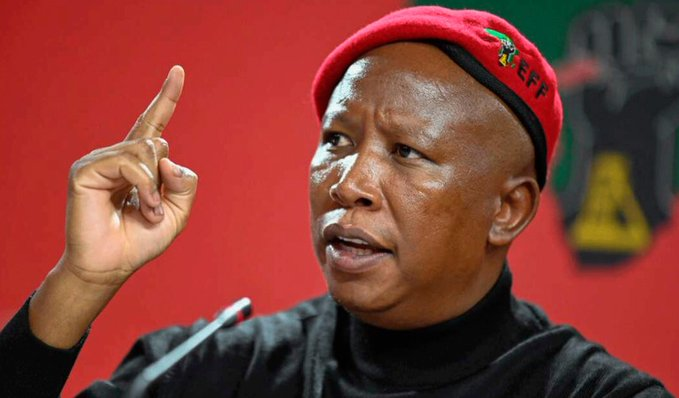
A South African magistrate court in East London has sentenced opposition politician Julius Malema, leader of the Economic Freedom Fighters (EFF), to five years in prison after finding him guilty of illegal possession of a firearm and discharging it in a public space during a political rally.
The ruling was delivered on Thursday by Magistrate Twanet Olivier, who stated that the conduct demonstrated during the incident was not impulsive but deliberate and occurred in a public setting where it posed a serious risk to safety. Malema appeared in court as the sentence was read and reportedly showed little emotional reaction.
The case stems from an incident in 2018 during the EFF’s fifth anniversary celebrations in South Africa’s Eastern Cape province. At the event, a video widely circulated at the time showed Malema handling a semi-automatic rifle and firing several shots into the air while addressing supporters.
Prosecutors argued that the act amounted to unlawful possession and reckless endangerment, emphasizing that the discharge of a firearm in a crowded public gathering created significant danger. The court ultimately agreed, convicting him last year on multiple charges, including illegal possession of a firearm and ammunition, unlawful discharge of a weapon, and reckless endangerment.
Malema, who is one of South Africa’s most prominent and controversial political figures, defended his actions during the trial. He told the court that the firearm did not belong to him and insisted that the discharge was intended as a symbolic gesture to energize supporters during the rally rather than to cause harm.
However, Magistrate Olivier rejected the explanation during sentencing, stating that the act could not be justified as spontaneous or symbolic. The court held that the circumstances showed premeditation in handling the weapon in a public environment, thereby violating firearms regulations and public safety laws.
In addition to the five-year custodial sentence on the primary count, the court also imposed a two-year sentence on a related charge, along with a financial penalty of R20,000 or an alternative six-month imprisonment term. The sentences are expected to run concurrently or as determined by correctional authorities, pending clarification in subsequent legal proceedings.
Following the judgment, Malema’s legal team immediately filed an appeal in an effort to suspend the execution of the sentence and prevent his immediate incarceration. The appeal process is expected to escalate the matter to higher judicial authorities, potentially reaching South Africa’s Constitutional Court.
The conviction also raises political implications, as South African law provides for the disqualification of individuals sentenced to imprisonment beyond a certain threshold from serving as members of parliament. Analysts say the ruling could therefore have significant consequences for Malema’s political career and his leadership role within the EFF.
Outside the courtroom after his conviction in October, Malema addressed supporters and struck a defiant tone, stating that imprisonment or even death would not deter him from his political convictions. He framed the legal proceedings as part of a broader ideological struggle and reaffirmed his commitment to continue political activism regardless of the outcome.
The sentencing has drawn widespread attention in South Africa, where Malema remains a polarizing figure known for his radical rhetoric, populist messaging, and outspoken criticism of government policies. His supporters have often viewed him as a champion of economic transformation, while critics accuse him of inciting unrest and undermining institutional authority.
Legal experts note that the case underscores the strict enforcement of firearms legislation in South Africa, particularly in relation to public gatherings and political events. The law prohibits the reckless use of firearms in public spaces, with severe penalties attached to violations, especially where public safety is at risk.
The prosecution maintained throughout the case that the incident was not only unlawful but also dangerous given the presence of large crowds at the rally. The court’s ruling reflects a broader judicial stance aimed at deterring the normalization of firearm display in political or public demonstrations.
Malema has indicated that he intends to pursue all available legal avenues to overturn the conviction, including a possible appeal to the country’s highest court. His legal team argues that the judgment misinterpreted the intent and context of the incident and that procedural and substantive grounds exist for reversal.
As the legal process continues, the case is expected to remain a major point of political and legal debate in South Africa, particularly regarding the intersection of political expression, public safety, and firearm regulation.
For now, the outcome of the appeal will determine whether Malema begins serving his sentence or remains free pending further judicial review, leaving his political future uncertain as the case progresses through the appellate system.
📩 Stone Reporters News | 🌍 stonereportersnews.com
✉️ info@stonereportersnews.com | 📘 Facebook: Stone Reporters News | 🐦 X (Twitter): @StoneReportNew | 📸 Instagram: @stonereportersnews
Add comment
Comments