

Reported by: Ijeoma G | Edited by: Oravbiere Osayomore Promise.
President Bola Ahmed Tinubu has taken a sharp swipe at former Vice President Atiku Abubakar, accusing him of attempting to “privatise” the African Democratic Congress (ADC), in remarks that have further intensified political tensions between leading figures in Nigeria’s ruling and opposition blocs.
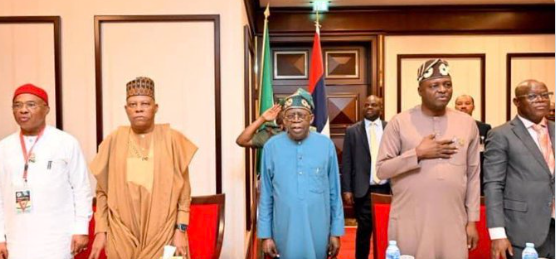
Tinubu made the comments on Thursday while hosting members of the Renewed Hope Ambassadors at the State House in Abuja, where he used the opportunity to criticise both Atiku’s political history and his role in ongoing opposition party disputes.
According to the president, the internal crisis within the ADC is linked to what he described as an attempt by Atiku to take control of the party in a manner similar to his involvement in past national economic reforms. Tinubu alleged that the former vice president had tried to “privatise another man’s political party,” but was resisted.
He also revisited Atiku’s tenure as chairman of Nigeria’s National Privatisation Council, arguing that several of the privatization decisions taken under his watch did not yield positive results. Tinubu cited the steel sector in Delta State and the Ajaokuta Steel Company as examples, claiming that these assets remain non-functional despite earlier privatization efforts.
The president said the situation in the ADC reflected what he described as a pattern of attempting to control systems without achieving sustainable outcomes. His remarks were framed as a broader critique of opposition leadership and governance approaches.
The African Democratic Congress has been embroiled in a deep internal crisis in recent months, following the emergence of competing leadership factions within the party. The disputes intensified after an opposition coalition took over the party’s leadership structure in mid-2025, triggering disagreements over legitimacy and control.
Three main factions have since emerged within the ADC, each claiming authority over the party’s national structure. These factions are reportedly led by former Senate President David Mark, Nafiu Bala, and Ogga Kingsley, with each group maintaining differing interpretations of the party’s leadership status.
The internal conflict has also attracted the attention of the Independent National Electoral Commission, which in early April declined to recognize some of the rival factions following a Court of Appeal ruling that affected the status of the leadership dispute. The matter remains subject to ongoing legal processes.
The crisis deepened further when a faction of the ADC in Adamawa State announced the suspension of Atiku Abubakar, accusing him of contributing to internal divisions within the party. The decision added another layer of controversy to an already fragmented political structure.
Legal proceedings relating to the party leadership dispute are ongoing, with the Supreme Court scheduled to hear an appeal on April 22 involving one of the factions challenging the legitimacy of the current leadership arrangement. The outcome is expected to have significant implications for the future structure of the party.
Tinubu’s remarks have added a new dimension to the political discourse surrounding the ADC crisis, particularly as opposition figures continue to navigate internal disagreements while also positioning themselves ahead of future electoral cycles.
The president’s comments also reflect broader political rivalries between key figures in Nigeria’s political landscape, where past alliances and roles continue to influence present-day disputes. Atiku, a long-standing political actor and former vice president, has remained a central figure in opposition politics, while Tinubu, now president, has increasingly positioned himself as a critic of opposition leadership approaches.
The ADC crisis itself has exposed deeper structural challenges within opposition politics, particularly around party control, coalition management, and leadership legitimacy. The emergence of multiple factions has raised questions about cohesion and long-term stability within the party.
As legal and political battles continue, the situation remains fluid, with no clear resolution yet in sight. The upcoming Supreme Court hearing is expected to play a key role in determining which faction, if any, will be recognized as the legitimate leadership of the party.
For now, Tinubu’s intervention has added further political weight to an already volatile situation, reinforcing the high level of contestation surrounding both party leadership and broader opposition dynamics in Nigeria.
📩 Stone Reporters News | 🌍 stonereportersnews.com
✉️ info@stonereportersnews.com | 📘 Facebook: Stone Reporters News | 🐦 X (Twitter): @StoneReportNew | 📸 Instagram: @stonereportersnews
Add comment
Comments