

Reported by: Oahimire Omone Precious | Edited by: Oravbiere Osayomore Promise.
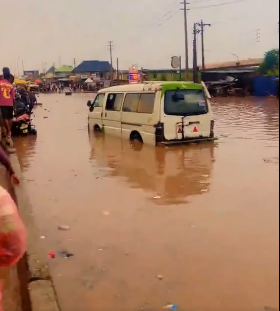
Heavy flooding has again affected parts of Sango Ota in Ogun State, leaving residents stranded, disrupting movement, and reigniting public criticism over the state of drainage infrastructure and flood control measures in the area.
The incident followed a period of intense rainfall that overwhelmed drainage channels in several streets, causing water to overflow into residential and commercial areas. Roads in affected parts of the town were submerged, making vehicular and pedestrian movement difficult and in some cases impossible.
Residents expressed frustration over what they described as recurring flooding in the community, arguing that the situation has persisted despite repeated complaints to authorities. One resident, visibly distressed by the extent of the flooding, lamented the lack of effective government intervention, pointing to the presence of administrative structures in the state without corresponding improvements in basic infrastructure.
The affected areas reportedly included densely populated neighborhoods where drainage systems are either poorly maintained or insufficient to handle heavy rainfall. Businesses were also impacted, with traders struggling to protect goods from water damage as floodwaters entered shops and market spaces.
Sango Ota, a key commercial hub linking Lagos and Ogun States, has in recent years experienced increasing pressure from rapid urbanization, unregulated construction, and inadequate drainage planning. These factors have contributed to recurring flooding, particularly during peak rainy periods.
Environmental experts have long warned that unplanned urban expansion without corresponding investment in drainage systems significantly increases flood risks. In many parts of Ogun State, including Sango Ota, natural waterways have been encroached upon or blocked, reducing the capacity for stormwater to flow freely.
Residents say the latest flooding episode is part of a pattern that has continued for years, often resurfacing during heavy rainfall seasons. Some communities have reportedly resorted to self-help measures, including sandbagging and improvised drainage clearing, in an attempt to reduce the impact of floodwaters.
The Ogun State government has previously acknowledged flooding challenges in various parts of the state and has initiated drainage expansion and road rehabilitation projects in some locations. However, residents argue that implementation has not kept pace with the scale of the problem, particularly in fast-growing urban corridors like Sango Ota.
Transportation was significantly affected as major roads became impassable, forcing commuters to either divert or abandon travel plans. Motorists who attempted to navigate flooded roads faced vehicle breakdowns and delays, further worsening congestion in surrounding routes.
Public reactions on social media mirrored on-the-ground frustrations, with many residents calling for urgent and sustained government action to address drainage failures, waste management issues, and urban planning deficiencies contributing to the recurring floods.
Flooding in southwestern Nigeria is often exacerbated by a combination of factors, including blocked waterways, inadequate infrastructure, and increasingly unpredictable rainfall patterns linked to broader climate variability. Experts note that without long-term investment in resilient urban drainage systems, communities like Sango Ota will continue to experience repeated disruptions.
Authorities in Ogun State are expected to assess the extent of damage in the affected areas, though no official casualty figures or comprehensive damage estimates have been released at the time of reporting. Emergency response efforts typically focus on clearing blocked roads, restoring drainage flow, and assisting affected residents.
The latest incident adds to growing calls for improved urban planning and infrastructure development across rapidly expanding towns in the state. Residents continue to urge government intervention, emphasizing that recurring flooding not only disrupts daily life but also poses risks to public health, property, and economic activity.
📩 Stone Reporters News | 🌍 stonereportersnews.com
✉️ info@stonereportersnews.com | 📘 Facebook: Stone Reporters News | 🐦 X (Twitter): @StoneReportNew | 📸 Instagram: @stonereportersnews
Add comment
Comments