

Reported by: Oahimire Omone Precious | Edited by: Pierre Antoine
The Nigerian Baptist Convention has issued one of the sharpest faith-based interventions yet in Nigeria’s worsening security debate, urging President Bola Tinubu to confront insecurity “as a matter of urgency” and describing the recurring spectacle of mass burials in Jos, Benue and other parts of the country as unacceptable. The call was made by the convention’s president, Rev. Israel Akanji, during the church’s 113th annual session in Abuja, where he said the scale and persistence of killings, kidnappings, banditry and terrorism had become unbearable.
Akanji’s remarks did not emerge in a vacuum. They came after a string of fresh attacks in north-central Nigeria, especially in Plateau and Benue states, where communities have again come under assault from armed men. In Plateau, Reuters reported that gunmen attacked a university community in the state in late March, killing at least 30 people in the latest episode of bloodshed in an area long scarred by farmer-herder conflict and retaliatory violence. Separately, the presidency said Tinubu condemned attacks in Angwan Rukuba in Jos and in Kaduna State, calling them barbaric and cowardly and promising that security agencies would bring the perpetrators to justice.
The NBC’s statement was broader than a reaction to a single atrocity. Akanji framed the issue as a national crisis requiring decisive presidential leadership, not episodic condolence statements. According to reports of his comments in Abuja, he said the “seemingly endless, senseless, brutal, torturous and unprovoked killings” had become intolerable, while mass burials in Plateau, Benue and elsewhere had become a grotesque marker of state failure. The convention also linked the violence to a wider atmosphere of fear and helplessness, arguing that Nigerians were being forced to live under constant threat.
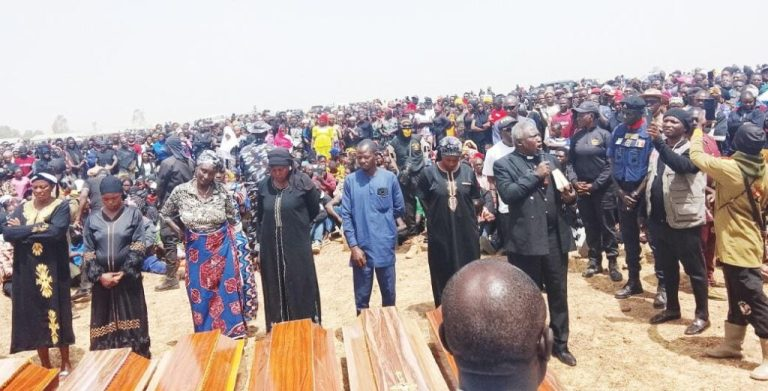
The reference to “mass burial” is especially loaded in the current moment because it resonates with multiple recent episodes of communal mourning and unresolved anger. In Plateau, violence around Jos and surrounding districts has produced conflicting casualty accounts in some cases, but local and international reporting confirms a significant rise in civilian deaths in recent weeks. In Benue, the pattern has been similar: repeated raids on rural communities, hurried funerals, displaced families and accusations that authorities are responding too slowly or too weakly. Associated Press reported only last week that at least 26 people were killed in three separate attacks over Easter weekend in northern Nigeria, including 17 civilians in Benue’s Gwer West area.
Even beyond those incidents, Benue has remained a symbol of the wider insecurity crisis. Reuters reported in February that Nigerian prosecutors had charged nine men over the June 2025 massacre in Yelwata, Benue State, where about 150 people were killed in one of the deadliest rural assaults in recent years. That prosecution showed some effort at accountability, but it also reinforced how grave the violence has become: entire villages attacked, homes burned, and communities left to bury scores of victims at once. For groups like the NBC, such episodes have become evidence that Nigeria is normalising levels of bloodshed that should provoke far more urgent state action.
The convention’s criticism also lands at a politically delicate time for Tinubu. His government is already under pressure over inflation, economic hardship and opposition claims that it has failed to improve daily life. Security, however, remains one of the most politically dangerous fronts because it speaks directly to the state’s basic legitimacy. When armed groups can raid villages, ambush roads, abduct students or massacre worshippers and residents, the issue is no longer simply criminality; it becomes a judgment on whether government is capable of protecting life. Today, AP reported another abduction attack in Benue, where a passenger bus carrying students was ambushed and some travellers were taken away, underscoring how insecurity continues to affect both rural communities and major routes.
Tinubu has publicly insisted that his administration will defeat terrorism and banditry. In an April 10 speech, he said the government would continue to equip and train the armed forces and that terrorism and other forms of violence would be defeated. The presidency also said after the Plateau and Kaduna attacks that he had directed security agencies to fish out those responsible. Those statements show that the federal government is not ignoring the crisis rhetorically. But the criticism from the NBC and other civic voices reflects a deeper complaint: that assurances have not yet translated into a visible reduction in killings.
That gap between promise and lived reality has widened frustration among churches, civil society groups and opposition politicians. BusinessDay recently captured that mood by arguing that repeated official condemnations are beginning to sound formulaic to communities that continue to bury victims. The NBC’s intervention fits into that wider pattern of moral and political pressure, though its language carries special weight because Baptist churches form one of Nigeria’s large and influential Christian constituencies. A direct appeal from the convention’s leadership signals not only institutional concern but a fear that congregants increasingly see insecurity as an existential national emergency.
There is also a structural issue beneath the headline outrage. The violence in Plateau and Benue is often described as farmer-herder conflict, but that shorthand can obscure the complexity on the ground. Attacks now often involve heavily armed assailants, displacement, reprisal dynamics, criminal opportunism and failures of deterrence. In some places, conflict over land and grazing routes remains central; in others, the violence increasingly resembles organised armed raids with weak consequences for perpetrators. The NBC’s call for urgency is, in effect, a demand that the federal government treat the crisis as a national security emergency rather than a collection of local disturbances.
For Tinubu, the significance of the NBC statement is not merely rhetorical. It is a reminder that concern over insecurity now cuts across partisan and institutional lines. Religious bodies, local communities, rights advocates and even international observers are watching whether the government can move from declarations to measurable security outcomes. Until that happens, every new funeral, every fresh raid and every mass burial will continue to sharpen the charge that the state is failing in its first duty. The Baptist Convention’s message was therefore simple but severe: Nigerians cannot keep normalising collective graves as part of public life, and the president must act with far greater urgency than the country has yet seen.
📩 Stone Reporters News | 🌍 stonereportersnews.com
✉️ info@stonereportersnews.com | 📘 Facebook: Stone Reporters News | 🐦 X (Twitter): @StoneReportNew | 📸 Instagram: @stonereportersnews
Add comment
Comments