

Reported by: Oahimire Omone Precious | Edited by: Pierre Antoine
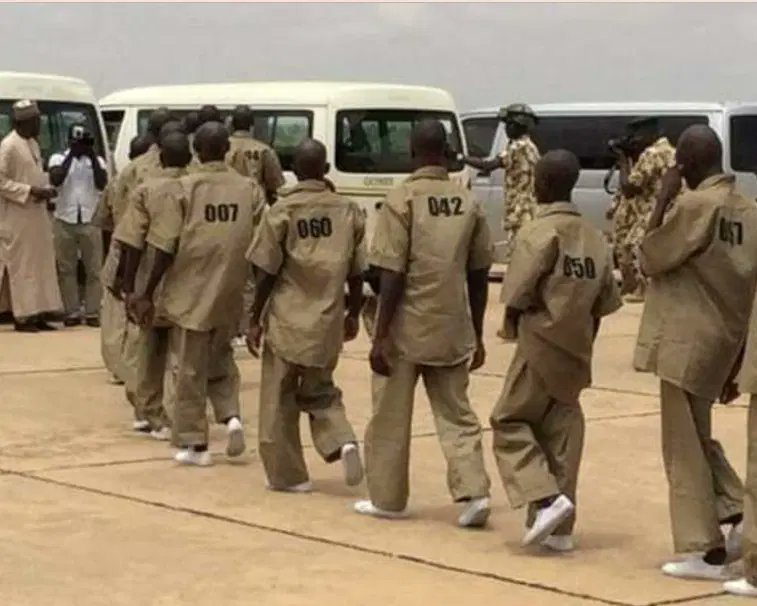
A fresh wave of anger has erupted across Nigeria after the federal government announced that 744 former terrorists and victims of violent extremism had completed a deradicalisation and rehabilitation programme and would now be reintegrated into society under Operation Safe Corridor, a non-kinetic counterinsurgency initiative launched in 2016. The graduation took place in Gombe, with officials presenting the scheme as a strategic part of the country’s effort to weaken extremist violence beyond the battlefield.
At the ceremony, Chief of Defence Staff General Olufemi Oluyede, represented by Rear Admiral Kabiru Tanimu, said the programme was “not a reward” for violence and should not be mistaken for amnesty. He argued that military force alone cannot end insurgency and that long-term stability requires disengagement, rehabilitation and reintegration for those deemed eligible under the system. Brigadier General Yusuf Ali, the programme’s coordinator, said the participants had undergone psychosocial support, vocational training, civic education, behavioural transformation and religious reorientation intended to counter extremist narratives.
The official breakdown illustrates both the scale and sensitivity of the initiative. Of the 744 graduates, 736 are Nigerians and eight are foreign nationals from Burkina Faso, Cameroon, Chad and Niger. Borno State alone accounts for 597 of the beneficiaries, followed by Yobe with 58, while smaller numbers came from several other states across the country. Officials said many participants were drawn into armed groups through coercion, abduction or manipulation, and insisted that only screened, low-risk individuals approved through a multi-agency process can enter the programme.
But the government’s message has collided with deep public distrust. Operation Safe Corridor’s own portal acknowledges that public confidence has been damaged by persistent perceptions that former insurgents receive support while many victims remain abandoned. In recent remarks published by the programme, Ali said authorities were trying to strengthen screening, improve transparency and expand support for victims, including plans for victims’ rehabilitation and reintegration camps in parts of the North-Central and North-West. He said the programme was not designed to prioritise ex-fighters over victims and maintained that individuals facing prosecutable offences should be separated from those qualified for rehabilitation.
That assurance has done little to calm critics. Vanguard reported a broad chorus of outrage from retired military officers, lawyers, civil society voices and community leaders who say the policy risks rewarding perpetrators while survivors of terrorism continue to live in displacement, poverty and trauma. The phrase that has resonated most strongly in the backlash is simple and blunt: help victims before helping killers. It captures a moral argument that now sits at the centre of the public debate over whether the Nigerian state is balancing peacebuilding with justice.
Among the most direct critics is retired Rear Admiral Dickson Olisemelogor, who argued that what Nigeria is seeing may be disengagement rather than true deradicalisation. He warned that some individuals may leave armed groups only under pressure from hunger or military operations and could later re-enter violent networks or infiltrate state institutions. His criticism reflects a longstanding concern in Nigerian security discussions: that unless ideology, grievances and community conditions are properly addressed over time, rehabilitation may remain superficial and vulnerable to relapse.
Lawyer Maxwell Opara has gone further, describing the reintegration effort as a fraud and saying he plans to seek a court order to halt it. He argues that Nigerian law requires investigation, prosecution and conviction where crimes have been committed, rather than a six-month rehabilitation track that appears to bypass justice. In one of the most pointed condemnations, he contrasted the treatment of former insurgents with that of ordinary prisoners and victims still languishing in camps, asking why those who destroyed communities seem to be receiving state-funded opportunities while survivors remain in hardship.
Human rights advocates have taken a more layered position, neither rejecting reintegration outright nor endorsing it unconditionally. Okechukwu Nwagunma said any such process must be grounded in accountability, transparency and a broader transitional justice framework that includes truth-telling, reparations and independent oversight. FENRAD’s Nnanna Nwafor similarly said the policy could support long-term peacebuilding, but only if it operates within a clear human rights framework and with sustained support for victims and affected communities. Their position suggests that the core issue may not be rehabilitation itself, but the absence of visible, credible justice safeguards around it.
The controversy is unfolding against the backdrop of Nigeria’s wider security and justice crisis. Just days before the latest reintegration debate intensified, a court in Abuja convicted 386 terrorism suspects in a mass trial involving 508 cases, with some receiving sentences of up to 20 years. That development underscored the government’s simultaneous use of punitive and non-punitive approaches: prosecution for some, rehabilitation for others. Yet for many Nigerians, that dual-track strategy remains poorly explained, especially in a country where Boko Haram and its splinter factions have killed and displaced large numbers of people over more than a decade of conflict.
Supporters of Operation Safe Corridor argue that modern counterinsurgency cannot rely on battlefield victories alone. The programme says more than 10,000 individuals have surrendered over time and presents this as evidence that a controlled exit route can reduce the manpower available to extremist groups. Research and policy literature have similarly noted that reintegration can be necessary in protracted conflicts, but they also warn that such programmes fail when communities are excluded, victims are neglected or public trust collapses. That tension is now sharply visible in Nigeria: the state sees deradicalisation as strategy, while many citizens see it as premature mercy.
For now, the immediate political and moral problem for Abuja is not merely whether 744 people can be safely returned to society. It is whether communities shattered by insurgency believe the state still recognises their suffering. Until victims see stronger rehabilitation, compensation, psychological care and justice, opposition to the programme is likely to persist. In that sense, the backlash is not only about repentant terrorists. It is also a warning that peace initiatives in Nigeria will struggle for legitimacy if survivors continue to feel like an afterthought.
📩 Stone Reporters News | 🌍 stonereportersnews.com
✉️ info@stonereportersnews.com | 📘 Facebook: Stone Reporters News | 🐦 X (Twitter): @StoneReportNew | 📸 Instagram: @stonereportersnews

Add comment
Comments