

Reported by: Ijeoma G | Edited by: Pierre Antoine
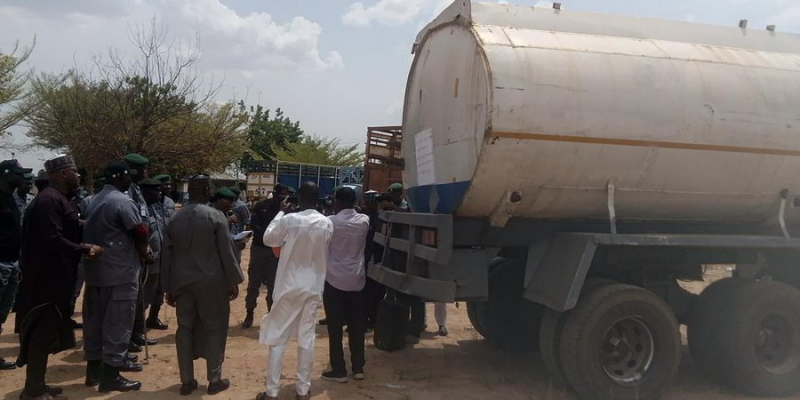
The Nigeria Customs Service has intercepted a fuel tanker and thousands of jerry cans of petrol in Adamawa State in what officials describe as an operation against smuggling along routes leading to Cameroon. The seizure, announced by the Comptroller-General of Customs through Operation Whirlwind, involved 64,410 litres of Premium Motor Spirit packed in 2,550 jerry cans of 25 litres each, three drums of 220 litres capacity, and a DAF tanker loaded with 50,000 litres of petrol intercepted on Mubi-Uba road. Customs valued the total seizure at N93.95 million and said the products were intended to be smuggled out of Nigeria.
The operation was disclosed at a press briefing in Yola, where Deputy Comptroller-General Abubakar Dalhatu Aliyu, who spoke on behalf of Customs Comptroller-General Bashir Adewale Adeniyi, said the interceptions were carried out at flashpoints in Adamawa. The routes named by Customs included Mubi-Sahuda axis, Farang-Belel, Gurin-Fufore axis, Maiha, Muva and Pariya-Wuro Bokki axis, all regarded as critical in the battle against fuel diversion and exports across the northeastern frontier.
According to Customs, the tanker was intercepted in the early hours of April 15, 2026, at about 12:26 a.m. along the Mubi-Uba road after intelligence suggested the product was being diverted. Aliyu said officers acted under the Nigeria Customs Service Act, 2023, especially provisions dealing with patrol, seizure and the movement of improperly conveyed goods. He added that the products would be handed over to the Nigerian Midstream and Downstream Petroleum Regulatory Authority for further action, in line with inter-agency cooperation rules under the same law.
What has amplified public attention is the suggestion in some reports that the seized petrol may have been headed through supply corridors used by insurgent networks linked to Boko Haram. The official Customs statement carried by major Nigerian newspapers did not directly say the products were destined for Boko Haram. It said the petrol was intended to be smuggled out of the country through border routes toward neighbouring territory. However, the wider concern is not without foundation. Earlier reporting from the same border belt has described communities around the Adamawa-Cameroon frontier as vulnerable channels through which smugglers move goods, and officials have warned that fuel diverted through such corridors could end up in the hands of armed groups if not intercepted.
That distinction matters. As of now, the verified official position is that Customs intercepted petrol allegedly being smuggled toward the border. The stronger claim, that it was specifically bound for Boko Haram networks, remains an allegation circulating in secondary reporting rather than a point publicly established by Customs in the April 2026 briefing. In security reporting, the difference between a confirmed destination and a plausible risk is significant, especially in a conflict zone where criminal smuggling, informal border trade and insurgent logistics can overlap.
Still, the security implications are serious. Petrol remains one of the most important supplies in the northeast conflict economy. It powers vehicles, motorcycles, generators and transport chains, making it valuable to legitimate commerce and criminal actors. Border districts in Adamawa have long drawn the attention of security agencies because of their proximity to Cameroon and because they can serve as transit points for illicit flows when enforcement weakens. Customs itself said the price of petrol in neighbouring countries remains significantly higher than in Nigeria, creating a strong incentive for smugglers to move products across the border.
The latest seizure also fits into a broader nationwide campaign by Customs under Operation Whirlwind, the anti-smuggling initiative launched to stop the diversion of petroleum products. Customs data reported earlier this month showed that the service had seized about 635,132 litres of smuggled petrol across different parts of the country over roughly six months. Those interceptions were recorded in Lagos, Ogun, Kebbi, Adamawa, Taraba and Cross River. In one Adamawa operation from late 2024, Customs said it seized 284,006 litres of petrol over two months. In another operation in 2024, Reuters reported that nearly 2,000 petrol outlets in Adamawa and Taraba shut in protest after Customs impounded tanker trucks and closed stations suspected of involvement in petrol smuggling toward Cameroon.
That history shows the scale of the problem. Smuggling is not treated by Customs as a narrow customs violation alone, but as a threat tied to economic sabotage, revenue loss, energy insecurity and, in some cases, wider criminality. Officials have repeatedly argued that petroleum diversion drains supply from domestic consumers, distorts markets and can intersect with terrorism financing, human trafficking and money laundering. In the northeast, those concerns are acute because armed groups have relied for years on shadow supply systems operating across difficult terrain and porous borders.
No official list of suspects was released in the latest Adamawa seizure, and Customs did not publicly announce arrests in the statement carried by major outlets. The emphasis instead was on the seizure itself, the routes involved, the legal basis for the interception and the warning that the service was escalating pressure on smugglers. Customs said it would sustain surveillance and intelligence-led patrols in the identified corridors.
For residents of the northeast, the case is about more than contraband. It speaks to the unresolved tension between border economies, fuel pricing, weak enforcement and insecurity. Where price gaps are large and borders are porous, smuggling networks adapt quickly. Where conflict is present, the consequences become more dangerous.
For now, the clearest established facts are these: Customs seized thousands of jerry cans and a petrol tanker in Adamawa; the products were allegedly being smuggled toward the Cameroon border; the seizure was valued at N93.95 million; and the consignment was intercepted on routes considered sensitive by security agencies. Whether investigators will eventually prove a direct link to Boko Haram remains to be seen. But even without that final confirmation, the interception is significant, both as an economic enforcement action and as a reminder that in Nigeria’s northeast, fuel can be more than a commodity. It can be a security asset, a smuggling prize and, potentially, a weapon of endurance in a wider conflict.
📩 Stone Reporters News | 🌍 stonereportersnews.com
✉️ info@stonereportersnews.com | 📘 Facebook: Stone Reporters News | 🐦 X (Twitter): @StoneReportNew | 📸 Instagram: @stonereportersnews
Add comment
Comments