

Reported by: Ijeoma G | Edited by: Oravbiere Osayomore Promise.
The administration of United States President Donald Trump has terminated an $11 million federal contract with Catholic Charities of the Archdiocese of Miami, a long-standing humanitarian organisation that provides shelter and care for unaccompanied migrant children, in a move that has intensified tensions between the White House and the Catholic Church.
The decision, communicated by the U.S. Office of Refugee Resettlement, includes a three-month notice period for the organisation to wind down its operations. The termination effectively ends a partnership that has existed for decades between the U.S. government and Catholic institutions in caring for vulnerable migrant minors entering the country without parents or guardians.
Catholic Charities in Miami has historically operated what officials describe as a federally supported foster care-style system for migrant children, offering housing, supervision, and specialised services. Church officials say the programme has served thousands of minors over more than 60 years and has been widely regarded as a model for similar initiatives nationwide.
Archbishop Thomas Wenski of Miami criticised the decision, describing it as both abrupt and difficult to understand given the organisation’s track record. He noted that the programme’s services had been recognised for their quality and effectiveness, adding that shutting it down would be difficult to justify or replicate at the same level of competence.
Federal authorities, however, defended the move as part of a broader policy shift linked to declining numbers of unaccompanied migrant children in government care. Officials from the Department of Health and Human Services stated that the daily population of such children has significantly reduced in recent months, leading to the closure or consolidation of facilities deemed no longer necessary.
Government data indicates that approximately 1,900 unaccompanied minors are currently in federal care, a substantial drop from earlier peaks that exceeded 20,000 during previous administrations. Officials argue that maintaining large-scale contracts is no longer justified under the reduced demand and forms part of wider efforts to curb irregular migration and human trafficking networks.
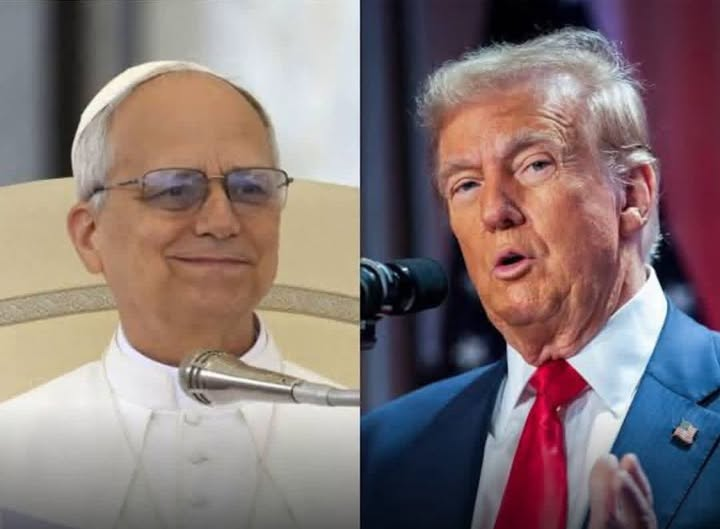
Despite these explanations, the timing of the decision has drawn widespread attention due to its proximity to an increasingly public and contentious dispute between President Trump and Pope Leo XIV, the head of the Roman Catholic Church.
The disagreement between the two leaders has unfolded over several days and centres on issues including immigration policy and the United States’ military involvement in the ongoing Iran conflict. Pope Leo XIV has repeatedly criticised global leaders for prioritising military expenditure over humanitarian needs, warning against the misuse of religion to justify violence.
Although the pope did not initially mention Trump by name, his remarks were widely interpreted as directed at U.S. policy. The situation escalated when Trump publicly criticised the pontiff, accusing him of interfering in political matters and expressing disagreement with his stance on foreign policy and migration.
The exchange has been described by observers as one of the most direct confrontations between a sitting U.S. president and a pope in modern history. Analysts note that tensions between Washington and the Vatican have been building since early 2026, forming part of a broader diplomatic rift driven by disagreements over war, migration, and global governance.
Within this context, the cancellation of funding to Catholic Charities has been viewed by some critics as politically motivated, although the administration has not explicitly linked the decision to the dispute with the Vatican. Church leaders and advocacy groups have nonetheless expressed concern that the move could have immediate humanitarian consequences.
Experts in child welfare warn that the shutdown of the Miami programme could disrupt the lives of children currently in care, many of whom have already experienced trauma during migration. Relocating minors to new facilities or foster arrangements, they caution, may expose them to further emotional stress and uncertainty.
The controversy has also extended to the broader Catholic leadership in the United States. In addition to the Miami programme, the administration has moved to cut ties with the United States Conference of Catholic Bishops in relation to refugee resettlement efforts, marking a significant shift in the government’s longstanding collaboration with religious organisations in humanitarian services.
Catholic leaders have responded by reaffirming their commitment to supporting vulnerable populations while urging dialogue rather than confrontation. Statements from church officials emphasise that their humanitarian work is rooted in longstanding religious and ethical principles, independent of political disputes.
At the same time, reactions within the United States political landscape have been mixed. Some political figures have defended the administration’s policy decisions as consistent with its broader immigration agenda, while others have criticised what they see as an unnecessary escalation of tensions with a major religious institution.
International reactions have also reflected concern about the implications of the dispute. Observers warn that the confrontation between Washington and the Vatican could have wider diplomatic and cultural repercussions, particularly given the global influence of both institutions.
The episode highlights the complex intersection of politics, religion, and humanitarian policy, especially in areas such as migration where moral, legal, and political considerations often overlap. It also underscores the challenges governments face in balancing domestic policy priorities with international perceptions and relationships.
As the three-month deadline approaches, uncertainty remains over the future of the children currently under the care of Catholic Charities in Miami. Authorities have not yet provided detailed plans for their relocation or continued support, leaving key questions about continuity of care unresolved.
The situation continues to evolve against the backdrop of the broader U.S.–Vatican dispute, with both sides maintaining their positions. While the Trump administration has framed its actions as policy-driven, critics argue that the broader context suggests a more complex dynamic shaped by both governance decisions and ideological differences.
For now, the cancellation of the contract represents a significant development in U.S. immigration policy and church-state relations, with implications that extend beyond the immediate programme to the wider framework of humanitarian cooperation in the country.
📩 Stone Reporters News | 🌍 stonereportersnews.com
✉️ info@stonereportersnews.com | 📘 Facebook: Stone Reporters News | 🐦 X (Twitter): @StoneReportNew | 📸 Instagram: @stonereportersnews
Add comment
Comments