

Reported by: Ijeoma G | Edited by: Oravbiere Osayomore Promise.
The National Drug Law Enforcement Agency has uncovered a carefully coordinated international drug trafficking attempt involving the concealment of cocaine in food flasks destined for the United Kingdom, in an operation that highlights the continued evolution of smuggling tactics through Nigeria’s aviation hubs.
The seizure, carried out at the export section of the Murtala Muhammed International Airport in Ikeja, Lagos, involved 12 large parcels of cocaine hidden in specially modified food flasks with false bottoms designed to evade routine airport screening procedures. The total weight of the intercepted narcotics was approximately 2.80 kilograms.
The operation, which took place on April 9, 2026, was executed by NDLEA operatives stationed at the airport cargo terminal following intelligence-led surveillance on outbound shipments flagged for suspicious packaging and routing patterns. The consignment was reportedly scheduled to be transported to the United Kingdom via a Virgin Atlantic flight, a detail that has raised renewed concerns about the use of commercial passenger airlines and cargo channels by organised drug trafficking syndicates.
According to the spokesperson of the agency, Femi Babafemi, the interception led to the immediate arrest of two cargo agents identified as 33-year-old Ama Obinna Ufeim and 39-year-old Ogabi Monday Akorede. Both individuals were reportedly involved in handling the export documentation and physical processing of the shipment at the airport export shed.
Preliminary investigations by the agency revealed that the suspects were part of a broader logistics chain facilitating the movement of illicit drugs through legitimate export frameworks. Authorities believe the concealment method—embedding cocaine within modified food flasks—was deliberately designed to exploit gaps in cargo inspection processes and avoid detection during standard scanning procedures.
Following initial interrogations, NDLEA operatives expanded the investigation beyond the airport environment, leading to the arrest of a 52-year-old freight and forwarding agent, Agoro Tajudeen Moninuola, identified as the alleged principal sender of the consignment. His arrest was carried out during a follow-up operation aimed at dismantling the network behind the shipment.
Officials say the coordinated arrests indicate a structured supply chain involving multiple layers of actors, including logistics facilitators, clearing agents, and exporters, all playing different roles in the attempted movement of narcotics out of Nigeria. The agency noted that such networks often rely on legitimate business operations to disguise illicit activities, making detection more complex.
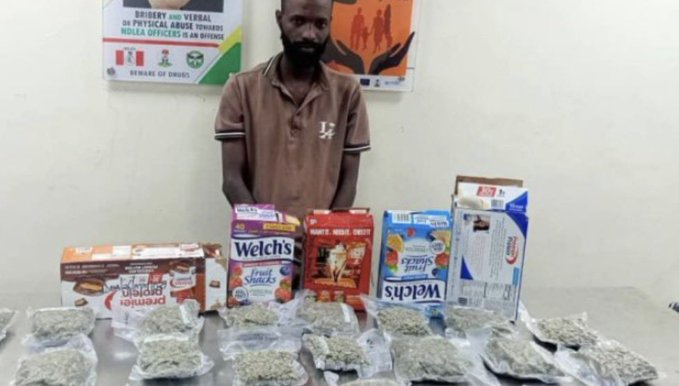
In a separate but related development at the same airport, NDLEA officers operating at the import section intercepted another consignment containing 2.90 kilograms of a potent cannabis strain known as “Loud.” The drugs were discovered concealed within snack packaging and had arrived in Lagos from the United States aboard a Delta Airlines flight.
The interception triggered another wave of arrests involving individuals linked to the importation process. Two cargo clearing agents, identified as Animashaun Moshood Adetunji and Mercy Gabriel Oluwasegun, were initially taken into custody after being connected to the clearance documentation of the shipment.
Further investigation led operatives to a follow-up arrest of the alleged consignee, 29-year-old fashion designer Saheed Adeshina Adegoke, who was apprehended at his residence on Oba Ogunji Road in the Ogba area of Lagos on April 13, 2026. Authorities say his arrest is part of efforts to identify end-point distributors within urban drug markets who receive imported narcotics for local circulation.
The NDLEA has described both operations as interconnected examples of how international drug trafficking networks are increasingly leveraging commercial shipping systems, passenger airlines, and courier services to move illicit substances across borders. The agency says traffickers are constantly adapting concealment methods, including the use of everyday household items, packaged food products, and commercial goods to bypass security checks.
Beyond Lagos, the agency also reported additional seizures across several states, including Kaduna, Cross River, Edo, and other parts of Lagos State, where quantities of skunk, cannabis, and tramadol were recovered during coordinated raids. These operations led to the arrest of seven additional suspects believed to be involved in local distribution and retail supply chains.
Officials say these multi-state operations form part of a wider national crackdown aimed at disrupting both international trafficking routes and domestic distribution networks. The agency has increasingly focused on targeting not only couriers but also financial backers, logistics coordinators, and retail-level distributors who sustain the drug trade ecosystem.
The NDLEA noted that traffickers are adopting increasingly sophisticated concealment techniques in response to enhanced airport surveillance technologies and intelligence-sharing between security agencies. Methods such as modified food containers, double-layer packaging, and integration into legitimate cargo exports are now frequently observed in interdicted shipments.
In response, the agency has intensified its intelligence-driven operations at airports, seaports, and land borders, while also strengthening collaboration with international partners to track drug movements across jurisdictions. Officials say these partnerships are critical in identifying transnational networks that operate across multiple countries.
The agency also highlighted its ongoing War Against Drug Abuse (WADA) initiative, which complements enforcement actions with public education campaigns aimed at reducing domestic demand for illicit substances. The programme has been implemented across schools, religious centres, workplaces, and community gatherings nationwide.
Authorities maintain that tackling drug trafficking requires a dual approach involving both supply reduction through enforcement and demand reduction through awareness and rehabilitation programmes. They argue that without addressing local consumption, international trafficking networks will continue to find viable markets.
As investigations continue into the latest seizures, NDLEA officials say efforts are underway to trace additional collaborators both within and outside Nigeria, particularly those involved in financing, packaging, and coordinating international shipments.
The agency reiterated its commitment to dismantling drug trafficking organisations operating within the country’s borders and warned that individuals involved in the illicit drug trade will face prosecution under existing national drug control laws.
The latest interceptions at Lagos airport further underscore Nigeria’s strategic position within global trafficking routes and the persistent challenge posed by organised criminal networks that continuously refine their methods to evade detection.
📩 Stone Reporters News | 🌍 stonereportersnews.com
✉️ info@stonereportersnews.com | 📘 Facebook: Stone Reporters News | 🐦 X (Twitter): @StoneReportNew | 📸 Instagram: @stonereportersnews
Add comment
Comments