

Reported by: Ijeoma G | Edited by: Oravbiere Osayomore Promise.
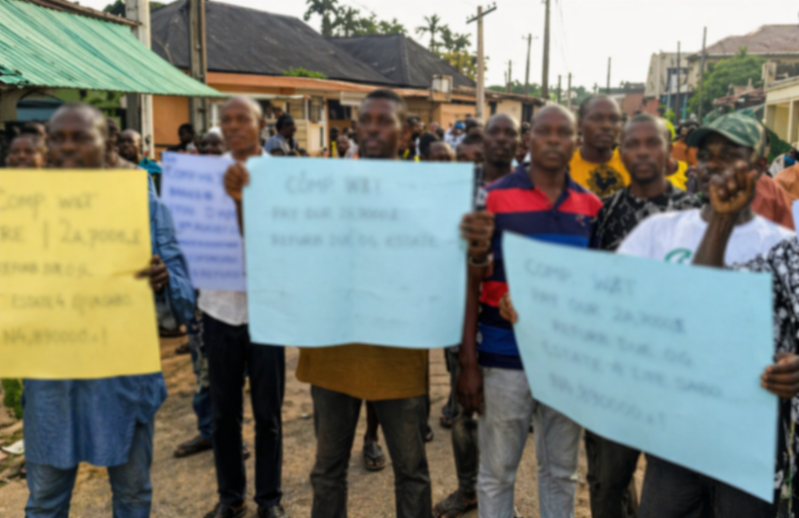
Residents of Maya Olorijo Estate in the Ikorodu area of Lagos State staged a peaceful but fiery protest on Monday, venting their fury over an 18-month power outage that has plunged their community into total darkness, crippled small businesses, and left families at the mercy of armed robbers and skyrocketing fuel costs. The protesters, predominantly landlords and youths, marched to the Ikeja Electric Business District office in the Alogba area, holding placards with inscriptions such as “18 months in darkness, killing Olorijo” and “18 months, no light for creditworthy customers, bring back our transformer”. The demonstration marks the latest in a growing wave of unrest across Lagos, as residents increasingly push back against electricity distribution companies over erratic power supply and what they describe as exploitative indifference.
Victor Ologhobo, Chairman of the Olorijo Community Development Association, addressed the crowd and laid out the sequence of neglect that led to the protest. According to Ologhobo, the crisis began after a transformer serving the area developed a fault. Staff of Ikeja Electric took the transformer for repairs on 13 January 2025, and the community has been in total darkness ever since. “We are not asking for too much, give us a new transformer or repair and return the one taken from our community,” Ologhobo said. He highlighted the severe impact of the prolonged blackout on local business owners, noting that reliance on fuel-powered generators has significantly increased operational costs. “We cannot continue like this; armed robbers disturb us, and we spend a lot of money on fuel and hiring local vigilantes,” he added.
The protestors’ frustration is rooted in more than just inconvenience. For 18 months, residents have been forced to navigate a perilous existence. Without streetlights, the community has become a prime target for criminal elements, forcing residents to pool resources to hire local vigilantes for protection. Small-scale artisans, traders, and food vendors have seen their profit margins evaporate as they are forced to run petrol generators for hours daily just to keep their businesses alive. Many have resorted to sleeping in their shops to protect their goods from theft, a direct consequence of the total darkness that envelops the area each night. The economic strain is compounded by the fact that many of these residents are still expected to pay electricity bills based on estimated readings, a practice they describe as adding insult to injury.
In response to the protest, Emmanuel Iberuche, the Business Manager for Ikeja Electric in Ikorodu, apologised to the residents for the delay in returning the transformer. He attributed the challenge to bureaucracy and due process involved in supplying new transformers or repairing faulty ones, noting that the company also suffers losses when communities are without electricity. Iberuche assured the protesters that reports of their grievances would be forwarded to the headquarters, promising a follow-up on their matter. “We are very sorry and we understand your plight, all your complaints will be forwarded to our headquarters,” he said. “Please give us till the end of the month. I will follow up on this matter and feed you back when the transformer will be ready”. Adding a technical perspective, Samuel Odukoya, Head of the Technical Unit at Ikeja Electric, told the gathering that his team would install the transformer at no cost to the community as soon as approval is granted.
The Maya Olorijo protest is not an isolated incident but part of a broader pattern of systemic failure in Nigeria’s power sector. In February 2026, residents of Waterfront Estate, Sekumade Estate, and the NBC Community in the Ebute axis of Ikorodu barricaded the entrance to the same Ikeja Electric office, protesting an eight-month blackout after their sole transformer developed a fault. In those cases, a senior company official admitted that about 300 faulty transformers across Ikorodu were awaiting attention in their workshop, explaining that the repair or replacement process could only be done one at a time. More recently, in March 2026, residents of the Okokomaiko area physically resisted attempts by Ikeja Electric officials to disconnect their community light after weeks of prolonged blackout, an incident that drew the backing of human rights activist Francis Nwapa. Nwapa described the privatised electricity system as exploitative and anti-poor, criticising the controversial band classification system where some households are made to pay as much as ₦90,000 monthly in a country where the minimum wage is ₦70,000.
As the sun set on Monday evening, the residents of Maya Olorijo returned to their homes, still in darkness, clutching only the vague promise of action by the end of the month. For a community that has waited 18 months for a solution, the timeline offered by Ikeja Electric feels less like a guarantee and more like another page in a long book of broken promises. The protest may have ended, but the underlying crisis remains unresolved. Until the transformer is restored, the residents of Olorijo will continue to count their losses, fuel their generators, and watch their doors through the night.
📩 Stone Reporters News | 🌍 stonereportersnews.com
✉️ info@stonereportersnews.com | 📘 Facebook: Stone Reporters News | 🐦 X (Twitter): @StoneReportNew | 📸 Instagram: @stonereportersnews
Add comment
Comments