

Reported by: Oahimire Omone Precious | Edited by: Oravbiere Osayomore Promise.
A facility assessment conducted last month by Tracka, the civic technology platform of BudgIT, has revealed a mixed picture of primary healthcare delivery in Kano State, with several centres fully operational yet still lacking basic infrastructure such as electricity, staff accommodation, and ambulance services. The assessment, which visited dozens of Primary Healthcare Centres across the state’s 44 local government areas, found that while some facilities have been completed and are actively serving residents, persistent gaps in funding and logistics continue to undermine the quality of care.
The findings come at a time when Kano State has committed to upgrading all 484 PHCs to provide 24-hour services by the end of 2026, a target that appears increasingly ambitious given the scale of infrastructure deficits documented in the assessment.
Among the facilities profiled, the Bichi Community Clinic Health Centre in Bichi Local Government Area stands as a facility that is both complete and actively serving residents. However, the assessment identified significant gaps that hinder its full potential. The centre operates without reliable electricity, forcing health workers to rely on torchlights and phone flashlights during night duties, a reality that mirrors conditions across many rural PHCs in Kano.
The facility also lacks staff accommodation, which forces many health workers to commute long distances, contributing to chronic staff shortages and fatigue. Additionally, the absence of an ambulance means that emergency referrals depend entirely on the personal vehicles of health workers or the goodwill of community members, a situation that can prove fatal in obstetric emergencies or trauma cases.
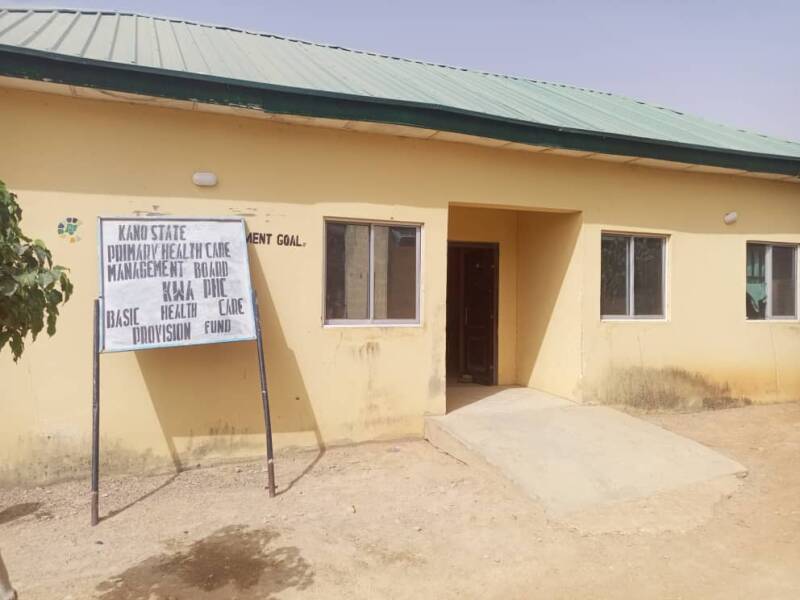
In contrast, the Mu’azu Ibrahim Mainasra Health Clinic in Tarauni Local Government Area and the KWA Primary Healthcare Centre in Dawakin Tofa Local Government Area were both found to be functional, properly fenced, and delivering healthcare services at the time of the Tracka visit. The assessment noted that these facilities had made notable progress in basic infrastructure, including secure perimeters and operational service delivery points. However, the broader context of Kano’s healthcare system suggests that even functional facilities face ongoing challenges, including drug shortages, inadequate staffing, and unreliable water supply.
The Tracka assessment forms part of the Strengthening Community Engagement and Accountability for PHC Project, a five-state initiative supported by BudgIT that empowers communities to monitor service delivery, financing, and infrastructure deployment at primary health facilities. The project currently operates in 75 communities across Kano, Kaduna, Gombe, Niger, and Yobe states, with plans for a national rollout to cover nearly 6,000 facilities. The PHC Accountability Tracka digital platform enables citizens to review and report on the state of their community’s health facilities, capturing key details on everything from facility location and available services to the condition of basic amenities such as toilets, water, electricity, and drug dispensing units.
The mixed findings from Tracka’s assessment must be viewed against the backdrop of a wider crisis in Kano’s primary healthcare system. An investigative report published last month by Economic Confidential found that across dozens of PHCs in Sumaila, Shanono, Gwarzo, and other local government areas, facilities are in a state of deep disrepair. At Jisai Health Post in Sumaila, the ceiling has fallen off and the roof leaks whenever it rains. At Yan Shadu Health Post in Shanono, the officer in charge said the clinic becomes unusable during heavy rains because rainwater enters the building and patients have nowhere to stay. Many PHCs have no clean water, forcing health workers to pay for water fetched from distant dams. Electricity is equally scarce, with many centres operating in total darkness. Most PHCs visited had only three common drugs: paracetamol, anti-malaria medication, and Flagyl.
Despite these challenges, the Kano State government has made significant investments in primary healthcare. The Commissioner for Health, Dr. Abubakar Labaran, announced in January that the state had constructed 324 functional PHCs over the previous two years, out of a proposed 483 across all wards. The 2026 budget prioritises facility renovations and the provision of modern technology to improve emergency response and reduce patient waiting times. However, civil society organisations have raised concerns about weak oversight, poor accountability, and inefficient use of funds. A Service Availability and Readiness Assessment conducted by the Resource Centre for Human Rights & Civic Education across 91 PHC facilities in 11 local government areas revealed that foundational infrastructure gaps remain widespread, with some local governments recording infrastructure readiness below 24 percent.
For the communities served by Bichi, Tarauni, and Dawakin Tofa, the Tracka assessment provides valuable data that can be used to advocate for improvements. The PHC Accountability Tracka platform allows patients and community members to provide real-time feedback on service gaps, forming the basis for structured advocacy meetings with local authorities and health officials. In other states, such advocacy has already led to documented responses, including the restoration of boreholes in Niger State and repairs to damaged facilities. Whether similar accountability mechanisms will yield tangible results for the people of Kano remains to be seen, but the assessment has at least put a spotlight on what is working and what is not. For now, mothers in Bichi continue to deliver babies by torchlight, health workers in Tarauni stretch their limited resources to serve growing patient numbers, and the promise of 24-hour healthcare remains just that: a promise.
📩 Stone Reporters News | 🌍 stonereportersnews.com
✉️ info@stonereportersnews.com | 📘 Facebook: Stone Reporters News | 🐦 X (Twitter): @StoneReportNew | 📸 Instagram: @stonereportersnews
Add comment
Comments