

Reported by: Oahimire Omone Precious | Edited by: Oravbiere Osayomore Promise.
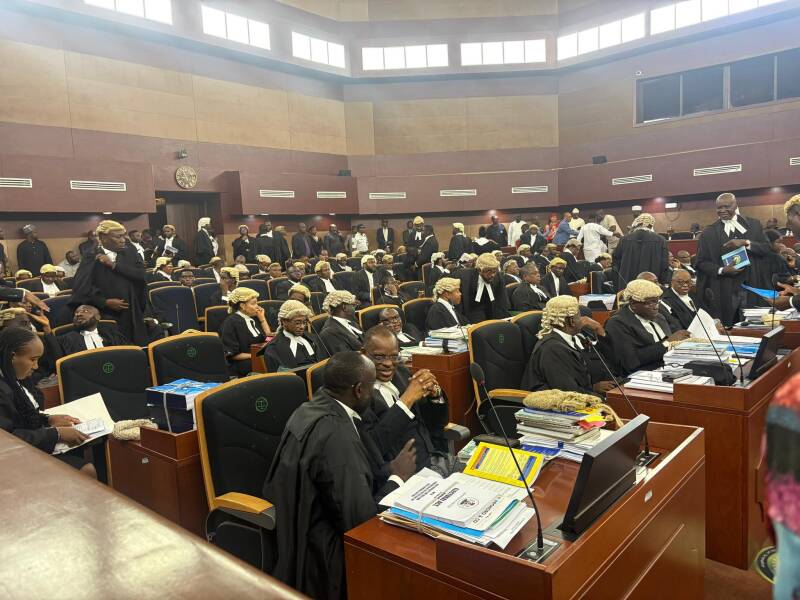
The Supreme Court of Nigeria has reserved judgment in the high stakes leadership dispute tearing apart the African Democratic Congress (ADC), following a full day of intense legal arguments that saw both factions present competing claims to the party’s national executive structure. The hearing, which commenced at the apex court in Abuja on Wednesday, April 22, 2026, attracted a crowd of party loyalists and legal observers, all waiting to see whether the five-member panel would deliver a definitive ruling that could determine the opposition’s shape heading into the 2027 general elections. Presiding Justice Mohammed Garba, leading a panel of five justices, heard submissions from lawyers representing the David Mark led faction and the faction loyal to Nafiu Bala Gombe, before announcing that the court would deliver its ruling on a date to be communicated to the parties. “Judgment is reserved,” Justice Garba declared after both sides concluded their arguments, leaving party members and political stakeholders in a state of anxious anticipation. The appeal, marked SC/CV/180/2026, challenges the March 12 judgment of the Court of Appeal, which dismissed an earlier appeal by the Mark faction and ordered all parties, including the Independent National Electoral Commission (INEC), to maintain the status quo ante bellum pending the determination of the substantive suit. That appellate ruling had triggered a cascade of consequences, including INEC’s decision on April 1 to remove the names of Mark and his interim National Secretary, Rauf Aregbesola, from its official portal, effectively derecognising the faction that had controlled the party’s national secretariat.
The courtroom drama unfolded against the backdrop of a party that has become the main gathering point for opposition heavyweights seeking to challenge President Bola Tinubu in 2027. The ADC has attracted a constellation of political figures, including former Vice President Atiku Abubakar, former Labour Party candidate Peter Obi, former Kaduna State Governor Nasir El Rufai, and former Transport Minister Rotimi Amaechi, all of whom have aligned with the Mark led structure. However, the leadership dispute, which pits Mark against Bala, a former Deputy National Chairman who claims the party’s constitution was violated during the July 2025 transition that brought Mark to power, has thrown the coalition’s preparations into disarray. Bala’s faction has insisted that the party’s National Executive Committee never properly ratified the changes, and that INEC must enforce the Court of Appeal’s status quo order, which predates Mark’s assumption of office. The Supreme Court’s eventual ruling is expected to resolve not only the question of who lawfully controls the ADC’s National Working Committee, but also which faction has the authority to conduct primaries, nominate candidates, and spend the party’s funds in the run up to the 2027 elections.
Key figures present in court included the ADC’s National Publicity Secretary, Bolaji Abdullahi, who sat among the Mark faction’s supporters, and the National Secretary of the Peoples Democratic Party, Senator Samuel Anyanwu, whose presence raised eyebrows given his own party’s simultaneous leadership crisis also before the same court. The legal teams were led by Jibril Okutepa (SAN) for the Mark faction and a battery of lawyers for the Bala faction, including counsel who argued that the Court of Appeal’s March 12 ruling remains binding and that the Supreme Court should not stay its execution. Okutepa, who had earlier withdrawn a motion for stay of execution to allow the substantive appeal to proceed, urged the panel to set aside the appellate court’s decision, arguing that the lower court had meddled in the internal affairs of a political party, a matter over which the judiciary lacks jurisdiction. Counsel for Bala countered that the appeal was an abuse of court process and that the Mark faction had already lost at two lower courts, insisting that the Supreme Court should affirm the status quo order and allow INEC to enforce it without further interference.
The Supreme Court’s decision to reserve judgment rather than deliver a ruling immediately has intensified speculation about the outcome. Political analysts note that the court may be preparing a detailed judgment that could set important precedents regarding judicial intervention in party affairs, particularly in light of the Electoral Act 2026, which contains provisions that restrict the courts’ powers over pre election matters. Some observers suggest that the delay could also indicate a split within the panel, requiring more time to reconcile differing opinions. However, court officials have not confirmed any internal disagreements, and the standard practice of reserving judgment does not necessarily signal complexity. What is clear is that the clock is ticking. INEC’s timetable for the 2027 elections, released in March, mandates that political parties conduct their primaries between April 23 and May 30, 2026, a window that is already open. Without a clear ruling on who leads the ADC, the party risks missing critical deadlines for the submission of candidate lists, which could disqualify its aspirants from the ballot.
The stakes could not be higher. The ADC has positioned itself as the main opposition coalition, hoping to unseat President Tinubu by uniting the fragmented opposition under one banner. However, the leadership dispute has paralysed the party’s secretariat, prevented the conduct of congresses, and created uncertainty among aspirants who have already purchased nomination forms worth millions of naira. If the Supreme Court rules in favour of the Mark faction, the party is expected to move quickly to conduct primaries and reconcile with Bala’s group. If the court upholds the Court of Appeal’s status quo order and effectively sides with Bala, the Mark led structure could be dismantled, throwing the party into a leadership vacuum that would require emergency conventions to fill. In either scenario, the party faces a race against time to meet INEC’s deadlines.
Meanwhile, the ADC’s rivals are watching closely. The ruling All Progressives Congress (APC) has already finalised its own primary schedule, with presidential primaries set for May 15 and 16, 2026. The PDP and Labour Party are also before the Supreme Court seeking resolution of their own leadership disputes, meaning that the apex court’s rulings could reshape the entire opposition landscape. For the ADC, the judgment will determine whether it enters the 2027 campaign as a unified force capable of mounting a serious challenge, or as a fractured entity struggling to field candidates. As the party awaits the Supreme Court’s date, the battle for its soul continues. But for now, the only certainty is uncertainty, and the only sound is the ticking clock.
📩 Stone Reporters News | 🌍 stonereportersnews.com
✉️ info@stonereportersnews.com | 📘 Facebook: Stone Reporters News | 🐦 X (Twitter): @StoneReportNew | 📸 Instagram: @stonereportersnews
Add comment
Comments