

Reported by: Ijeoma G | Edited by: Oravbiere Osayomore Promise.
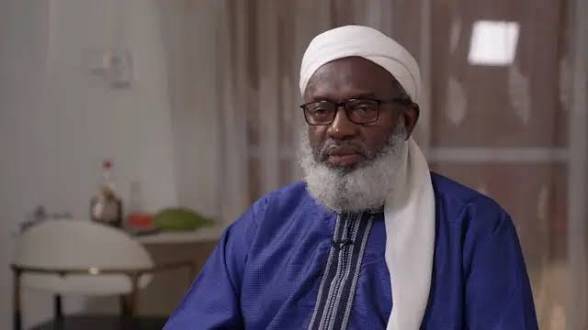
Islamic cleric Sheikh Ahmad Gumi has called on the Nigerian government to reconsider its longstanding refusal to negotiate with terrorist groups, arguing that the “Western slogan” of non-negotiation has trapped the country in a perpetual cycle of violence. In a Facebook post on Wednesday, the Kaduna-based scholar urged authorities to adopt a more pragmatic approach, citing ongoing diplomatic talks between the United States and Iran as evidence that even sworn enemies can sit around a negotiating table.
Gumi, who has frequently courted controversy for his direct engagement with bandit leaders, insisted that military force alone has failed to deliver lasting peace. “As long as Nigeria’s borders remain porous, and the government struggles to control the influx of illegal weapons, drugs, and explosives, the cycle of violence will persist,” he wrote. He warned that heavy-handed military responses often result in civilian casualties, leaving the same communities to bear the brunt of violence from both sides. The cleric suggested that Nigeria might benefit from what he described as a “Pakistan-style” circuit breaker — a neutral mediator capable of facilitating dialogue and reducing tensions. “The lesson is clear: lasting solutions require realism, dialogue, and strategic understanding, not just force,” Gumi said. He maintained that understanding the root causes of terrorism is essential before designing any effective response, adding that “what violence creates, violence alone cannot resolve.”
The cleric’s latest intervention drew immediate condemnation from civil society. The Human Rights Writers Association of Nigeria (HURIWA) recalled Gumi’s earlier claim that the government knows the identities and locations of every terrorist operating in the country. “If indeed the Federal Government knows every terrorist by name and location as claimed, then Nigerians deserve to know why these criminals continue to roam freely, kidnapping school children, murdering farmers, attacking communities and destabilising the nation,” the group said in a statement. HURIWA has previously threatened to drag the Nigerian government before the United States Congress and the International Criminal Court if it fails to act on what it called “actionable intelligence” allegedly known to authorities. The group also questioned why Gumi himself has not been formally interrogated despite his admitted interactions with armed groups, raising concerns about the seriousness of the country’s counterterrorism policy.
The federal government has remained firmly opposed to dialogue with terrorist organisations. In January, the Minister of Defence, General Christopher Gwabin Musa (retired), explicitly warned state and local governments to discontinue any form of negotiation with bandits, insisting that “peace deals with terrorists are not one of our non-kinetic approaches.” Musa declared that “terrorists do not respect peace agreements,” describing such engagements as “deceptive and harmful to national security.” The government has also repeatedly affirmed that it does not pay ransom to kidnappers or terrorist groups, with the military under strict orders to engage and eliminate armed non-state actors without delay.
The debate over dialogue versus military force has intensified as Nigeria continues to grapple with multiple security challenges across its northern regions. Boko Haram and Islamic State West Africa Province (ISWAP) remain active in the North East, while heavily armed bandit groups have turned vast areas of the North West and North Central into theatres of abduction, extortion, and mass killings. President Bola Tinubu, in December 2025, issued an executive order classifying all armed non-state actors as terrorists, declaring that “we will show no mercy to those who commit or support acts of terrorism, banditry, and kidnapping for ransom.”
Gumi, for his part, has defended his mediation efforts as a moral and religious duty. He has consistently argued that amnesty programmes — such as the one extended to Niger Delta militants under the late President Umaru Musa Yar’Adua — offer a viable template for resolving the current crisis. In a recent interview, he disclosed that he does not visit bandit camps alone but is accompanied by security agencies, claiming that his role is to facilitate dialogue where trust between the government and armed groups has broken down. However, critics argue that such engagements risk legitimising criminality and may undermine ongoing military operations.
The cleric’s call for dialogue also drew a parallel with US-Iran relations, where both nations continue to engage diplomatically despite publicly labelling each other as adversaries. “Iran sees the USA as the biggest devil. The USA sees Iran as part of the axis of evil. All parties see the other as terrorists. Yet they are over a roundtable,” Gumi said. He questioned why Nigeria should adopt a stricter posture than major world powers. “We should not be misled by the Western slogan, ‘We don’t negotiate with terrorists’,” he wrote. “In practice, negotiations do occur.”
While some security analysts argue that a purely military approach cannot succeed without addressing the underlying socio-economic drivers of insurgency and banditry, the government has shown no indication of shifting its position. Defence Minister Musa, speaking at the Antalya Diplomacy Forum in Türkiye, reaffirmed that Nigeria remains committed to international counterterrorism cooperation, but insisted that dialogue with non-state armed groups is not on the table. As the debate continues, Gumi remains one of the most polarising figures in the national conversation, with his latest intervention likely to further divide public opinion between those who see dialogue as a necessary evil and those who view any form of negotiation as a betrayal of victims of terrorism.
📩 Stone Reporters News | 🌍 stonereportersnews.com
✉️ info@stonereportersnews.com | 📘 Facebook: Stone Reporters News | 🐦 X (Twitter): @StoneReportNew | 📸 Instagram: @stonereportersnews
Add comment
Comments