

Reported by: Oahimire Omone Precious | Edited by: Oravbiere Osayomore Promise.
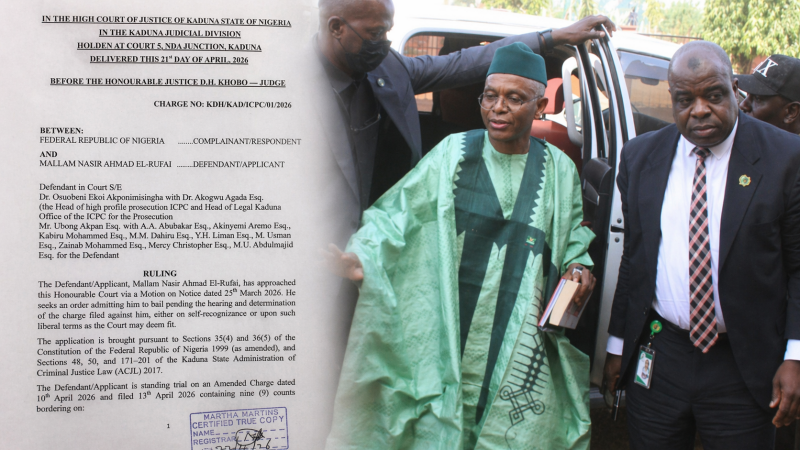
A Certified True Copy of the ruling by a Kaduna State High Court has revealed that the bail application of former governor Nasir El-Rufai was refused primarily because his legal team failed to file a further affidavit to counter the “weighty” allegations levelled against him by the Independent Corrupt Practices and Other Related Offences Commission (ICPC). Justice Darius Khobo, in his ruling delivered on April 21, 2026, held that the prosecution’s unchallenged claims, which included allegations that the former governor was a flight risk and had obstructed law enforcement, were therefore deemed admitted by the court. The ruling, a copy of which was obtained by TheCable, provides the most detailed judicial reasoning behind the denial of bail in the former governor’s ongoing nine‑count corruption case.
Justice Khobo noted that while El-Rufai’s bail application, filed on March 25, was supported by a 24‑paragraph affidavit arguing that the charges were non‑capital and that the former governor had deep community ties and had voluntarily returned from Egypt to honour an EFCC invitation, the ICPC’s counter‑affidavit raised serious objections. The anti‑graft agency described the alleged offences as “economically sabotaging” and expressed a “genuine fear of interference with witnesses and ongoing investigations involving other persons still at large.” The ICPC also told the court that El‑Rufai had obstructed law enforcement officers at the Abuja airport in February and that he was a “flight risk with the means to evade trial due to his high standing in society.”
The judge said the applicant failed to file a further and better affidavit to controvert these “weighty depositions.” Citing established legal principles, Justice Khobo ruled that “failure to file a further affidavit by the applicant to further controvert the above‑outlined weighty depositions in the Respondent’s counter affidavit leaves the said weighty depositions in the counter affidavit unchallenged and deemed to be admitted as being correct.” The judge also noted that while El‑Rufai had claimed underlying health conditions requiring specialist care, “no medical evidence was provided to substantiate the claim of ill‑health.”
The court, therefore, refused the bail application and ordered that El‑Rufai remain in the custody of the ICPC pending the commencement of an accelerated trial scheduled for the first week of June 2026. Justice Khobo directed that the trial will proceed on a day‑to‑day basis once it begins. The ruling was delivered at Court 5, NDA Junction, Kaduna, after the judge had reserved judgment following the April 14 hearing.
El‑Rufai’s lead counsel, Ubong Akpan (SAN), expressed dissatisfaction with the ruling, arguing that the decision was based on the former governor’s status, which the court described as a “double‑edged sword.” “We are grateful to His Lordship for the learning he has shown, but we respectfully disagree,” Akpan said, adding that the defence team would challenge the decision through appropriate legal channels. He maintained that the charges against his client were politically motivated.
The former governor is standing trial on an amended nine‑count charge dated April 10, 2026, and filed on April 13. The ICPC accuses him of multiple infractions during his tenure as governor from 2015 to 2023. Among the most serious allegations is that El‑Rufai induced the Kaduna State Government to release about N11 billion to an unregistered entity, Indokaduna MRTS JV Nigeria Limited, for a light rail project that was never executed. He is also accused of approving and receiving approximately N289.8 million as severance allowance, far above the legally entitled sum of about N20 million, and of mismanaging over $1.08 million, part of a World Bank loan to the state, in violation of the loan agreement. The ICPC further alleged that he conspired with an associate, who is reportedly at large, to offer monetary inducements to federal investigators in an attempt to compromise an ongoing investigation involving a private firm.
This bail refusal comes despite a separate Federal High Court in Kaduna granting El‑Rufai bail in the sum of N200 million in another corruption case filed by the ICPC. In that instance, Justice Rilwanu Aikawa admitted him to bail but ordered that he remain in ICPC custody pending the fulfilment of the conditions, which include a bar on making public comments on the case.
El‑Rufai has been in ICPC custody since February 19, 2026, following his release by the Economic and Financial Crimes Commission. He was briefly released on compassionate grounds on March 27 to attend the burial of his mother, who passed away that same day, before being returned to custody. The former governor, who served as Minister of the Federal Capital Territory under President Olusegun Obasanjo, has consistently denied all allegations, describing his legal travails as a politically motivated witch‑hunt. His legal team has vowed to appeal the ruling, but for now, the man who once governed Kaduna State remains behind bars, his freedom hanging on the outcome of a trial yet to begin.
📩 Stone Reporters News | 🌍 stonereportersnews.com
✉️ info@stonereportersnews.com | 📘 Facebook: Stone Reporters News | 🐦 X (Twitter): @StoneReportNew | 📸 Instagram: @stonereportersnews
Add comment
Comments