

Reported by: Oahimire Omone Precious | Edited by: Oravbiere Osayomore Promise.
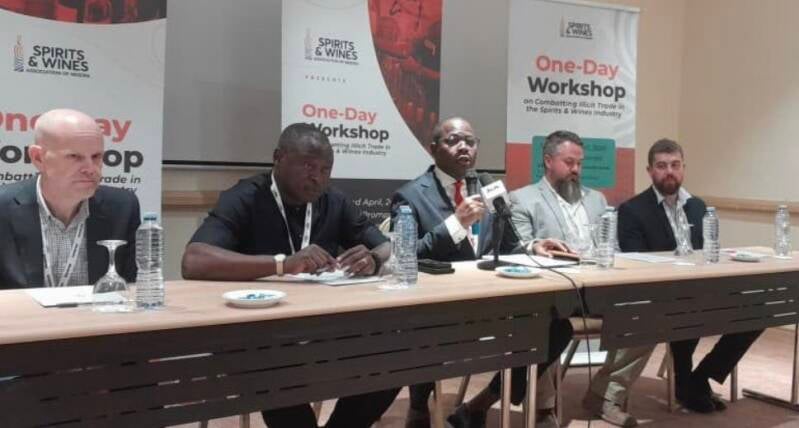
The Spirits and Wines Association of Nigeria has called for stronger multi-level action towards tackling illicit spirits and wines trade in the country, citing how much it is affecting lives, businesses and the economy. Speaking at a press briefing in Abuja on Wednesday at the end of a one-day stakeholder workshop on combating illicit trade in Nigeria’s spirits and wines sector, Michael Ehindero, president of SWAN, noted the urgency of collective action while rallying key players in the industry against the menace. He said the event, which brought together regulators, policymakers, enforcement agencies, and key industry players, was aimed at forging a coordinated response to the growing challenge of illicit trade in Nigeria. The workshop was themed “Combating illicit trade in the spirits and wines industry in Nigeria.”
“Illicit trade in spirits and wines is not just an industry issue—it is a national concern. It undermines consumer safety, erodes government revenue, and distorts fair competition,” Ehindero said. “Today’s engagement reinforces that sustainable solutions will only come from coordinated efforts across government, industry, and enforcement agencies.” He said deliberations during the workshop reaffirmed a shared concern that illicit trade, particularly in spirits and wines, remains a significant threat to the public health of Nigerians, to government revenue, and to the sustainability of legitimate businesses operating within the law in the country. According to him, participants examined the scale and impact of illicit alcohol, shared insights from both local and international perspectives, and identified practical and coordinated approaches to tackle the problem.
One of the most startling revelations to emerge from the workshop was the sheer scale of the illicit market. Citing a 2024 survey conducted by the global market research firm Euromonitor, SWAN president stated that an astonishing 40 per cent of all spirits and wines consumed in Nigeria are illicit products. “According to a survey carried out by Euromonitor in 2024, the level of illicit trade in spirits and wines in Nigeria was about 40 per cent, which suggests that for every five bottles sold, two were from illicit trade,” the organisation’s Director-General, Tony Okwoju, explained. This revelation has profound implications. It means that a significant portion of the alcoholic beverages consumed daily at social gatherings, weddings, religious ceremonies, and in private homes across the nation are unregulated, unsafe, and potentially lethal.
The economic cost of this widespread criminal activity is staggering. SWAN estimates that the federal and state governments forfeit a staggering N428 billion in revenue annually due to the illicit trade. This includes unpaid excise duties, import tariffs, and value-added taxes. This money, the association argues, represents a substantial loss of funds that could be channeled into critical public services such as healthcare, education, and infrastructure development. The impact on legitimate businesses is equally severe. Law-abiding companies that invest heavily in quality control, regulatory compliance, and employee welfare are being systematically undercut by illegal operators who face none of these costs. The result is a hostile and distorted business environment that discourages investment and threatens the long-term viability of the sector, which, in its legitimate form, supports thousands of direct and indirect jobs.
The drivers of the illicit trade are complex and multifaceted. Ehindero identified consumer demand for cheaper alternatives as a primary factor. In a challenging economic environment where inflation is eroding purchasing power, the allure of a lower-priced bottle can be overwhelming. This consumer behaviour is then exploited by sophisticated criminal networks. The SWAN president also pointed to systemic regulatory gaps that create opportunities for illegal trade to flourish, as well as taxation pressures that can inadvertently push operations underground. Participants at the workshop concluded that tackling the menace requires a holistic strategy of stronger collaboration, improved regulatory alignment, consistent enforcement, and a significant increase in consumer awareness.
The dark underbelly of this illicit market is the counterfeit segment. While it may represent a smaller portion of the overall problem, it is by far the most dangerous. In a separate but concurrent development, the National Agency for Food and Drug Administration and Control (NAFDAC) announced that it had dismantled two illegal production outlets in Lagos State, seizing products valued at approximately N350 million. At the Trade Fair Complex, NAFDAC said its enforcement operatives discovered makeshift production facilities equipped with plastic mixing tanks, improvised filtration systems, and vast quantities of empty branded bottles and used corks. These were used to produce and package counterfeit alcoholic drinks under unsanitary, unregulated conditions. NAFDAC warned that the consumption of such adulterated beverages poses serious health risks, including poisoning, organ damage, and death, and reiterated its commitment to prosecuting offenders.
The SWAN president emphasised that the issue should not be reduced to mere financial statistics. “We will not look at this conversation in solely monetary terms,” Ehindero said. “We must look at it in terms of the value of human lives. There is no value to human lives. We have seen reports of loss of life and serious health damage from exposure to illicit and counterfeit alcohol.” He stressed that the conversation is fundamentally about public safety and the value of human life. The workshop, which brought together over 800 participants, concluded with a call for sustained action. SWAN has committed to working closely with partners to translate the outcomes of the workshop into concrete measures that will curb illicit trade and strengthen the sector.
While the association has sounded the alarm, it is also offering solutions. SWAN believes that the tide can be turned through a multi-pronged approach: strengthening border controls to stem the flow of smuggled goods, enhancing surveillance of local distribution channels, imposing stiffer penalties on offenders, and launching widespread public awareness campaigns to educate consumers about the risks associated with unregulated products. The association has also pledged to continue collaborating closely with enforcement bodies such as NAFDAC and the Nigeria Customs Service. The message from the association is clear: the era of ignoring the pervasive threat of illicit alcohol must end. The battle to protect Nigerian lives and the Nigerian economy from the scourge of bad liquor has begun.
📩 Stone Reporters News | 🌍 stonereportersnews.com
✉️ info@stonereportersnews.com | 📘 Facebook: Stone Reporters News | 🐦 X (Twitter): @StoneReportNew | 📸 Instagram: @stonereportersnews
Add comment
Comments