

Reported by: Ijeoma G | Edited by: Oravbiere Osayomore Promise.
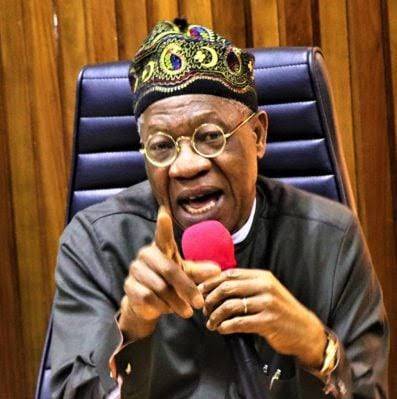
Former Minister of Information and Culture, Lai Mohammed, has dismissed allegations of a targeted genocide against Christians in Nigeria, describing such claims as “fake news” and insisting that the country’s security crisis is complex and not rooted in any deliberate religious extermination. Speaking in the United Kingdom during an interactive session with students of Abbey College, Cambridge, on Wednesday, April 21, 2026, Mohammed argued that Boko Haram initially targeted mainly Muslims who embraced Western education and only later extended its attacks to Christians as a calculated strategy to attract wider global attention. “Now, people say that there is religious persecution in Nigeria and that there is genocide against Christians. It’s not true. It is fake news,” he said.
Mohammed’s comments have reopened a fierce debate over the nature of violence in Nigeria’s North-East and North-Central regions, where thousands have been killed and millions displaced over nearly two decades of insurgency. He traced Boko Haram’s ideological roots to a rejection of Western education, a stance that originally made conventional, educated Muslims its prime targets. “At the beginning, the victims of Boko Haram were largely Muslims, not Christians. Boko Haram started as a revolt by extreme Muslims against conventional Muslims like me,” he said. He then explained the group’s tactical evolution: “They realised that Muslims killing one another doesn’t gain traction. When Muslims start killing Christians, it causes an uproar. That is the honest truth”.
The former minister stressed that Nigeria’s challenges are not the outcome of a state-driven or systematic campaign against Christians, but a complex web of poverty, weak governance, and criminal opportunism. “Nigeria as a country has challenges that will not be resolved by genocide against any religion,” he said. He also pushed back against the idea that banditry in the North-West is religiously motivated, describing it as a criminal enterprise in which perpetrators and victims often belong to the same ethnic and religious communities. “The bandits are Muslims, they are Hausa-Fulanis. Their victims are Muslims, they are Hausa-Fulanis. So how can you now talk about religion? It has nothing to do with religion,” he argued.
Mohammed held up what he called Nigeria’s long tradition of religious tolerance, pointing to interfaith marriages and everyday coexistence as evidence that communities are not defined by sectarian hatred. “In Nigeria, the average Muslim and Christian only disagree over money, not theology. They are more concerned about the economy and ways of life,” he said. He cited the marriage of President Bola Tinubu, a Muslim, and the First Lady, Oluremi Tinubu, who is a pastor of the Redeemed Christian Church of God (RCCG), as a reflection of the country’s religious harmony. “That is the Nigeria I know and I am very proud of,” he said.
The former minister’s remarks came just a day after US Senator Ted Cruz accused Nigerian officials of complicity in attacks against Christians. At a Senate Foreign Relations subcommittee hearing on Tuesday, Cruz alleged that Nigeria records the highest number of Christians killed for their faith anywhere in the world, claiming that more than 50,000 Christians have been killed since 2009 and over 20,000 churches, schools and other religious buildings destroyed. “Nigerian officials had been, unfortunately, complicit in facilitating these atrocities,” Cruz said. He also introduced the Nigeria Religious Freedom Accountability Act of 2025, which would ban any US official from attending events hosted by or in honour of Nigerian government officials implicated in the violence. According to the bill, the president of the United States would be required to submit to Congress a list of Nigerian officials alleged to be involved, and they would be subject to visa bans, asset freezes and blocked property transactions until remedying actions are taken.
The radically different assessments from Mohammed and Senator Cruz reflect the deep partisan and international split over how to characterise Nigeria’s violence. Meanwhile, the Christian Association of Nigeria (CAN) has previously denounced attacks on worshippers in Plateau and Kaduna states, describing the violence as “unacceptable” and demanding action rather than statements. In August 2025, the United States Commission on International Religious Freedom (USCIRF) recommended the continued designation of Nigeria as a Country of Particular Concern (CPC), citing “abysmal” religious freedom conditions and the broad scale of extremist attacks on Christian communities in the Middle Belt and northern states. In its 2026 annual report, USCIRF noted that, beyond Boko Haram and Islamic State West Africa Province (ISWAP), extremist violence has increasingly targeted Christian villages, worship centres and schools.
On the other side, the African Union has explicitly stated that there is no evidence of genocide in Nigeria, noting that the violence does not meet the legal definition under international law, which requires demonstrable intent to destroy a protected religious group in whole or in part. In late 2025, the Nigerian Supreme Council for Islamic Affairs (NSCIA) also rejected the narrative of a Christian genocide, arguing that jihadist groups kill both Muslims and Christians indiscriminately and destroy both mosques and churches. “As Amnesty International correctly stated, ‘The jihadist groups kill both Muslims and Christians. They demolish Mosques and Churches. They don’t differentiate’,” the NSCIA said at the time.
Mohammed’s intervention, though coming nearly 15 months after he left office, has been interpreted by analysts as a deliberate effort to shape the international conversation ahead of the 2027 elections and to push back against growing external pressure for targeted sanctions on Nigerian officials. By framing the genocide claim as “misinformation,” he aligns with the official stance of President Tinubu’s administration. However, the former minister’s critics, including human rights groups, have accused him of downplaying documented patterns of religiously motivated killings and forced displacement of Christian communities in the Middle Belt. Amnesty International’s Nigeria office, while noting that both Muslims and Christians are killed by jihadist groups, has also repeatedly condemned attacks targeting civilians and has called for these acts to be treated as war crimes.
As the debate continues, families of the thousands killed since 2009 are left to bury their dead, while survivors struggle to rebuild lives in camps and resettled communities. Mohammed’s call to “vigorously use public communication to challenge” the genocide narrative is unlikely to end the discord. For now, the international community remains divided: some continue to press for the classification of violence against Christians as genocide, while others argue that such a designation is legally unsound and risks undermining broader counter‑insurgency efforts. The truth on the ground is as contested as ever.
📩 Stone Reporters News | 🌍 stonereportersnews.com
✉️ info@stonereportersnews.com | 📘 Facebook: Stone Reporters News | 🐦 X (Twitter): @StoneReportNew | 📸 Instagram: @stonereportersnews
Add comment
Comments