

Reported by: Oahimire Omone Precious | Edited by: Oravbiere Osayomore Promise.
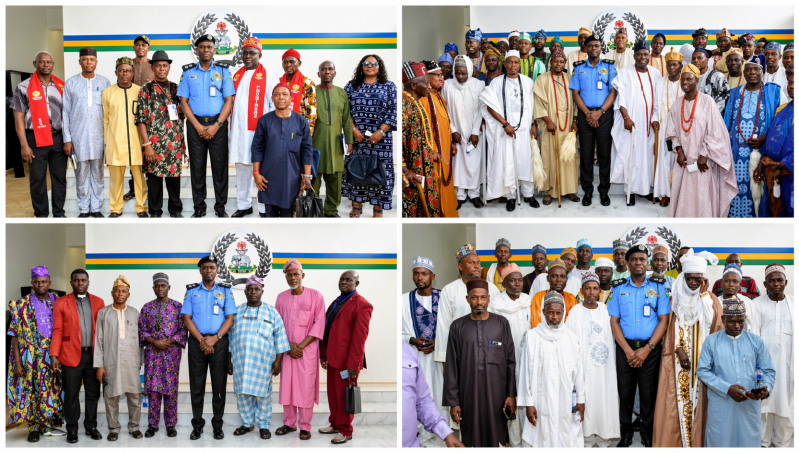
In a proactive and unprecedented move to address one of Nigeria’s most persistent security challenges, the Oyo State Police Command on Thursday convened a high-level stakeholders’ consultative meeting at its headquarters in Eleyele, Ibadan, bringing together traditional rulers, herders, farmers, religious leaders, and community representatives to forge a sustainable path toward peaceful coexistence. The landmark dialogue, which lasted several hours, marked the first time in recent memory that all key actors in the herder-farmer crisis sat around the same table without exchanging accusations. Instead, they engaged in frank and constructive discussions, openly expressing concerns while collectively shifting from entrenched grievances toward practical and collaborative solutions. The meeting was convened by the Commissioner of Police, CP Abimbola Ayodeji Olugbenga, who emphasised that true security cannot be achieved through enforcement alone but through mutual understanding and cooperation, noting that both farmers and herders play vital roles in the nation’s food security and economic stability.
The conflict between herders and farmers has plagued Oyo State and much of the North-Central and South-Western regions for decades, claiming thousands of lives and displacing countless communities. In Oyo State alone, multiple clashes have been recorded in areas such as Ido, Ibarapa, and Oke Ogun, where disputes over grazing routes, crop destruction, and access to water have frequently escalated into violent confrontations. Criminal elements have also exploited the tensions, with bandits and kidnappers sometimes disguising as herders to carry out attacks, further complicating the security landscape. Thursday’s dialogue was therefore not merely a peace meeting but a strategic intervention aimed at dismantling the cycle of suspicion and retribution that has fuelled the violence. The Commissioner of Police, CP Abimbola Ayodeji Olugbenga, said the command had observed that many clashes could have been prevented if there had been early warning systems and swift mediation at the grassroots level.
The meeting brought together a broad spectrum of critical stakeholders, including traditional rulers such as the Asaaju of Ido, the Baale of various farming communities, and representatives of the Sarkin Hausawa in Ibadan. Leaders of the Hausa, Fulani, and Yoruba communities were present, as were representatives of Miyetti Allah Cattle Breeders Association of Nigeria (MACBAN), farmers’ associations, market leaders, religious leaders, youth groups, and members of the Igbo community. The diversity of the participants underscored the command’s determination to address the crisis as a multi-dimensional problem affecting all ethnic and religious groups in the state. Participants engaged in open and honest exchanges, with herders complaining about the blocking of traditional grazing routes by farmers and the destruction of their cattle by suspected rustlers, while farmers accused herders of allowing cattle to graze on their crops and contaminating water sources.
After hours of deliberation, the meeting yielded several key resolutions designed to foster both immediate and long-term stability. The first and most significant resolution was the establishment of joint mediation committees at all area command levels across Oyo State. These committees, which will comprise representatives of herders and farmers from each locality, are tasked with promptly resolving disputes before they escalate into violence. The committees will operate under the supervision of the area commander and will have the authority to summon any party involved in a land or grazing dispute. The CP noted that the success of these committees would depend on the willingness of community leaders to cooperate and provide timely information. He also announced that the police would provide dedicated communication lines for each committee to ensure rapid response to emerging conflicts.
The second resolution focused on resource mapping, specifically the clear identification and demarcation of gazetted grazing reserves and traditional farming lands. Stakeholders acknowledged that many conflicts arise from uncertainty about which land is designated for grazing and which for farming. The state government has already identified several grazing reserves, including the Oke Ogun Grazing Reserve and the Ibarapa Grazing Reserve, but many are not properly marked or maintained. The meeting agreed that the Oyo State Ministry of Agriculture and the police would work with local communities to produce updated maps of grazing routes and farming zones, which will be disseminated to all area commands. The police also committed to enforcing the demarcations and preventing encroachment by either party.
The third key resolution was the proposal to deploy structured communication systems, including CCTV cameras at strategic intersections and information-sharing platforms that would allow farmers and herders to send real-time alerts about suspicious movements. The police command already operates a toll-free emergency line, 615, and control room numbers, but the new system would integrate community-based reporting channels, enabling local leaders to notify the police immediately when tensions rise. The CP emphasized that technology alone cannot solve the crisis, but it can provide the intelligence needed to deploy officers before a dispute turns deadly. He also noted that the police would work with telecommunication companies to improve network coverage in rural areas where many clashes occur.
Representatives of both farmers’ and herders’ associations pledged their commitment to working closely with the police to ensure a peaceful and secure environment. The state chairman of the All Farmers Association of Nigeria (AFAN), who attended the meeting, said farmers would cooperate with the joint mediation committees and would encourage their members to report grievances through official channels rather than resorting to self-help. Similarly, the chairman of Miyetti Allah in Oyo State expressed gratitude to the police for bringing all parties together, stating that herders had often felt demonised and unfairly targeted. He promised that his members would abide by the resolutions and would not allow their cattle to graze on farmlands without permission.
In their separate remarks, stakeholders expressed appreciation to the Oyo State Police Command for convening the timely and strategic meeting. The traditional rulers, in particular, praised the Commissioner for his courage in initiating such a dialogue at a time when inter-communal tensions were high. The Asaaju of Ido, who spoke on behalf of the traditional council, said that peace cannot be achieved by force alone and that the dialogue had shown a path forward. Religious leaders from both Christian and Muslim communities also offered prayers and pledged to use their pulpits to preach tolerance and non-violence. Youth leaders, who are often the first to take up arms in reprisal attacks, were given a platform to voice their frustrations and were urged to channel their energies into productive activities such as farming and skills acquisition.
The Commissioner of Police warned members of the public against taking the law into their own hands, reiterating the command’s unwavering commitment to safeguarding lives and property. He said that anyone found guilty of inciting violence or participating in jungle justice would be arrested and prosecuted, regardless of their ethnic or religious background. He also appealed to residents to use the emergency lines provided by the command and to trust the mediation committees to resolve disputes fairly. The CP noted that the success of the initiative would depend on sustained engagement and follow-up meetings, and he announced that the command would reconvene the stakeholders in three months to review progress and address any emerging challenges.
The Oyo State Police Command has urged residents to continue to support security agencies by providing timely and credible information. The command’s emergency contact numbers are 615 (toll-free), 08081768614, and 07055495413. The CP expressed confidence that with continued collaboration between herders, farmers, and the police, Oyo State could become a model for peaceful coexistence and agricultural prosperity in Nigeria. As the meeting ended, participants shook hands and exchanged phone numbers, a small but powerful symbol of a new beginning. The real test, however, will be whether the resolutions are implemented and whether the peace holds when the next dry season arrives and resources become scarce. For now, the police have lit a candle of hope in a region long shrouded in the darkness of conflict.
📩 Stone Reporters News | 🌍 stonereportersnews.com
✉️ info@stonereportersnews.com | 📘 Facebook: Stone Reporters News | 🐦 X (Twitter): @StoneReportNew | 📸 Instagram: @stonereportersnews
Add comment
Comments