

Reported by: Ijeoma G | Edited by: Oravbiere Osayomore Promise.
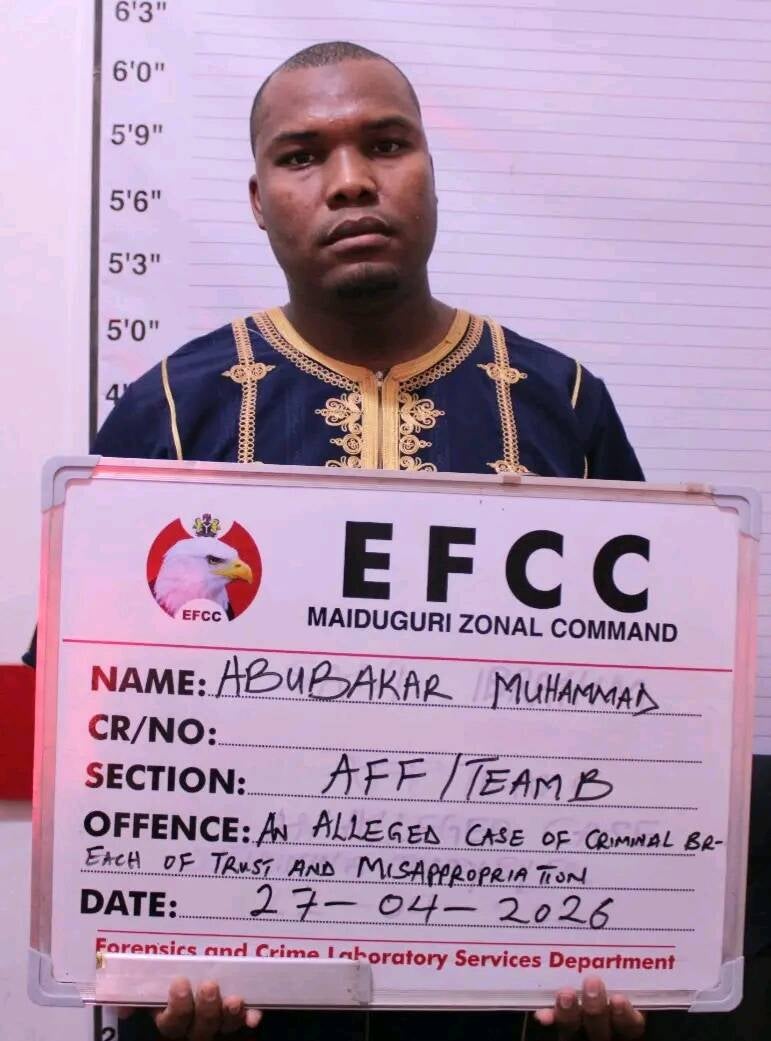
The Maiduguri Zonal Directorate of the Economic and Financial Crimes Commission has launched a major legal crackdown against financial crimes by officially arraigning a prominent suspect involved in a staggering multi-million naira corporate fraud scheme. In a coordinated legal offensive spanning two consecutive days on Wednesday, June 3, and Thursday, June 4, 2026, the anti-graft agency brought Abubakar Muhammad before two separate high-ranking judicial institutions sitting in Maiduguri, the Borno State capital. The legal proceedings shed light on a complex web of alleged financial deception, corporate betrayal, and systematic asset diversion that has sent shockwaves through the regional business community and highlighted the agency's aggressive stance on economic sabotage.
The defendant faced a total of five separate criminal counts split across the two distinct jurisdictions, with all charges fundamentally bordering on money laundering, criminal misappropriation, and a gross breach of public and corporate trust. When aggregated across the separate indictments, the total financial volume involved in the alleged criminal activities stands at a staggering six hundred and fifty million naira. The legal strategy of using both the Federal High Court and the Borno State High Court reflects the multi-layered nature of the alleged offenses, which combine state-level criminal property violations with federal-level financial system infractions.
The core of the prosecution’s case was formally unveiled during the first leg of the arraignment before Justice Shehu Umaru Adamu of the Federal High Court, where a detailed three-count charge was officially read to the accused. According to the specific details contained in the primary count of the federal indictment, Muhammad systematically converted the aggregate sum of six hundred and fifty million naira between the long-term window of January 2021 and February 2026. The state prosecution maintains that the illegal asset conversion took place directly within the city of Maiduguri and comfortably fell within the geographic and legal jurisdiction of the honorable court.
To execute this massive financial diversion over the five-year period, the defendant allegedly weaponized the formal banking system by routing the massive volume of illicit capital through three separate personal and corporate bank accounts. Investigators traced the suspicious inflows directly to an account domiciled with the United Bank for Africa Plc, a second account held with Taj Bank, and a third digital banking account held with Moniepoint Microfinance Bank. The prosecution explicitly notes that the defendant knew or reasonably ought to have known that these massive deposits formed part of the direct proceeds of an entirely unlawful activity, despite his efforts to cloak the transactions.
The anti-graft agency revealed that Muhammad attempted to mask the fraudulent inflows by fabricating a legitimate corporate veneer, falsely claiming to investors and financial auditors that the funds represented legitimate capital payments for a highly lucrative investment in a mining business. This purported mining venture was supposed to be completely managed and overseen by the defendant himself, providing a convenient justification for the rapid movement of millions of naira across his various bank accounts. The state argues that this deceptive masking technique directly violates Section 18 of the Money Laundering Prevention and Prohibition Act of 2011, an offense that carries severe statutory penalties under Section 15 of the same legislation.
Following the reading of the federal charges, the legal battle shifted on the subsequent day to the Borno State High Court, where Muhammad was brought before Justice Amina Mustapha Ibrahim to face an additional two-count charge focusing primarily on criminal breach of trust and the physical misappropriation of commercial assets. When the official charges were formally read aloud by the court clerks in both judicial halls, the defendant maintained a firm stance of innocence, pleading not guilty to all counts levied against him by the federal government. This clear rejection of guilt set the stage for an intense legal showdown between the state prosecution and the defense team.
With the non-guilty pleas officially entered into the court records, the lead counsel for the prosecution, Mukhtar Ali Ahmed, immediately moved to secure the judicial perimeter by praying for definitive trial dates across both courts. The prosecuting attorney strongly urged the respective judges to remand the defendant in the custody of the Economic and Financial Crimes Commission to ensure his availability for the upcoming trial and to prevent any potential tampering with vital financial witnesses or digital evidence. However, the defense counsel, B.G. Zanna, fiercely countered the remand application by moving a comprehensive bail application before Justice Ibrahim to secure his client's temporary freedom.
After listening to the spirited arguments from both sides regarding the constitutional right to liberty versus the gravity of the financial crime, Justice Amina Mustapha Ibrahim decided to grant the defendant bail under stringently defined conditions designed to prevent flight. The high court judge admitted Muhammad to bail in the substantial sum of three hundred million naira, a figure that directly reflects the massive volume of the alleged fraud. Furthermore, the court mandated that the defendant must provide two reliable sureties who can match the financial weight of the bond, with an explicit condition that one of the sureties must possess verified landed property within the jurisdiction valued at no less than four hundred million naira.
The deeper context surrounding Muhammad’s initial arrest by the anti-graft agency stems from a highly detailed petition submitted to the zonal directorate by an aggrieved commercial entity. The original petitioner alleged that the defendant was a trusted distributor or agent who had been completely entrusted with the sales and distribution of a massive consignment of official Nestle goods valued at the exact sum of six hundred and fifty million naira. Instead of remitting the sales proceeds back to the parent company, Muhammad allegedly manipulated the internal sales records, cooked the corporate books, and secretly diverted the entire cash crop into his personal accounts to fund his fictional mining empire.
As the preliminary bail conditions are being processed, the two presiding jurists have officially drawn the battle lines for the main judicial hearings. Justice Shehu Umaru Adamu of the Federal High Court adjourned the federal leg of the matter until June 11, 2026, for the formal commencement of the trial hearing. Meanwhile, Justice Amina Mustapha Ibrahim of the Borno State High Court fixed June 15, 2026, to begin receiving testimonies regarding the criminal breach of trust. The twin trials are expected to draw heavy public interest in Maiduguri as the state moves to prove its corporate fraud case.
📩 Stone Reporters News | 🌍 stonereportersnews.com ✉️ info@stonereportersnews.com | 📘 Facebook: Stone Reporters News | 🐦 X (Twitter): @StoneReportNew | 📸 Instagram: @stonereportersnews
Add comment
Comments