

Reported by: Ijeoma G | Edited by: Oravbiere Osayomore Promise.
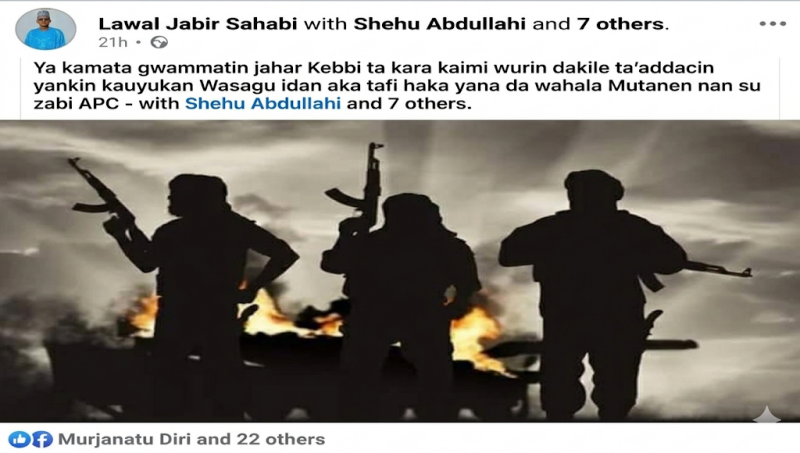
WASAGU TOWN, Nigeria – A resident of Wasagu town in Kebbi State’s Danko-Wasagu Local Government Area made a social media post on the afternoon of June 4, 2026, expressing concern over the worsening security situation in his community. By nightfall, he was gone. Bandits reportedly raided the area later that evening, abducting him alongside several other residents in a brazen attack that has once again exposed the fragility of life in Nigeria’s northwestern rural belt.
The attack occurred late on June 4, though security agencies have yet to release an official statement confirming the exact number of those taken. Local sources, speaking on condition of anonymity for fear of reprisals, said the gunmen arrived on motorcycles, firing sporadically into the air before breaking into homes and seizing their victims. The abducted resident, whose social media post had earlier highlighted the daily fear ordinary people face, is believed to be among those now held captive somewhere in the dense forests that surround the town.
The post, made just hours before the raid, did not name any specific threat. Instead, it spoke of a generalized anxiety — the kind that has become routine for millions living across Nigeria’s North-West and North-Central regions. “Residents have repeatedly raised concerns about insecurity, not to spread negativity, but to show the daily fear and danger affecting ordinary lives,” a community representative later told local media. The tragic coincidence of the post and the subsequent kidnapping has since circulated widely on social media, with many sharing the resident’s words as a haunting prophecy.
Kebbi State, known largely as a hub for rice farming and fishing along the banks of the River Niger, has not suffered the same level of high-profile banditry as neighboring Zamfara, Sokoto, or Katsina states. But the crisis has been creeping closer. Danko-Wasagu LGA shares borders with Zamfara and Niger states, both of which have experienced waves of mass abductions, village burnings, and cattle rustling for years. Bandits operating in the area are often part of larger, well-armed criminal networks that exploit weak governance, vast ungoverned forests, and a scarcity of security outposts.
The immediate reaction from the community has been one of fear and desperate prayer. “We pray for their safe and immediate release and for strength and comfort for their families and community,” read a statement circulated by local elders. But behind the prayer lies anger. Residents told this correspondent that they have repeatedly reported suspicious movements to security agencies, only to be told that resources are stretched thin. “We are on our own,” one farmer said. “They come when we are already crying, not before.”
This incident is not isolated. Across Nigeria, banditry has evolved from cattle rustling into a full-blown kidnapping-for-ransom economy. According to data tracked by civil society groups monitoring violence, more than 3,500 Nigerians were abducted in 2025 alone, with the North-West accounting for nearly sixty percent of those cases. While federal and state governments have launched military operations — including air strikes and ground offensives — the attacks continue. The bandits simply move deeper into the forests or across state borders where security coordination breaks down.
The abduction in Wasagu town raises a painful question that the resident himself asked in his final post before his capture: “How many more abductions must occur before authorities deliver lasting security for vulnerable communities?” The question has been echoed by governors, lawmakers, and traditional rulers across the region for years. Yet concrete answers remain elusive. The Nigerian Police Force’s Kebbi State Command has not issued an official response as of the morning of June 5. Attempts to reach the spokesman for the command were unsuccessful.
For the families of those taken, every hour is an eternity. Kidnappers in the region typically contact relatives within days to demand ransom payments, which can range from hundreds of thousands to millions of naira. Many families sell land, livestock, or borrow from money lenders to secure their loved ones’ release. Those who cannot pay face an uncertain fate — some are killed, others held for months, and a small number manage to escape.
The abduction also underscores a grim pattern: victims are often ordinary farmers, traders, or housewives, not politicians or wealthy businessmen. Wasagu is a rural town without large banks or major industries. Those taken are unlikely to afford the ransoms that bandits demand. That raises fears for their safety.
As the sun rose over Wasagu on June 5, the town felt emptier. Shops remained closed. Children stayed home from school. Men gathered in small clusters, speaking in hushed tones. “This is the harsh reality many communities across Nigeria continue to face,” a local youth leader said. “We are not spreading negativity. We are shouting for help.” The Nigerian military has previously stated that operations are ongoing to clear bandit enclaves in the region. But for the people of Danko-Wasagu, help cannot come soon enough. Their neighbor, who just yesterday afternoon typed out his fears for the world to see, is now living the very nightmare he described. And no one knows if he will come back.
📩 Stone Reporters News | 🌍 stonereportersnews.com ✉️ info@stonereportersnews.com | 📘 Facebook: Stone Reporters News | 🐦 X (Twitter): @StoneReportNew | 📸 Instagram: @stonereportersnews
Add comment
Comments