

Reported by: Oahimire Omone Precious | Edited by: Oravbiere Osayomore Promise.
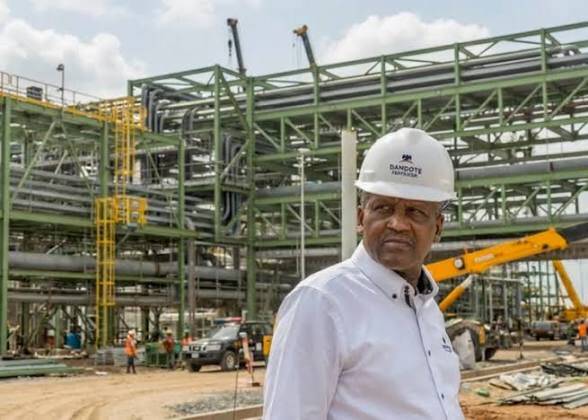
LAGOS, Nigeria – Africa’s largest oil refinery has achieved a landmark operational milestone, processing 700,000 barrels of crude oil per day and surpassing its official nameplate capacity in a performance test that signals a new era for Nigeria’s refining industry and energy security across the continent. The Dangote Petroleum Refinery and Petrochemicals facility, located in the Lekki Free Zone, announced the development on June 4, 2026, following a formal verification by its independent process licensors. The achievement represents a critical validation of the $20 billion plant's engineering and operational capabilities, coming barely two years after it began fuel production.
The refinery’s official nameplate capacity stands at 650,000 barrels per day, making it already the world’s largest single-train petroleum refinery. The successful test, which saw throughput climb 50,000 barrels above that design limit, demonstrates the facility’s ability to process additional feedstock while optimising performance across its production units. In a statement issued in Lagos, the refinery’s Head of Corporate Communications, Anthony Chiejina, described the increased capacity as a testament to the strength of the plant’s engineering design and the operational efficiency of its management team.
Beyond the immediate milestone, the company has laid out a far more audacious vision. Vice President for Oil and Gas at Dangote Industries Limited, Devakumar Edwin, confirmed that the refinery is targeting an expansion to 1.4 million barrels per day within the next 30 months, a move that would position the facility among the largest refining complexes on the planet, potentially surpassing India’s Jamnagar refinery and Saudi Arabia’s Ras Tanura. “The goal is to position the facility among the largest refineries in the world,” Edwin said. He added that the expansion would enhance Nigeria’s energy self‑sufficiency, eliminate the country’s long‑standing dependence on imported refined petroleum products, and strengthen its role as a major export hub. He noted that the refinery’s growth trajectory reflects a deliberate move toward continental and global refining dominance, not merely domestic supply sufficiency.
The refinery began fuel production in 2024 after years of construction delays, and has since steadily increased its output of petrol, diesel, aviation fuel, liquefied petroleum gas, and other refined products. It has rapidly established itself as a major supplier to both domestic and international markets. Exports now reach several African countries, including Cameroon, Ghana, Angola, Tanzania, and South Africa, as well as key European destinations such as the United Kingdom, France, Spain, Italy, and the Netherlands. The facility has also supplied gasoline to the United States and jet fuel to Saudi Arabia – an extraordinary commercial reach that underscores its growing global influence.
That influence has only been amplified by geopolitical turbulence. Ongoing disruptions in the Middle East have pushed many African governments to diversify their energy supply chains, and Dangote’s plant has stepped into that gap. In April 2026, according to data from S&P Global Commodities, the Dangote Petroleum Refinery became the world’s largest exporter of jet fuel for that month, a data point the company has moved quickly to publicize. On the domestic front, the refinery has played a pivotal role in stabilising fuel supplies across Nigeria, helping to eliminate the country’s reliance on imported petroleum products and easing persistent pressure on foreign exchange reserves. Nigeria has historically haemorrhaged hard currency to import refined fuel, straining central bank reserves and contributing to recurring naira weakness. By substituting domestic refining capacity for those imports, the Dangote facility provides at least partial relief, though analysts note that distribution bottlenecks, ageing pipelines, and logistics gaps remain separate, unresolved constraints on how fully those savings materialise at the pump.
The refinery’s rising production has also attracted growing interest from international crude suppliers and commodity trading firms, with the facility sourcing feedstock from both domestic and international producers to sustain its output. This comes amid ongoing tensions between the refinery and the Nigerian National Petroleum Company Limited over crude supply volumes. In April 2026, NNPC agreed to increase crude allocation to seven cargoes per month, up from five, but Dangote’s CEO David Bird has stated that the refinery requires 13 to 15 cargoes monthly under the crude‑for‑naira programme to meet domestic fuel requirements. “Currently, we’re only getting five,” Bird said in a recent interview. “So that’s an underperformance against that pre‑agreed volume contract.”
Looking further downstream, the company has flagged plans to produce higher‑margin derivatives beyond simple fuel throughput. Future plans include the supply of polypropylene, a key material for packaging manufacturing, and Linear Alkylbenzene, a precursor used in the production of detergents. Founder Aliko Dangote has also signalled interest in building a second refinery in East Africa, with Kenya emerging as the preferred location for a proposed 650,000 barrel‑per‑day facility that would process crude from Uganda and other regional producers. The 1.4 million barrel‑per‑day target for the Lekki complex, scheduled for 2028, would coincide, if achieved, with a period when the global refining map is being redrawn by the energy transition, making scale and efficiency more critical than ever.
For a country that has spent decades as one of Africa’s top crude producers while simultaneously importing billions of dollars’ worth of refined fuel, the 700,000‑barrel milestone is more than a corporate announcement. It is a long‑awaited answer to a persistent national paradox. Whether the refinery fully delivers on that promise remains to be written, but 700,000 barrels a day is a credible opening argument.
📩 Stone Reporters News | 🌍 stonereportersnews.com ✉️ info@stonereportersnews.com | 📘 Facebook: Stone Reporters News | 🐦 X (Twitter): @StoneReportNew | 📸 Instagram: @stonereportersnews
Add comment
Comments