

Reported by: Ijeoma G | Edited by: Oravbiere Osayomore Promise.
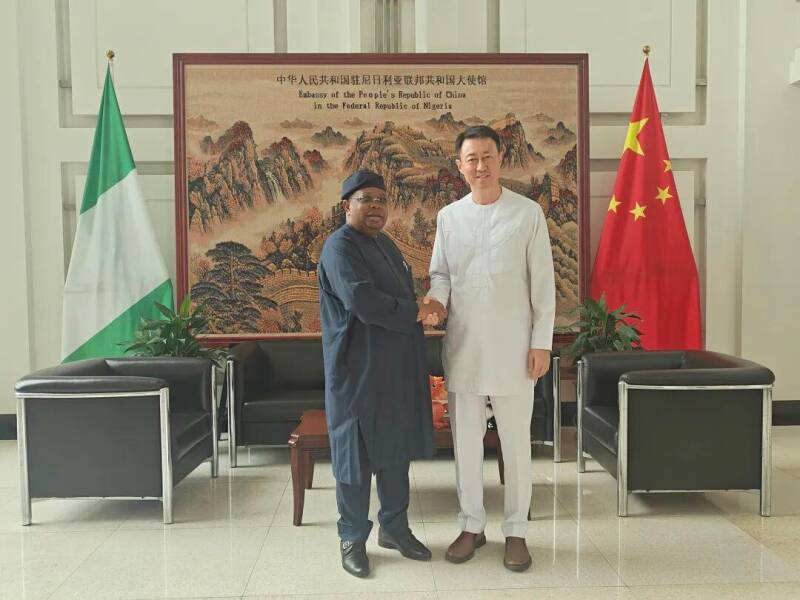
ABUJA, Nigeria — Nigeria has formally approached China to seek a strategic partnership aimed at overhauling its dilapidated electricity infrastructure, a move that could finally illuminate a nation long crippled by chronic blackouts. The announcement follows high-level discussions between China's Ambassador to Nigeria, Yu Dunhai, and the newly appointed Minister of Power, Joseph Tegbe, on Thursday, June 4, 2026.
The talks, held in the nation's capital, focused on deepening cooperation in electricity, infrastructure, and industrial development. This collaboration, framed within the context of the Nigeria-China Comprehensive Strategic Partnership, seeks to translate the outcomes of the recent Forum on China-Africa Cooperation (FOCAC) Beijing Summit into tangible on-ground projects.
Minister Tegbe reaffirmed Nigeria's unwavering commitment to strengthening ties with its vital development partner. "We are determined to move beyond rhetoric and achieve concrete results for our people," Tegbe was quoted as saying, pledging to promote practical initiatives in electricity infrastructure, manufacturing, and agricultural development. Ambassador Yu echoed this sentiment, underscoring China's dedication to collaborating with Nigeria in energy and power infrastructure.
This diplomatic push arrives amid a severe domestic energy crisis. Despite possessing an installed generation capacity exceeding 13,000 megawatts, Nigeria, Africa's largest economy and most populous nation, struggles to deliver barely 4,000 megawatts to its 230 million citizens. The gap is largely attributed to aging transmission lines, decades of underinvestment, and a fragile grid prone to systemic collapse.
The partnership with China is envisioned to be comprehensive, addressing these systemic flaws. Discussions included modernizing the national grid, which currently loses a significant portion of generated power before it reaches consumers, building new power plants, and leveraging Chinese expertise in digital grid management to transition from unreliable analog systems to an "intelligent" network capable of real-time monitoring.
This official collaboration builds on a wave of active private-sector engagements. Chinese firms are already deepening their footprint in Nigeria's energy sector. Notably, GCL Group has partnered with Swiber Africa Group to develop a massive 7-gigawatt mix of gas, solar, and hydroelectric projects under Nigeria's Presidential Power Initiative (PPI). Other major Chinese contractors, such as China Civil Engineering Construction Corporation (CCECC), are constructing Nigeria's first floating solar farm at the University of Lagos, while Sinohydro is rehabilitating the decades-old Kainji Hydropower Plant, bringing it back from zero generation.
The urgency of the situation has even prompted unconventional proposals. Earlier this week, during the minister's senate screening, former Gombe State Governor and Senator Danjuma Goje suggested that Nigeria should "swallow its pride" and consider handing over management of its entire power value chain to a country like China for 20 years to fix it wholesale.
However, translating political will into stable megawatts presents a formidable challenge. The West African nation has a history of unfulfilled power sector promises and failed reforms. The financial strain on electricity distribution companies (DisCos) is immense, with many unable to provide basic equipment like transformers, creating a bottleneck that could frustrate new generation capacity.
Furthermore, currency volatility has previously impacted the financial viability of long-term Chinese-funded infrastructure projects, serving as a cautionary tale for the massive investments required for a grid overhaul. For the upcoming partnership to succeed, it will require not just the export of Chinese equipment and engineering—as seen in projects like the Zungeru Hydroelectric Power Plant—but a robust framework to address commercial losses and ensure the financial sustainability of the entire system.
As Nigeria pushes towards its ambitious economic and industrialization agenda, the stability of its power supply will be the single greatest determining factor of its success. For now, the diplomatic channels are open, and the contractors are ready. The world will be watching whether this renewed push for Chinese collaboration will finally turn on the lights for Africa's sleeping giant.
📩 Stone Reporters News | 🌍 stonereportersnews.com ✉️ info@stonereportersnews.com | 📘 Facebook: Stone Reporters News | 🐦 X (Twitter): @StoneReportNew | 📸 Instagram: @stonereportersnews
Add comment
Comments