

Reported by: Ijeoma G | Edited by: Oravbiere Osayomore Promise.
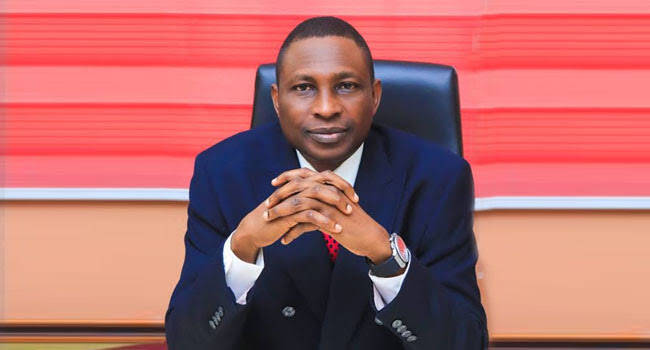
The Executive Chairman of the Economic and Financial Crimes Commission, Ola Olukoyede, has warned that the staggering amounts spent by aspirants to secure electoral victory are undermining Nigeria’s democracy and fuelling corruption, revealing that some governorship hopefuls deployed between N20 billion and N30 billion to win party primaries and defend their mandates through post-election litigation. The anti‑graft boss made the disclosure on Wednesday, June 10, 2026, while delivering the inaugural High‑Level Guest Speakers’ Series organised by the Centre for Peace and Strategic Studies of the University of Ilorin.
Speaking on the theme “De‑risking and Mobilising Critical Stakeholders for Peaceful and Credible 2027 Elections in Nigeria”, Olukoyede explained that the EFCC conducted an assessment late last year to establish the financial burden that a politician bears in order to become a state governor. “Sometime late last year, we took an assessment of how much a contestant for the office of a governor in Nigeria spends in the build‑up to the election, during the primaries, during the election itself, and post‑election tribunal issues and all of that, and we saw it to be between N20 billion and N30 billion,” he told the audience at the University of Ilorin auditorium. The figure, which covers the entire electoral journey from the party primary through the general election and up to the resolution of tribunal cases, illustrates the extraordinary cost of accessing public office in Africa’s most populous nation.
Olukoyede warned that such astronomic expenditures encourage corruption, because successful candidates inevitably treat public office as an investment that must yield financial returns. “If you spend that kind of money to get to an office, of course, everybody sees it as an investment, and that’s why we are here, to see what we can do to sanitise our electoral process and ensure that the process is not contaminated,” the EFCC chairman said. He added that when the process is contaminated, the leaders it produces are also contaminated. He further argued that the huge financial outlay placed unbearable pressure on officeholders to divert public funds after assuming office in a bid to recoup their investments.
The EFCC boss also expressed concern that the commercialisation of votes undermines the foundation of good governance by corrupting the political recruitment process. “Leaders who buy their way into office are more likely to focus on recovering their investments rather than serving the public interest,” he said. He disclosed that the commission had already made several arrests across the country over vote‑buying and related electoral offences, and had secured a number of convictions. Those prosecuted included politicians, electoral officials, and ordinary citizens found culpable of electoral misconduct.
Olukoyede warned that impunity in the electoral process could erode democracy and destabilise the nation, stressing that there would be no sacred cows in the enforcement of electoral laws. He further revealed that the anti‑graft commission plans to deploy drones and other technological tools to strengthen election monitoring ahead of the 2027 general elections, particularly to track vote‑buying and financial inducements at polling units. He called on political parties and their supporters to embrace issue‑based campaigns and avoid inflammatory rhetoric capable of inciting violence. He also appealed to the Independent National Electoral Commission, security agencies, civil society organisations, the media, and political actors to work collaboratively to ensure peaceful, free and credible elections.
Earlier, the Vice‑Chancellor of the University of Ilorin, Professor Wahab Egbewole (SAN), described electoral corruption as a major threat to national security and democratic development. He said credible elections were essential for national stability, economic growth, and public confidence in governance, and stressed the need for stronger collaboration between academic institutions and agencies responsible for safeguarding electoral integrity. The Director of the Centre for Peace and Strategic Studies, Professor G.A. Animasawun, said the lecture series was conceived to provide a platform for proactive engagement on threats to Nigeria’s electoral process ahead of the 2027 polls, bringing together policymakers, security experts, electoral officials, civil society groups, and scholars to develop practical solutions for peaceful and credible elections.
The disclosure has since dominated political discourse, with civil society organisations renewing calls for urgent campaign finance reform. Analysts note that the astronomical sums cited by the EFCC chairman reflect a reality in which only the super‑rich or those backed by powerful financial interests can realistically aspire to top political offices in Nigeria. Without strict spending limits, transparent funding disclosures, and credible enforcement, the electoral process will continue to favour those who can buy their way into power, ensuring that the quality of governance remains a casualty of the country’s expensive democracy.
📩 Stone Reporters News | 🌍 stonereportersnews.com ✉️ info@stonereportersnews.com | 📘 Facebook: Stone Reporters News | 🐦 X (Twitter): @StoneReportNew | 📸 Instagram: @stonereportersnews
Add comment
Comments