

Published by Oravbiere Osayomore Promise.
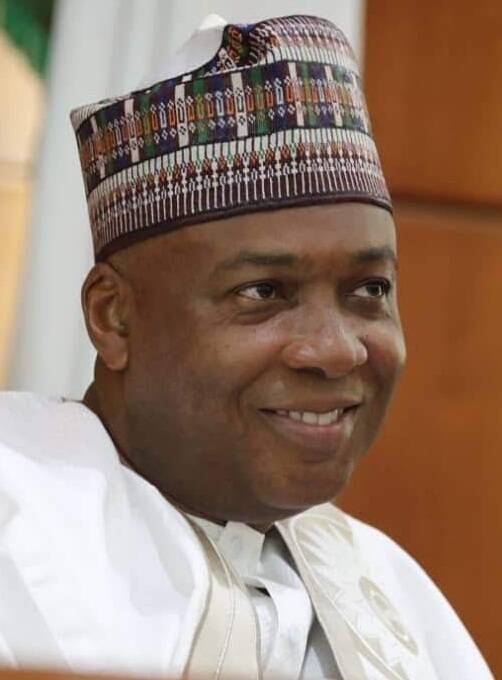
Former Senate President Bukola Saraki has stressed the critical need for an independent legislature in a democracy, declaring that a parliament which merely nods to executive proposals without scrutiny has failed its constitutional mandate. Speaking at The Platform, a public lecture organised by The Covenant Nation to mark Democracy Day, Saraki drew on his experience leading the 8th Senate to warn against the dangers of a rubber‑stamp parliament.
“So what I learned in those four years in the National Assembly is that a legislature that cannot say no is not a legislature at all,” Saraki told the gathering in Lagos on Friday, June 12, 2026. “A legislature which simply receives executive proposals, approves them without scrutiny, and goes home has not fulfilled its constitutional mandate. It has merely performed a ceremonial function. It’s an echo. A democracy made only of echoes is only one election away from becoming something else entirely.”
The former Kwara State governor argued that the primary danger to a free people is not a weak government but an unchecked one. “The greatest danger to a free people is not a weak government but an unchecked government: authority that answers to no one and cannot be questioned,” he said.
Saraki noted that the framers of the Nigerian Constitution deliberately split power into three separate arms of government that depend on one another yet are meant to be independent. “They built friction into the system on purpose; it was not a mistake. That friction is not dysfunction; it is the very thing that guarantees your freedom,” he explained. “People ask, ‘Why are the executive and the legislature always at each other?’ By constitutional design, they are meant to challenge each other so there can be checks and balances.”
Addressing the significance of Democracy Day, Saraki linked the annulment of the June 12, 1993, presidential election to the weakness of institutions that should have protected the people’s mandate. “On this June 12th, the lesson is plain. We did not lose democracy in 1993 because the people failed; we lost it because the institutions that should have defended the people’s verdict were too weak to do so. The remedy is not less politics; it is stronger institutions, and the legislature stands at the centre of them,” he said.
The former Senate President also warned that suppressing political tension without providing institutional channels for expression only allows grievances to accumulate. “A society where grievances cannot find expression through its institutions will see those grievances vent on the streets. The legislature is built to let those voices be heard and resolved before they explode,” he stated.
To illustrate the value of a proactive legislature, Saraki recalled how the 7th Senate under his leadership uncovered alleged corruption in the fuel subsidy regime. He said that through independent investigation, lawmakers discovered that vessels for which payments had been made were nowhere near Nigerian ports. “As somebody who had the ability to reach out, I went as far as going to the register, and I could see that the vessel that was supposed to be in Lagos port was somewhere in Colombia,” he told the audience, adding that he then confronted the Nigerian National Petroleum Corporation with the evidence.
Saraki emphasised that legislative independence should not be mistaken for hostility toward the government in power. “The independence of the National Assembly is no rebellion against the government of the day,” he said, adding that an independent parliament strengthens the legitimacy of any administration by subjecting its policies and decisions to rigorous scrutiny. “Because if the National Assembly is independent, it is a very great thing that makes the government legitimate. A mandate that is never tested is one no one can trust.”
His remarks came amid growing national debate over the balance of power between the executive and legislative arms, with critics accusing the current 10th National Assembly of surrendering its independence and acting as a “rubber stamp” for the executive. Saraki’s intervention, delivered on Democracy Day, served as both a historical reflection and a pointed warning about the future of Nigeria’s democratic institutions.
📩 Stone Reporters News | 🌍 stonereportersnews.com ✉️ info@stonereportersnews.com | 📘 Facebook: Stone Reporters News | 🐦 X (Twitter): @StoneReportNew | 📸 Instagram: @stonereportersnews
Add comment
Comments