

Reported by: Oahimire Omone Precious | Edited by: Oravbiere Osayomore Promise.
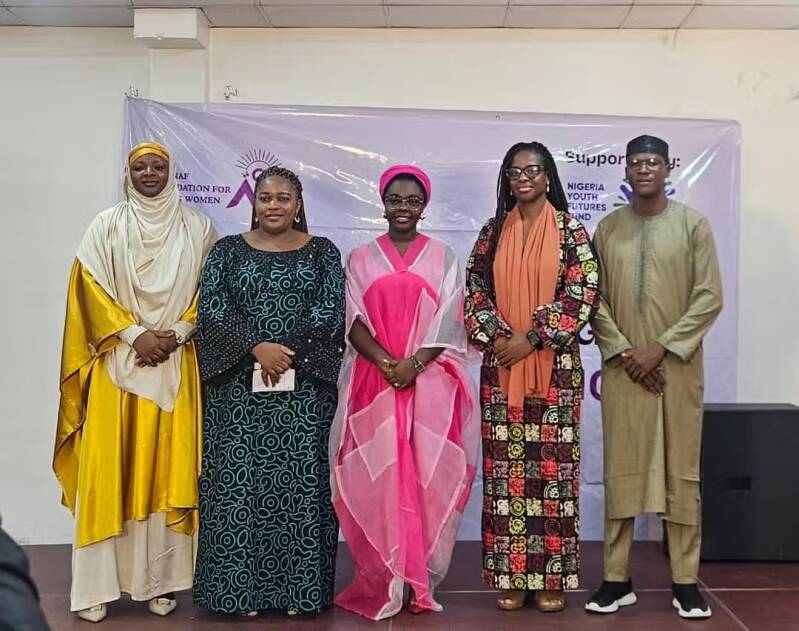
A diverse coalition of gender advocates, civil society leaders and development experts has raised a collective alarm over the systematic political exclusion of young women, describing the total absence of female lawmakers under the age of 35 in Nigeria’s current National Assembly as a democratic emergency that impoverishes governance and undermines the country’s claim to inclusive representation. Speaking at the graduation ceremony of the Voices of Change Fellowship Programme organised by the NAF Foundation for Young Women in Abuja on Sunday, June 14, 2026, stakeholders warned that Nigeria cannot build a thriving democracy when half its population remains locked out of decision-making tables.
Onyeche Elisabeth Agbiti-Douglas, Director of the Nigeria Youth Futures Fund (NYFF) at LEAP Africa, told the gathering that the fears of women who attempt to enter Nigerian politics are not imaginary but rooted in systemic violence, double standards and deep‑seated exclusion that has been normalised across party structures. “The fears of women entering Nigerian politics are completely valid due to systemic violence, double standards, and deep‑seated exclusion,” she said. Her remarks struck a chord among the graduating fellows, many of whom have experienced or witnessed the barriers that keep young women from contesting for elective offices.
Current statistics paint a stark picture. According to data from the Inter-Parliamentary Union and Nigeria’s National Assembly, women currently occupy just 3.7 per cent of seats in the Senate (four out of 109) and 4.4 per cent of seats in the House of Representatives (16 out of 360) – a percentage that has remained stubbornly low for nearly two decades. Worse still, the window for change is closing. Results from primary elections conducted by major political parties ahead of the 2027 general elections have reinforced fears of a sharp decline in women’s political representation. Civil society organisations warned in May that only three women secured senatorial tickets across all parties, a development that could reduce female Senate seats to an even more marginal 2.7 per cent after the 2027 polls.
The Voices of Change Fellowship graduation was held against this backdrop of institutional inertia. The programme, run by the NAF Foundation for Young Women, was designed to equip a new generation of young women with advocacy skills, leadership training and strategic knowledge to navigate Nigeria’s male‑dominated political landscape. It was conceived as a pipeline to fill a gap that the country’s political parties have refused to address voluntarily.
The foundation’s founder, Nafisa Atiku-Adejuwon, told the graduates that their presence in the room was itself an act of resistance. “We are not waiting for political parties to change. We are building the change ourselves,” she said. “You are the answer to the question ‘Where are the young women in politics?’” Atiku-Adejuwon noted that the fellowship had trained participants from across the six geopolitical zones, many of whom had already begun to engage with local government structures and political party mechanisms.
The graduate ceremony also heard from lawmaker Fatima Abubakar, representing a constituency in Kano State, who urged the young women to contest elections despite the obstacles. “Do not wait for invitation. Create your own table. If the parties will not give you tickets, run as independent candidates. Change the mathematics of Nigerian politics,” she said.
Her words echo a growing frustration among gender advocates who argue that despite decades of advocacy, Nigerian political parties have failed to adopt meaningful affirmative action. The Inter-Party Advisory Council (IPAC) has no binding gender quota, and most parties routinely exclude women from primary election processes through prohibitive nomination fees, informal zoning arrangements and outright intimidation.
The United Nations has also entered the conversation with unusual bluntness. The UN Women Country Representative to Nigeria and ECOWAS, Beatrice Eyong, in a June 8 statement, insisted that women should occupy at least half of the seats in Nigeria’s parliament. “The rules and regulations of this country should have mandated parity,” Eyong said. “We should not witness a parliament with less than 5 per cent representation.” She warned that the 2027 election would represent a defining moment for Nigeria to address the historic exclusion of women from governance and political leadership, adding that any failure to act would constitute a setback for the country’s democratic development.
Earlier in March, during International Women’s Day, Eyong had cautioned that Nigeria’s democracy and development risk stagnation if the political class continues to sideline women. “Nigeria’s democracy and development risk stagnation as women hold just 3.9 per cent of parliamentary seats,” she said during a media briefing in Abuja.
National Assembly leadership has not been entirely silent on the issue. In May, Senate President Godswill Akpabio described the underrepresentation of women as a “democratic emergency.” Speaking at the HerCademy graduation, Akpabio noted that Nigerian women currently hold only 3.67 per cent of seats in the 10th National Assembly, a figure he described as unacceptable for a country of Nigeria’s size and democratic aspirations. However, critics have noted that no binding legislation has emerged from the Senate to remedy the situation.
One legislative intervention that has generated considerable hope is the Reserved Seats Bill – formally known as the Special Seats for Women Bill – which is expected to be voted on when the National Assembly resumes on July 7, 2026. The bill, sponsored by Deputy Speaker Benjamin Kalu, proposes a constitutional amendment to create 12 additional seats for women in the Senate, 37 additional seats in the House of Representatives, and three additional seats for women in each of the 36 state Houses of Assembly, totalling 108 new state legislative seats. On June 12, women’s groups staged a solidarity rally at the National Assembly to demand its passage, and Kalu has since confirmed that the bill remains on the House order paper and will be considered after the recess.
The proposed legislation has drawn support from across the political divide, though some feminists argue that reserved seats should not replace organic competition for regular constituencies. Halimat Olufade, a gender consultant, told Tribune in January that reserved seats do not tear down the barriers that keep women from winning on their own merit. “We still need to address the violence, the financial obstacles, and the cultural biases that prevent women from even being considered as candidates,” she said.
Nevertheless, many of the graduating fellows of the Voices of Change programme argue that the moment calls for pragmatic solutions. One participant, Amina Yusuf, 28, who intends to run for a seat in Kaduna State House of Assembly in 2027, told the gathering: “If reserved seats are what it takes to get us in the room, then take it. Once we are inside, we will prove that we deserve to stay.”
The fellowship graduation ended with a call to action signed by all 50 participants, urging President Bola Tinubu to support the Reserved Seats Bill and for the National Assembly to pass it without further delay. “We are the generation that will not wait another 20 years for representation,” the statement read in part. “We are ready to lead. Nigeria must be ready to let us.”
As the 2027 election approaches, the urgency of the moment is unmistakable. If the current trends hold, women’s representation in the next National Assembly could actually decline. The Voices of Change fellows have vowed to reverse that trajectory. Whether the country’s political establishment will make room for them remains the open question.
📩 Stone Reporters News | 🌍 stonereportersnews.com ✉️ info@stonereportersnews.com | 📘 Facebook: Stone Reporters News | 🐦 X (Twitter): @StoneReportNew | 📸 Instagram: @stonereportersnews
Add comment
Comments