

Reported by: Oahimire Omone Precious | Edited by: Oravbiere Osayomore Promise.
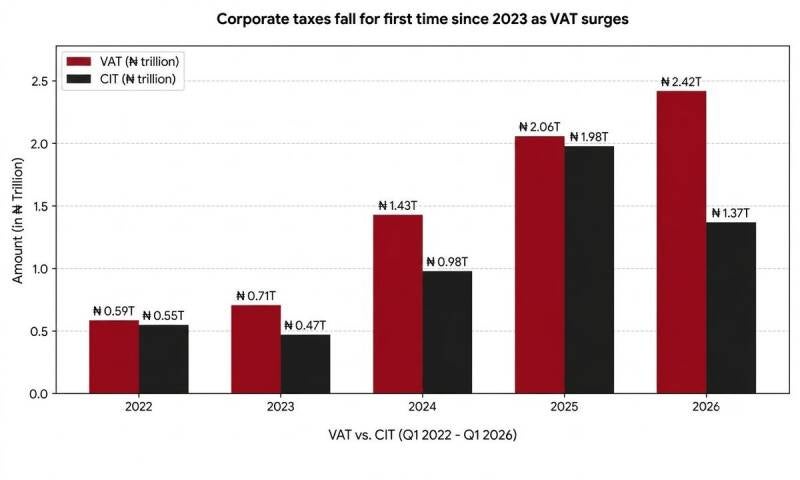
A sharp divergence between Nigeria’s two major tax receipts has exposed a troubling trend in the country’s private sector: businesses are generating sales but failing to convert them into profits. Data released by the National Bureau of Statistics (NBS) for the first quarter of 2026 revealed that Company Income Tax (CIT) collections fell by 31.05 percent year‑on‑year to ₦1.37 trillion, down from ₦1.98 trillion in Q1 2025. In stark contrast, Value Added Tax (VAT) collections rose by 17.06 percent to ₦2.42 trillion during the same period, compared to ₦2.06 trillion a year earlier. The divergent trend has drawn attention because VAT reflects spending and transactions, while CIT is a direct indicator of corporate profitability. “Two NBS numbers from Q1 2026 that nobody is reading together are VAT collections and company income tax collections,” said Opeyemi Ajetunmobi, head of advisory and research at a Lagos‑based investment and advisory firm. “VAT collections rose 17 percent year‑on‑year, while company income tax fell 31 percent. The headline VAT number looks like progress. The CIT number tells a different story.”
The figures suggest that while economic activity remains relatively active, businesses are facing increasing difficulty preserving margins amid elevated interest rates, exchange‑rate pressures, and rising operating costs. The latest tax data comes against a backdrop of persistent inflationary pressures. Nigeria’s headline inflation rate rose to 15.69 percent in April 2026, while food inflation stood at 16.06 percent and core inflation at 15.86 percent, reflecting continued pressure on households and businesses. For many firms, rising costs of energy, logistics, financing, and imported inputs have remained key challenges despite signs of improving macroeconomic stability. “This is a reflection of the mounting pressures facing businesses across the economy,” said Bolanle Daniel‑Utere, finance director at a free trade zone. “It could be a result of weakened corporate profitability driven by rising operating costs, increased borrowing costs, inflationary pressure, and generally challenging economic conditions.” She acknowledged that while many companies continue to report growth in turnover, higher costs are eroding profit margins, reducing taxable profits, and ultimately lowering company income tax collections.
The tax figures also reveal a growing dependence on foreign companies for corporate tax revenue. Foreign companies contributed ₦828.82 billion in CIT during the quarter, significantly higher than the ₦538.91 billion generated from domestic firms. Ajetunmobi said the figures suggest multinational and export‑oriented companies are proving more resilient than many local businesses. “Foreign companies are carrying domestic companies,” he said. “Multinationals and export‑oriented firms are contributing more than 60 percent of corporate tax revenue, while Nigerian‑owned businesses are under disproportionate pressure.” The development suggests government efforts to capture taxes from foreign digital businesses are beginning to yield significant results and are reshaping the country’s tax base.
However, not all companies are experiencing weaker profitability. Corporate earnings released for the first quarter paint a more mixed picture. MTN Nigeria reported a 165.9 percent increase in profit after tax to ₦355.5 billion, supported by strong data revenue growth and reduced foreign exchange exposure after repaying outstanding foreign currency loans. Similarly, Dangote Cement grew profit before tax by 35 percent to ₦421.1 billion as revenue rose to ₦1.19 trillion and cost pressures moderated. The strong performances suggest that while many businesses remain under pressure, some large corporates with strong pricing power and efficient cost structures are managing to sustain profitability.
In terms of sectoral contributions, financial and insurance activities remained the largest source of CIT revenue, accounting for 24.73 percent of total collections, followed by mining and quarrying at 16.06 percent and manufacturing at 13.82 percent. On a quarter‑on‑quarter basis, the water supply, sewage, waste management and remediation sector recorded the highest growth rate at 485.71 percent, while construction recorded the steepest decline at 63.15 percent. The agriculture, forestry and fishing sector also recorded one of the weakest performances. Despite the overall decline in CIT, VAT collections have become a major component of federation revenue, with manufacturing contributing 29.75 percent, information and communication 20.61 percent, and mining and quarrying 12.32 percent of total VAT.
The decline in CIT comes despite repeated assurances by the Federal Government that ongoing fiscal and economic reforms would improve the operating environment and expand the country’s tax base. Over the past year, businesses have faced the combined effects of fuel subsidy removal, exchange‑rate liberalisation, higher energy costs, and persistent inflation, all of which have increased production and operating expenses. Data from the National Bureau of Statistics recently showed that inflation, although moderating compared to previous peaks, remains a major challenge for households and businesses. Many firms have reported shrinking profit margins as rising costs outpace consumer purchasing power. The company income tax figures also contrast with the Federal Government’s ambitious revenue projections contained in the 2026 budget framework, which places significant emphasis on increasing non‑oil tax revenue to fund infrastructure, social services and debt obligations.
The latest data follows a series of mixed revenue signals from Nigeria’s economy. While oil production has shown signs of gradual recovery in recent months and customs collections have improved, concerns remain about the health of the productive sector. The financial services sector, mining industry and segments of manufacturing reportedly remained among the strongest contributors to tax collections during the period, helping to cushion what could have been a steeper decline in government receipts. The NBS said company income tax is one of the government’s key non‑oil revenue sources, and the coming quarters will be closely watched to determine whether recent economic reforms translate into stronger corporate profitability and improved tax collections or whether businesses will continue to face pressures that weigh on government revenues. For Nigeria’s policymakers, the divergence between VAT and CIT collections presents a sobering reality: the economy may be moving, but many businesses are struggling to keep their heads above water.
📩 Stone Reporters News | 🌍 stonereportersnews.com ✉️ info@stonereportersnews.com | 📘 Facebook: Stone Reporters News | 🐦 X (Twitter): @StoneReportNew | 📸 Instagram: @stonereportersnews
Add comment
Comments