

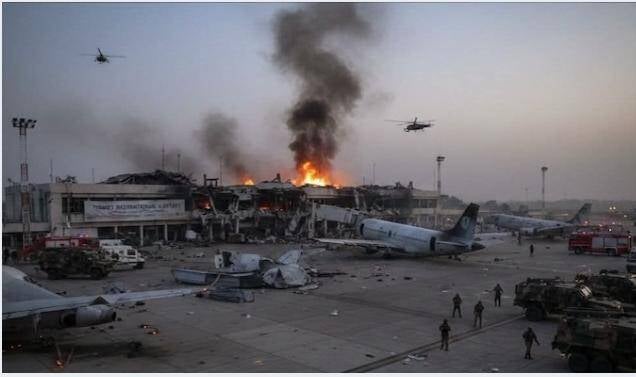
At least 35 people were killed after heavily armed gunmen launched a coordinated pre-dawn attack on Niger’s main international airport in the capital, Niamey, in one of the deadliest assaults on a strategic government facility this year.
According to Niger’s defence ministry, those killed included 22 suspected attackers, 11 soldiers, and two civilians following intense fighting around Diori Hamani International Airport, a critical infrastructure hub that serves both civilian and military operations. The airport also houses a military installation and strategic facilities linked to the Alliance of Sahel States, the regional bloc formed by Niger, Mali, and Burkina Faso.
The assault began in the early hours of Thursday shortly after morning prayers. Residents living near the airport reported hearing loud explosions followed by sustained gunfire that sent shockwaves across surrounding neighborhoods.
One witness, Lawalli Tsalha, said the attack unfolded moments after worshippers had completed prayers. He recalled that the first explosion came at approximately 5:50 a.m., followed almost immediately by heavy gunfire. Residents initially struggled to understand the scale of the incident until security forces rapidly mobilized around the airport perimeter.
Military officials said the attackers attempted to breach highly sensitive areas of the airport complex but were met with strong resistance from security personnel. A fierce gun battle ensued, lasting several hours before the attackers were pushed back.
Security forces later launched a widespread search operation to track down any surviving assailants or accomplices who may have escaped during the chaos. Authorities confirmed that significant quantities of weapons and tactical equipment were recovered from the attackers, including rocket-propelled grenades, assault rifles, explosives, ammunition, and communications devices.
Witness accounts indicated that some civilians briefly joined local security personnel in helping search for fleeing attackers, though authorities later instructed them to withdraw to avoid further casualties.
Later on Thursday, Jama’at Nusrat al-Islam wal-Muslimin (JNIM), an Al-Qaeda-affiliated militant group active across the Sahel, claimed responsibility for the attack. The group has emerged as one of the most dangerous jihadist networks operating in West Africa, carrying out repeated attacks on military and civilian targets across Niger, Mali, and Burkina Faso.
The latest assault underscores the deepening security crisis in Niger, where Islamist insurgencies linked to both Al-Qaeda and the Islamic State continue to destabilize large parts of the country despite years of military operations.
Niger has battled extremist violence for more than a decade, particularly in regions bordering Mali, Burkina Faso, and Nigeria. Armed groups exploit porous borders, weak governance structures, and local grievances to expand their influence and stage increasingly sophisticated attacks.
The attack on Niamey airport is particularly significant because it represents a direct strike on one of the country’s most heavily protected strategic assets. The airport serves not only as Niger’s primary international gateway but also as a major logistics center for military operations and regional security coordination.
This is the second major attack targeting the airport in less than five months. In January, militants launched a similar operation against the same facility, injuring several soldiers before security forces repelled the attackers.
Following the January incident, Niger’s military leadership accused foreign actors, including France and certain West African countries, of involvement in destabilization efforts. However, no public evidence was presented to substantiate those claims, and the allegations drew mixed reactions from regional observers.
The renewed attack is likely to intensify concerns about Niger’s ability to secure key national assets despite recent political and military restructuring.
Since the July 2023 coup that brought military leaders to power, Niger has significantly altered its security alliances. The ruling junta expelled French troops, reduced Western military cooperation, and strengthened ties with neighboring military-led governments in Mali and Burkina Faso.
The three countries later formalized their partnership under the Alliance of Sahel States, presenting the bloc as a new regional security framework aimed at countering jihadist threats without reliance on Western support.
Despite these changes, insurgent attacks have continued, raising questions about whether the new security arrangements are delivering improved protection on the ground.
Analysts note that militant groups in the Sahel have adapted rapidly to military pressure, shifting tactics from rural ambushes to high-profile strikes on urban and symbolic targets. Attacks on airports, military bases, and government facilities serve both operational and propaganda objectives, demonstrating reach and undermining public confidence in state security.
The humanitarian impact of the prolonged insurgency remains severe. Thousands of civilians have been killed across the Sahel over the past decade, while millions have been displaced from their homes due to violence and insecurity.
International observers have repeatedly warned that deteriorating security conditions in the Sahel could further destabilize West Africa if coordinated regional responses fail to contain militant expansion.
Thursday’s attack is expected to trigger renewed military operations and tighter security measures around Niamey and other strategic sites nationwide. Authorities have not yet announced whether airport operations will be fully suspended or how long enhanced security restrictions will remain in place.
Government officials urged residents to remain calm and cooperate with security agencies as investigations continue. No immediate indication has emerged suggesting foreign nationals were among those killed or injured in the attack.
The assault highlights the persistent threat facing Niger at a time when the country remains under intense domestic and international scrutiny over governance, security, and regional stability.
As security forces continue their manhunt for any remaining suspects, the attack on Niamey’s main airport stands as a stark reminder that despite repeated military offensives and shifting alliances, militant groups remain capable of launching deadly operations against even the country’s most fortified installations.
📩 Stone Reporters News | 🌍 stonereportersnews.com
✉️ info@stonereportersnews.com | 📘 Facebook: Stone Reporters News | 🐦 X (Twitter): @StoneReportNew | 📸 Instagram: @stonereportersnews
Add comment
Comments