

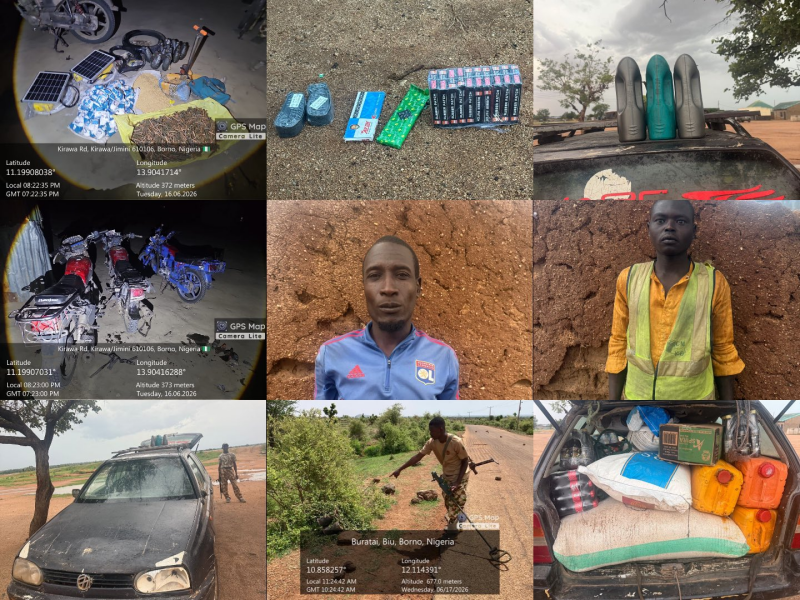
MAIDUGURI, Nigeria — June 20, 2026 — Troops of Operation HADIN KAI have recorded a series of significant operational successes against terrorist elements across Nigeria’s North-East region, including the destruction of improvised explosive devices, the recovery of terrorist supplies, and the arrest of two suspected logistics suppliers linked to insurgent groups.
According to a statement issued by Captain Mohammed Goni, Acting Military Information Officer at the Headquarters Joint Task Force North East Operation HADIN KAI, the operations were conducted between June 16 and June 19, 2026, as part of ongoing military efforts to degrade the capabilities of terrorist organizations operating within the theatre.
The latest achievements underscore the military's continued campaign against insurgent groups, particularly Boko Haram and the Islamic State West Africa Province (ISWAP), which have remained active in parts of northeastern Nigeria despite years of counter-terrorism operations.
One of the most notable operations took place on June 16, when troops of the 135 Special Forces Battalion Explosive Ordnance Disposal Team, working alongside a Quick Reaction Force, responded to intelligence provided by local residents concerning suspected improvised explosive devices planted along the Biu–Buratai Road.
Military authorities said the information was received from vigilant community members who noticed suspicious activities in the area and promptly alerted security personnel. Acting on the intelligence, troops conducted a fighting patrol to the location and discovered five IED cylinders strategically emplaced by terrorists along the road.
The devices were professionally identified and safely detonated by the Explosive Ordnance Disposal specialists, preventing what could have become a deadly attack on military personnel, travelers, or civilians using the route. Authorities confirmed that the operation was completed successfully without any casualties among troops or civilians.
Security analysts have frequently warned that improvised explosive devices remain one of the most dangerous weapons employed by insurgent groups in the North-East. Such devices are often planted along highways and access roads in an attempt to inflict casualties, disrupt troop movements, and create fear among local populations.
Building on that success, troops of the 153 Task Force Battalion engaged terrorist fighters on June 17 while returning from a picketing assignment in Kirawa. According to military authorities, the encounter occurred along the Miyanti–Ngoshe axis when soldiers came into contact with an unconfirmed number of insurgents travelling on approximately 60 motorcycles.
The terrorists reportedly initiated the confrontation by opening fire on the troops. However, soldiers responded with sustained and superior firepower, forcing the insurgents to abandon their attack and retreat toward Miyanti.
Although the exact number of casualties inflicted on the terrorists could not be immediately verified, military officials reported that the insurgents withdrew in disarray after failing to overpower the troops.
Following the engagement, soldiers conducted a search of the area and recovered a substantial quantity of materials believed to have been used in support of terrorist activities. Among the items recovered were 817 rounds of 7.62mm ammunition, three motorcycles, two solar panels, 102 sachets of salt, a motorcycle tyre, two motorcycle tubes, and several motorcycle spare parts.
The recovered materials are considered strategically significant because terrorist groups operating in remote locations often rely on motorcycles for mobility and use supplies such as fuel, spare parts, food items, and solar equipment to sustain operations in difficult terrain.
Stone Reporters note that disrupting supply chains has become a central component of Nigeria’s counter-terrorism strategy. Security experts have repeatedly argued that weakening logistics networks can significantly reduce the operational effectiveness of insurgent groups by limiting their ability to move personnel, transport weapons, and maintain camps in remote areas.
The military recorded another breakthrough on June 19 when troops of the 27 Task Force Brigade Garrison intercepted two individuals suspected of supplying materials to Boko Haram and ISWAP elements.
The arrests were made during a routine stop-and-search operation at the brigade’s checkpoint following intelligence reports concerning terrorist logistics activities. Security personnel stopped a cyan Volkswagen vehicle bearing registration number FGF-357-AG and conducted a thorough inspection.
Military authorities identified the suspects as Mohammed Bukar, also known as "Dege," aged 35, and his apprentice, Iliyasu Abdullahi, aged 26. According to the statement, the pair were allegedly transporting Premium Motor Spirit (PMS) and relief materials intended for Boko Haram and ISWAP fighters.
The suspects were taken into custody for further investigation, while the recovered materials were secured as evidence. Authorities did not immediately disclose the quantity of fuel or supplies recovered from the vehicle but indicated that the operation represented a significant disruption of terrorist logistics activities.
Counter-terrorism experts have consistently highlighted fuel supply networks as critical enablers of insurgent operations. Fuel is often used to power motorcycles, generators, and vehicles employed by armed groups in conducting attacks and maintaining mobility across vast territories.
Military authorities said the recent operations demonstrate the effectiveness of intelligence-driven operations and close collaboration between troops and local communities. The successful destruction of explosive devices, recovery of operational materials, and arrest of suspected logistics suppliers collectively represent important gains in the ongoing campaign against terrorism in northeastern Nigeria.
Operation HADIN KAI reaffirmed its commitment to denying terrorists freedom of movement, dismantling support networks, and protecting civilian populations across the region. The military also urged residents to continue providing credible and timely information to security agencies, emphasizing that community cooperation remains vital to sustaining progress in the fight against insurgency.
As military pressure continues across the North-East, authorities maintain that sustained offensives, intelligence gathering, and public support will remain crucial in efforts to restore lasting peace and stability to communities affected by years of insurgent violence.
📩 Stone Reporters News | 🌍 stonereportersnews.com
✉️ info@stonereportersnews.com | 📘 Facebook: Stone Reporters News | 🐦 X (Twitter): @StoneReportNew | 📸 Instagram: @stonereportersnews
Add comment
Comments