

Publish by Osasere Edomwonyi Ikpoba
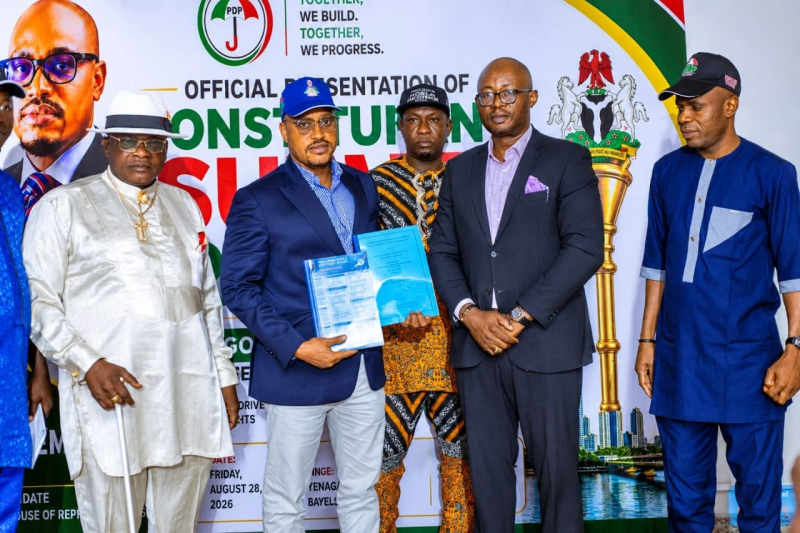
The Peoples Democratic Party candidate for the Yenagoa/Kolokuma-Opokuma Federal Constituency in the 2027 House of Representatives election, Elvis Donkemezuo, has pledged to anchor his legislative agenda squarely on the needs and priorities of his constituents, vowing to let data—not political convenience—determine the laws he will champion if elected. Donkemezuo made the pledge in Yenagoa, Bayelsa State, while receiving a Constituency Needs Assessment Survey conducted across Yenagoa and Kolokuma/Opokuma Local Government Areas, a groundbreaking exercise he described as the first of its kind in the region.
The survey, whose findings were released in a statement on Tuesday by lead consultant Victor Ikem, identified unemployment, poor road networks, and inadequate healthcare facilities as the most pressing concerns of residents. According to the data, approximately 40 per cent of respondents identified unemployment as a major and pressing problem, while 33 per cent cited the lack of accessible road networks and inadequate healthcare facilities. Donkemezuo said these findings would form the foundation of his legislative agenda if elected, stressing that lawmakers must first understand the problems confronting their constituents before proposing interventions.
“As someone seeking to make laws that have direct bearing on the people, I needed to hear directly from the people first,” Donkemezuo said. “This survey tells us the real problems our constituents are facing — from infrastructure, education, and health to jobs and security. With this data, we can now craft legislation and attract projects that will truly solve those problems”. The PDP candidate argued that the assessment was necessary to prevent elected representatives from imposing projects on communities without understanding their actual needs, a practice he said had become all too common in Nigerian politics. “Oftentimes we find people who just come and tell people, 'I want to do this and that for you,' without really knowing the exact problems of the people,” he lamented.
Donkemezuo further pledged to sponsor bills and facilitate interventions that would address the development gaps identified by the survey, while maintaining regular engagement with constituents to assess the impact of such interventions. “This is about service with facts, not politics as usual,” he declared. “My goal is to represent Yenagoa/Kolokuma-Opokuma with competence, integrity, and results that our people can feel”. The candidate's emphasis on evidence-based representation marks a departure from the traditional campaign rhetoric that often prioritises vague promises over concrete, data-driven proposals.
The survey's lead consultant, Victor Ikem, emphasised that the exercise was designed to identify the core needs of residents rather than promote any political interest. “The survey was not driven by politics. It is driven essentially to find out the needs of people. Interestingly, much of what they have said is aligned with the agenda of Elvis Donkemezuo,” Ikem said. He added that the findings showed that many respondents considered Donkemezuo's personality more reflective of the type of representation they wanted in the constituency. The PDP South-South Auditor, Chief Loveday Agbarigbote, commended Donkemezuo for commissioning the assessment, saying the exercise would help the candidate understand the concerns of the people. “With what our candidate did, in fact, I'm overwhelmed. I don't know where to start, but the joy in me has made me tell the people that go to the public, go to the market, go everywhere around Bayelsa, it's PDP that the people want,” Agbarigbote said.
Donkemezuo's data-driven approach is part of a broader trend among PDP candidates across the country who are seeking to distinguish themselves through constituency-focused agendas. In Ogun State, the PDP candidate for Ifo/Ewekoro Federal Constituency, Honourable Olumide Jones, has declared that he will not do anything except it directly benefits his constituents, emphasising that his programmes were compiled after extensive consultation with stakeholders and the people of his constituency. “We will not do anything except it directly benefits our people. We have reached out to them and we understand their needs and we will address it,” Jones said, noting that needs vary from community to community. His primary objective, he stated, is to legislate and sponsor bills that will make life easier for his constituency and facilitate projects that bring dividends of democracy to the people.
Similarly, in Anambra State, the PDP candidate for Nnewi North/Nnewi South/Ekwusigo Federal Constituency, Dr. Freeman Ezeiruaku, has unveiled a comprehensive people-first agenda anchored on legislative advocacy, economic empowerment, education and healthcare transformation, and open governance. Ezeiruaku has proposed the establishment of a Constituency Prosperity Fund to provide grants and interest-free loans for women traders, artisans, and young entrepreneurs, alongside vocational training centres focused on skill acquisition. He has also pledged to hold quarterly town hall meetings across the constituency to engage directly with residents and provide updates on his legislative activities. In Bayelsa Central Senatorial District, PDP candidate Richard Akinaka has similarly pledged that his legislative contributions will stem from his knowledge of the needs of his constituency, promising to introduce bills that would strengthen institutions in the Niger Delta and address critical issues affecting the people.
The emphasis on constituency-based legislation reflects a growing recognition among political candidates that Nigerian voters are increasingly demanding accountability and tangible results from their elected representatives. With unemployment, poor infrastructure, and inadequate healthcare ranking among the top concerns of citizens across the country, candidates who can demonstrate a clear understanding of these challenges—and a concrete plan to address them—may find themselves at a distinct advantage in the 2027 elections. For Donkemezuo, the survey has provided not just a roadmap for his legislative agenda, but a powerful campaign tool that signals his commitment to listening to the people he seeks to represent. “This is about service with facts, not politics as usual,” he said. Whether that message resonates with voters in Yenagoa/Kolokuma-Opokuma will be decided at the polls in 2027.
📩 Stone Reporters News | 🌍 stonereportersnews.com
✉️ info@stonereportersnews.com | 📘 Facebook: Stone Reporters News | 🐦 X (Twitter): @StoneReportNew | 📸 Instagram: @stonereportersnews
Add comment
Comments