

Reported by Ariajegbe Sylvia Esezobor
Nigeria's Coordinating Minister of Health and Social Welfare, Muhammad Pate, has identified tax reforms and economic growth as critical to expanding the country's domestic capacity to finance its healthcare system, warning that Nigeria can no longer count on external donor funding remaining at historical levels.
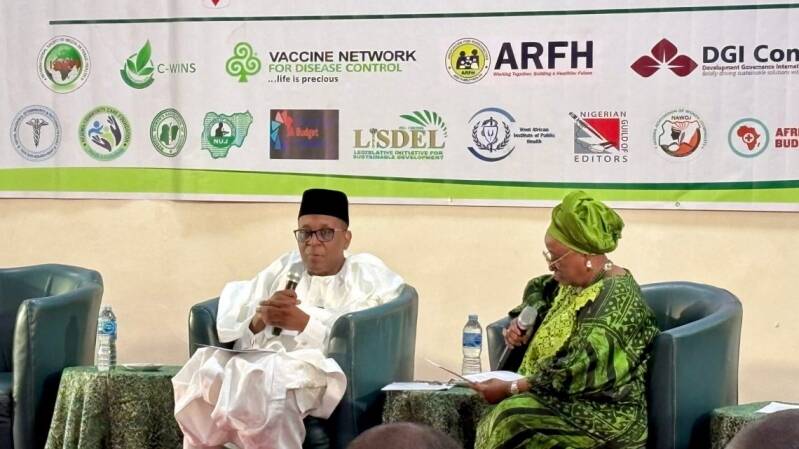
Pate made the remarks on Monday in Abuja during a fireside chat at the Health Sector Reform Coalition and Nigeria Universal Health Coverage Civil Society Organisations-Media Mid-Year Review of Nigeria's Health Sector Reforms, an event that brought together government officials, civil society groups, development partners and journalists to assess progress on reforms aimed at improving health outcomes across the country. The session was moderated by veteran journalist and broadcaster Moji Makanjuola.
Addressing what he described as a long-standing dependence on external support, Pate acknowledged that Nigeria's health programmes, particularly in areas such as HIV response and immunisation, have benefited substantially over the decades from bilateral, multilateral and philanthropic organisations. However, he cautioned that shifting global priorities and mounting financial pressures within donor countries mean that level of support can no longer be assumed to continue unchanged. He pointed to competing demands on wealthier nations' budgets, including defence spending, climate change response and migration management, as factors reshaping how those countries allocate resources abroad. For Nigeria, he argued, the implication is straightforward: the country must take greater ownership of financing its own health needs. "The path out of that dependency that we have enjoyed over the last several decades is to put domestic resources, federal, state, local government, to invest in health for people," Pate said.
That responsibility, he noted, is directly tied to how much revenue government can generate, which is why he linked sustainable health financing to the federal government's wider economic reform agenda. According to Pate, the removal of the fuel subsidy and ongoing tax reforms are among the measures capable of creating additional fiscal space for social sectors such as health and education, provided both federal and state governments choose to prioritise such investment once that space is created. "The implication of removing the subsidy is that it provides added revenue to the government, federal and state, that ideally should be channelled more towards social sectors, because you are creating fiscal space," he said. He further tied health financing to the pace of economic growth more broadly, explaining that a stronger economy expands government revenue overall and, in turn, the pool of resources available for public services, making growth itself a central pillar of Nigeria's strategy for sustaining health investment over time.
Beyond growing the economy, Pate said Nigeria also needs to improve how much of its existing tax base it actually collects. He stressed that the government's tax reforms are not solely about raising tax rates but about closing the gap between taxes owed and taxes collected. He cited Nigeria's revenue-to-GDP ratio, which he put at roughly 7.8 per cent, as considerably below the international average of about 15 per cent. Narrowing that gap, he argued, would substantially increase the pool of resources available to finance healthcare, education and other social sectors, a point he said becomes even more pressing as donor countries and development partners face their own fiscal constraints.
The minister also addressed how external support itself is being managed, describing the historical donor landscape in Nigeria's health sector as fragmented, with development partners at times funding selected states and programmes with limited coordination with government. "There wasn't as much coherence," he said. He explained that the government is now working to bring donor interventions into closer alignment with national and state health priorities, noting that states have developed operational plans tied to broader national objectives, while quarterly performance dialogues are being held with states to review progress using available data. Pate said the government has also introduced joint annual reviews and a State of Health for the Nation report intended to give a clearer, more comprehensive picture of health-sector performance nationwide, with the broader goal of reducing duplication, improving accountability and ensuring government maintains oversight of the full scope of interventions under way across the country, regardless of how much donor support is available at any given time.
Pate's push for greater domestic capacity extended beyond financing to the production of medical supplies themselves. He pointed to growing investment in local pharmaceutical manufacturing and the domestic production of rapid diagnostic test kits as an opportunity to retain economic value within Nigeria while creating jobs, and linked this shift to the rising cost of imported medical commodities following the depreciation of the naira. "When the naira was devalued, the cost went up significantly. Now some of the production is here. So there's a bit of an import substitution component," he said, describing the trend as part of a broader transition away from a health system reliant on imported products toward one capable of producing more of what its population needs, including eventually building local supply chains for raw materials and other inputs.
The minister's comments echo similar remarks made in the past year by other senior economic officials, including the Minister of Finance, who has separately argued that reforms such as subsidy removal, fiscal consolidation and improved tax administration have helped stabilise Nigeria's economy and created room for greater investment in health, education and social protection. Pate said the ultimate impact of the current reforms will depend on their continuity, pointing to improvements in indicators including contraceptive use, antenatal care attendance and skilled birth attendance as evidence that sustained implementation could yield further reductions in maternal, neonatal and child mortality. He also framed Nigeria's progress as consequential well beyond its own borders, given the country's size and influence over health outcomes across the African continent. "If Nigeria doesn't move, Africa doesn't move," Pate said.
📩 Stone Reporters News | 🌍 stonereportersnews.com
✉️ info@stonereportersnews.com | 📘 Facebook: Stone Reporters News | 🐦 X (Twitter): @StoneReportNew | 📸 Instagram: @stonereportersnews
Add comment
Comments